

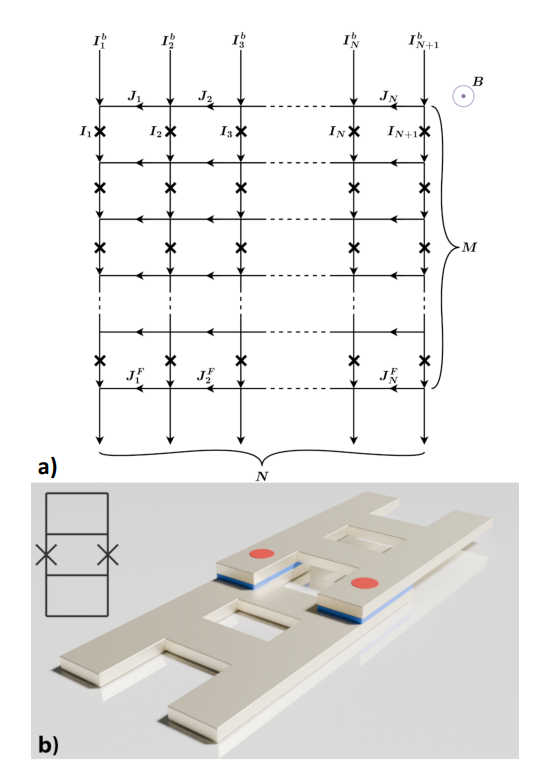
Quantum engineers at Adelaide University’s Quantum and Nano Technology Group (QuaNTeG) have resolved a long-standing performance trade-off in superconducting quantum magnetometers, demonstrating a technique called synthetic area spread that enables absolute magnetic field sensing without degrading intrinsic detector sensitivity. Published in Physical Review Applied, the study reveals how two-dimensional Superconducting Quantum Interference Filter (SQIF) arrays can identify absolute zero-field baselines using uniform loop geometries, bypassing the physical lithography challenges and screening distortions historically required for absolute magnetometry.
| Adelaide Synthetic Area Spread SQIF Architecture & Experimental Specifications | ||
|---|---|---|
| Design Dimension | Specification & Implementation Parameters | Architectural Significance |
| Core Architecture | 2D SQIF arrays incorporating strategically positioned “bare” superconducting loops. | Eliminates physical area incommensurability while synthetically inducing a zero-field voltage anti-peak. |
| Mathematical Foundation | Extended Resistively-Shunted Junction (RSJ) circuit model mapping an effective synthetic area vector: a‘ = aJ + CaB. | Proves network Kirchhoff laws project inductive bare-loop flux onto active junctions as synthetic incommensurate areas. |
| Screening Optimization | Maintains uniform loop dimensions and stable screening parameter βL = LIC / Φ0 across all cells. | Prevents single-junction sensitivity degradation that occurs when varying physical loop inductances (L). |
| Foundry Fabrication | SEEQC commercial Nb/AlOx/Nb tri-layer process on 150 mm silicon wafers (4.5 kA/cm2 critical current density). | Validates manufacturability using standard superconducting semiconductor fabrication lines. |
| Demonstrated Geometries | 16×16 uniform baseline array vs. 46×16 mixed array (16 junction rows interleaved with 2 bare-loop rows). | Confirms appearance of a sharp, reproducible central anti-peak absent in pure SQUID baseline configurations. |
While conventional DC SQUIDs rank among the most sensitive magnetic field detectors available, their periodic voltage-magnetic flux (VMF) response prevents them from functioning directly as absolute magnetometers. In standard SQIF arrays, engineers generate a unique voltage dip—known as an anti-peak—at zero flux by fabricating loops with incommensurate (mutually non-divisible) physical areas, causing destructive interference across all non-zero fields. However, varying loop sizes drastically alters the inductance (L) of individual cells, destabilizing the critical screening parameter βL and compromising the intrinsic sensitivity of the junctions.
The Adelaide research team—led by Associate Professor Giuseppe Tettamanzi alongside PhD researchers Ross Monaghan and Jonathan Marenkovic—demonstrated that physical area variations are mathematically unnecessary. By reformulating the RSJ equations of motion to incorporate bare superconducting loops (closed loops containing no Josephson junctions), the authors showed that bare loops inject an anomalous inductive flux term into the network. Because Kirchhoff’s current conservation constraints overdetermine the array, this inductive contribution maps onto the remaining active junctions as an effective synthetic area spread. Consequently, a circuit with identical physical loop areas produces the interference signature of an incommensurate array.
The researchers verified the design experimentally by fabricating test arrays through commercial superconductor foundry SEEQC. While standard 16×16 uniform arrays displayed typical periodic VMF oscillations, a 46×16 device—comprising sixteen rows of active Josephson junctions separated by pairs of bare-loop rows—produced a pronounced, reproducible central anti-peak at zero flux. The underlying concept is protected under international patent application PCT/AU2025/050991, establishing a streamlined fabrication methodology for quantum-limited sensors across magnetoencephalography (MEG) brain imaging, low-noise RF receivers, and quantum hardware readout.
Official study documentation and university announcements are accessible via the Physical Review Applied Paper here, the arXiv Preprint here, and the Adelaide University Press Release here.
In GQI Portal
The players behind the news
The team that writes QCR tracks every company, deal and technology in the GQI Factory, GQI's verified database of the quantum industry. Next up: every story linked to its players, coming to QCR's paid plans.
- Players Companies and institutions across the quantum industry, by segment.
- Scorecards How the players compare on hardware, software, funding and more.
Newsletter
QCR Alerts in your inbox
The latest reporting and analysis from Quantum Computing Report. Free, unsubscribe any time.