

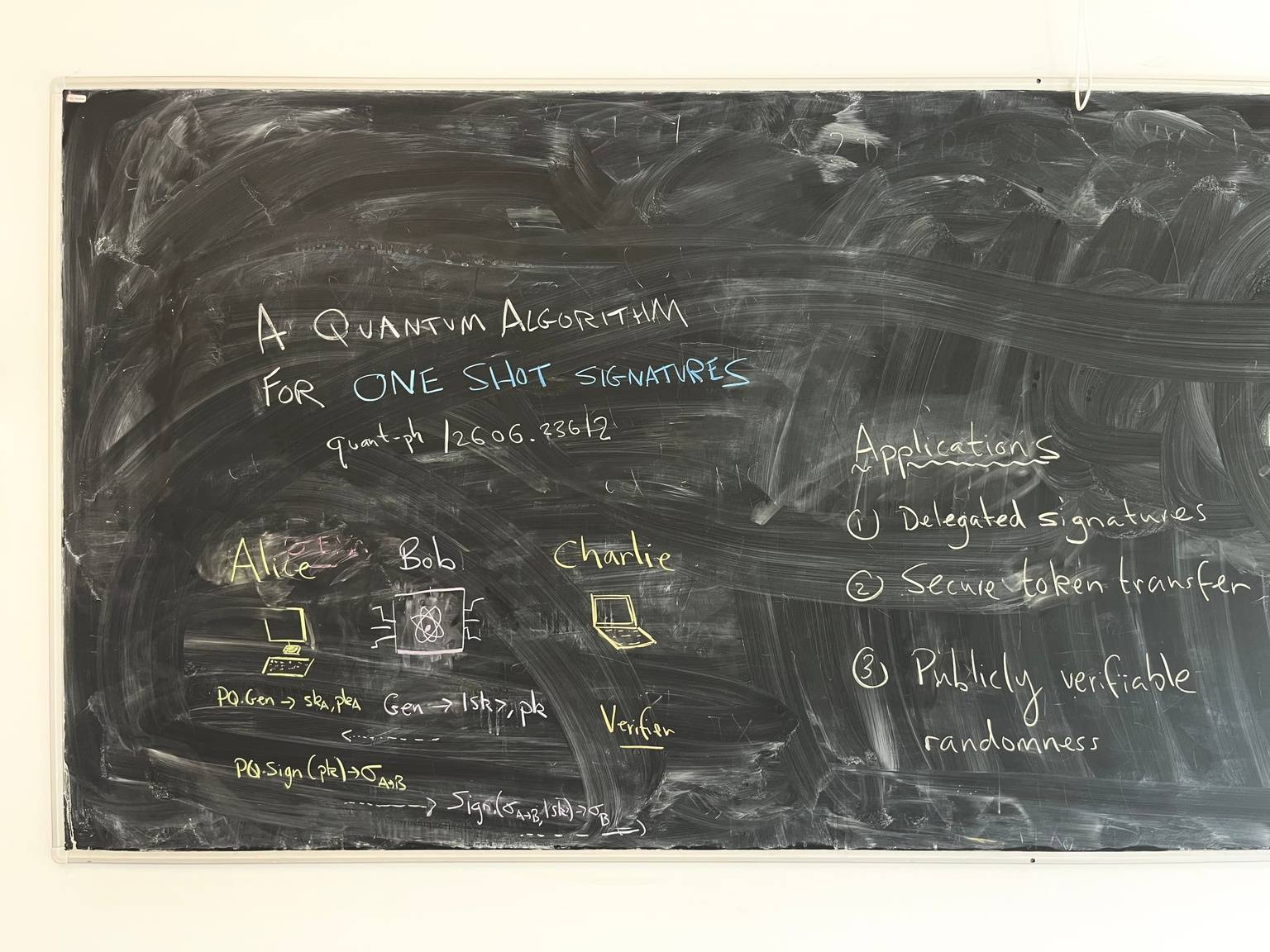
Researchers from BTQ Technologies and its French subsidiary QPerfect have published an explicit, circuit-level implementation of a one-shot signature (OSS) scheme in a preprint titled A quantum algorithm for one-shot signatures. The work translates theoretical protocols into concrete quantum gate instructions, establishing a practical primitive for “local quantum cryptography.” By encoding signing keys into fragile quantum states stored in local memory, the primitive enforces single-use security through measurement collapse and the no-cloning theorem, eliminating the need for decentralized ledgers or blockchains to prevent key reuse.
Circuit Construction, Bruhat Coset Sampling, and Multi-Bit Signing
Original theoretical frameworks for one-shot signatures relied on complex permutable pseudorandom permutations (PPRPs) and lacked detailed physical implementations. BTQ and QPerfect streamlined the architecture by replacing the PPRP layer with a single puncturable pseudorandom function (PPRF) based on a Goldreich-Goldwasser-Micali (GGM) tree lookup. The algorithm pairs GGM path traversal with a reversible Bruhat decomposition subroutine to sample uniform superpositions over random affine cosets. To sign arbitrary l-bit messages, the team bypassed iterative, bit-by-bit phase-flipping gates in favor of a global measurement routine coupled with a single dual-phase translation oracle (Dp→m).
| BTQ Technologies & QPerfect One-Shot Signature Circuit Specifications | ||
|---|---|---|
| Pipeline Stage | Algorithmic Mechanism | Computational Scaling & Resource Role |
| Key Generation (KeyGen) | GGM PPRF Tree Lookup + Bruhat Decomposition | Prepares an equal superposition over an affine coset (Ayz + by); outputs a classical public key and a quantum secret key. |
| Multi-Bit Signing (Sign) | Global measurement + Dual Phase Oracle (Dp→m) | Executes single translation step to match target message m, collapsing the quantum state to prevent second signatures. |
| Verification (Verify) | Classical deterministic tree traversal + Graff inversion | Checks pre-image validity and message-bit alignment purely on classical processors. |
| Logical Resource Footprint | Logical Qubits: Θ(κ log r + n + l) Gate Complexity: Θ(n3 + nl) | Requires 206 to 2,438 logical qubits across security parameters λ = 2 to 10 for single-bit signatures. |
Cryptographic Agility, Obfuscation Boundaries, and Memory Constraints
The circuit architecture was validated using QPerfect’s MIMIQ quantum emulator to establish baseline resource requirements before factoring in cryptographic program obfuscation. While classical fully succinct indistinguishability obfuscation (iO) can protect the classical GGM master key, fully securing the key-generation stage against adversarial input-state manipulation (such as Bell-pair entanglement attacks) requires future advances in quantum indistinguishability obfuscation. Practically, one-shot signatures depend on maintaining coherent quantum states until a message is signed, making long-coherence neutral-atom processors a natural deployment target for secure digital delegation, tokenized transfers, and trustless random beacons.
Detailed proofs and resource estimates are available in the arXiv here, with architectural analysis outlined in QPerfect’s Technical Blog here.
In GQI Portal
The players behind the news
The team that writes QCR tracks every company, deal and technology in the GQI Factory, GQI's verified database of the quantum industry. Next up: every story linked to its players, coming to QCR's paid plans.
- Players Companies and institutions across the quantum industry, by segment.
- Scorecards How the players compare on hardware, software, funding and more.
Newsletter
QCR Alerts in your inbox
The latest reporting and analysis from Quantum Computing Report. Free, unsubscribe any time.