
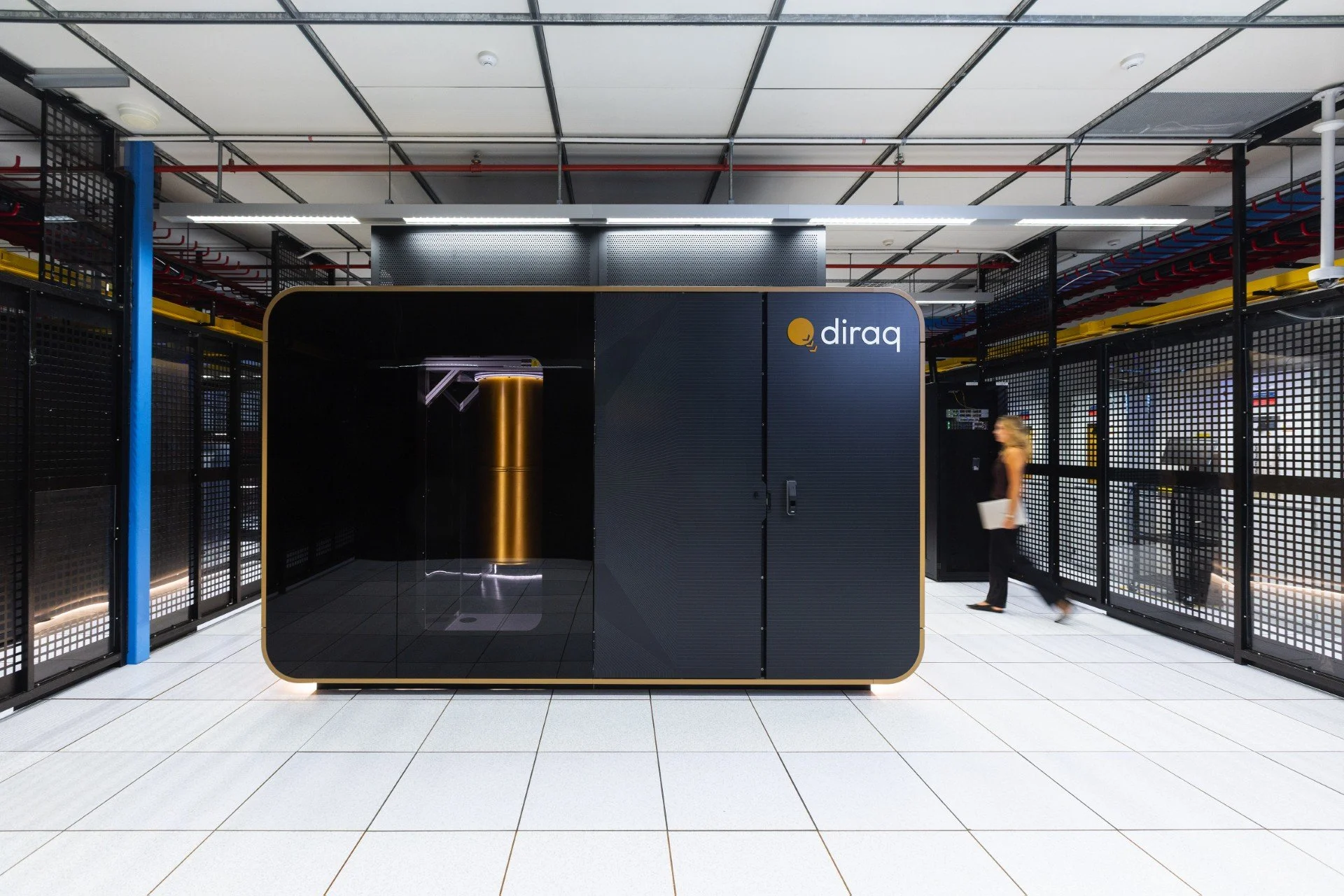
Silicon quantum computing developer Diraq has deployed an operational eight-qubit quantum computer inside an Equinix commercial data center in Sydney, Australia. The installation tests the viability of operating electron-spin-in-silicon processors outside specialized laboratory environments, integrating the cryostat and control systems into shared colocation infrastructure used by commercial enterprises.
| Diraq Silicon Spin Deployment Specifications & Architectural Roadmap | |||
|---|---|---|---|
| System Metric | Commercial Deployment (Live) | Short-Term Target (2027) | Utility-Scale Projection (2031) |
| Qubit Count | 8 silicon spin qubits | Up to 256 qubits via processor upgrade | > 2 million qubits integrated on a single die |
| Facility Host | Equinix commercial data center (Sydney) | Same colocation footprint | Standard enterprise and AI data center integration |
| Power Draw | < 20 kW total system load | Within existing power envelope | ~300 kW estimated peak draw |
| Physical Footprint | 172 sq ft (16 m²) | 172 sq ft | ~54 sq ft (5 m²) |
| Manufacturing Process | Silicon-MOS foundry fabrication | Standard semiconductor lines | Industrial-scale CMOS wafer manufacturing |
The system operates using quantum dots fabricated via standard silicon-metal-oxide-semiconductor (Si-MOS) lithography. Unlike architectural modalities requiring bespoke physical plants, Diraq’s packaging aims to integrate within enterprise facilities. The eight-qubit system draws under 20 kW of power and occupies 172 square feet of floor space. Over the next twelve months, Diraq plans to deploy a 256-qubit processor into the existing refrigeration unit, evaluating whether qubit capacity can scale via modular chip swaps without expanding facility infrastructure.
Operating a quantum processor within an active data center exposes the dilution refrigerator and control electronics to electromagnetic interference, cooling water flow fluctuations, and mechanical floor vibrations not found in subterranean academic laboratories. The Equinix deployment will establish baseline metrics for hardware uptime, gate fidelity stability, and control drift under continuous facility operation.
The hardware milestone coincides with the release of Diraq’s Quantum at Work white paper, which models the economic impact of quantum simulation on pharmaceutical lead optimization. Based on industry clinical trial cost datasets, the company’s internal model projects that a 10-percentage-point improvement in candidate success rates could reduce drug development costs by roughly $600 million per approved molecule by screening out unviable compounds prior to clinical trials.
The deployment builds on Diraq’s selection for Stage C of DARPA’s Quantum Benchmarking Initiative (QBI)—evaluating verifiable paths toward fault-tolerant computing—and a $38 million non-binding preliminary memorandum of terms under the U.S. CHIPS and Science Act.
Official release details are available from Diraq here and the Quantum at Work report here.
In GQI Portal
The players behind the news
The team that writes QCR tracks every company, deal and technology in the GQI Factory, GQI's verified database of the quantum industry. Next up: every story linked to its players, coming to QCR's paid plans.
- Players Companies and institutions across the quantum industry, by segment.
- Scorecards How the players compare on hardware, software, funding and more.
Newsletter
QCR Alerts in your inbox
The latest reporting and analysis from Quantum Computing Report. Free, unsubscribe any time.