

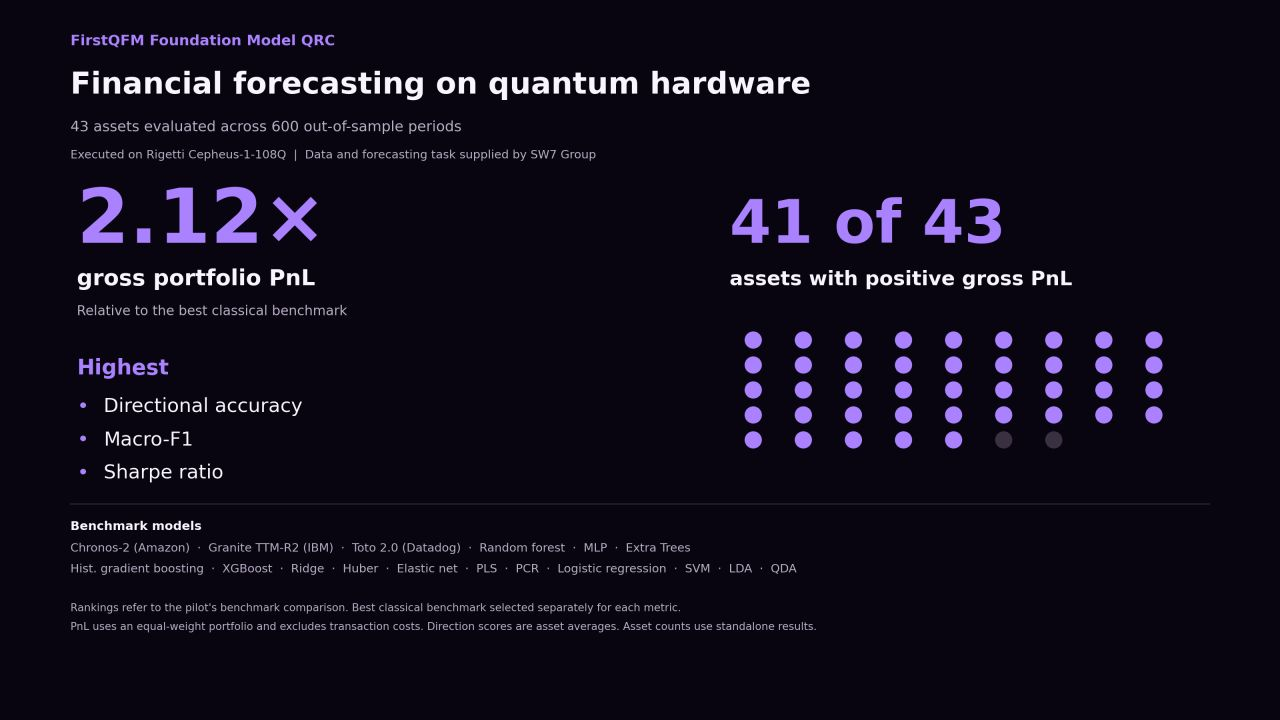
Stockholm-based quantum software startup FirstQFM, in collaboration with London quantitative research firm SW7 Group and Rigetti Computing, has demonstrated a financial forecasting pilot using quantum reservoir computing (QRC) executed on Rigetti’s 108-qubit Cepheus-1-108Q superconducting processor. Across a blinded out-of-sample evaluation spanning 43 anonymized assets and 600 trading dates, FirstQFM’s hybrid QRC pipeline outperformed standard machine learning models and classical time-series foundation models across directional accuracy, macro-F1, cumulative gross profit and loss (P&L), and risk-adjusted Sharpe ratios.
| SW7 Financial Forecasting Pilot: Top Model Performance (600 Out-of-Sample Dates) | ||
|---|---|---|
| Forecasting Model | Directional Accuracy / Macro-F1 | Cumulative Gross P&L / Annualized Sharpe |
| FirstQFM QRC (Cepheus-1-108Q) | 52.02% / 0.5176 | 513,473 / 1.22 (Positive P&L on 41 of 43 assets) |
| Multilayer Perceptron (Pooled MLP) | 51.25% / 0.5075 | 242,100 / 0.75 |
| PCR with Ridge Regression | 50.44% / 0.4856 | 220,104 / 1.02 |
| PLS Regression | 50.62% / 0.4972 | 166,339 / 1.01 |
| Random Forest (Asset-Specific) | 50.66% / 0.5036 | 101,247 / 0.61 |
| Amazon Chronos-2 (Zero-Shot) | 50.70% / 0.4849 | 100,071 / 0.39 |
Rather than requiring deep, error-mitigated circuit execution or variational parameter optimization on hardware, quantum reservoir computing injects time-series covariates into fixed, non-linear quantum dynamics and measures expectation values to construct high-dimensional feature representations for a classical linear readout head. In the pilot, FirstQFM generated hardware-stabilized reservoir embeddings utilizing 61 to 84 physical qubits across Rigetti’s multi-chiplet processor. When tested on a 43-asset equally weighted portfolio without transaction costs, the QRC system achieved 2.12× the cumulative gross P&L of the top classical baseline (pooled MLP) and an annualized Sharpe ratio of 1.22. A historically diversified five-asset sub-portfolio yielded a Sharpe ratio of 1.73.
To eliminate lookahead bias and data leakage, SW7 Group anonymized all features and asset identifiers across six expanding chronological training, validation, and test folds. Notably, FirstQFM’s model exhibited a 49.0% average directional disagreement with classical benchmarks; on days where the QRC forecast opposed the majority consensus of the classical models, QRC achieved a 50.89% win rate. While the authors explicitly disclaim general quantum advantage—acknowledging that larger drawdowns accompanied the higher P&L and that classical simulability boundaries remain an evolving target—the study establishes QRC as a latency-efficient paradigm for deploying NISQ processors in quantitative finance.
Technical methodology and validation data are detailed in FirstQFM’s Technical Report here and corporate Pilot Announcement here.
In GQI Portal
The players behind the news
The team that writes QCR tracks every company, deal and technology in the GQI Factory, GQI's verified database of the quantum industry. Next up: every story linked to its players, coming to QCR's paid plans.
- Players Companies and institutions across the quantum industry, by segment.
- Scorecards How the players compare on hardware, software, funding and more.
Newsletter
QCR Alerts in your inbox
The latest reporting and analysis from Quantum Computing Report. Free, unsubscribe any time.