

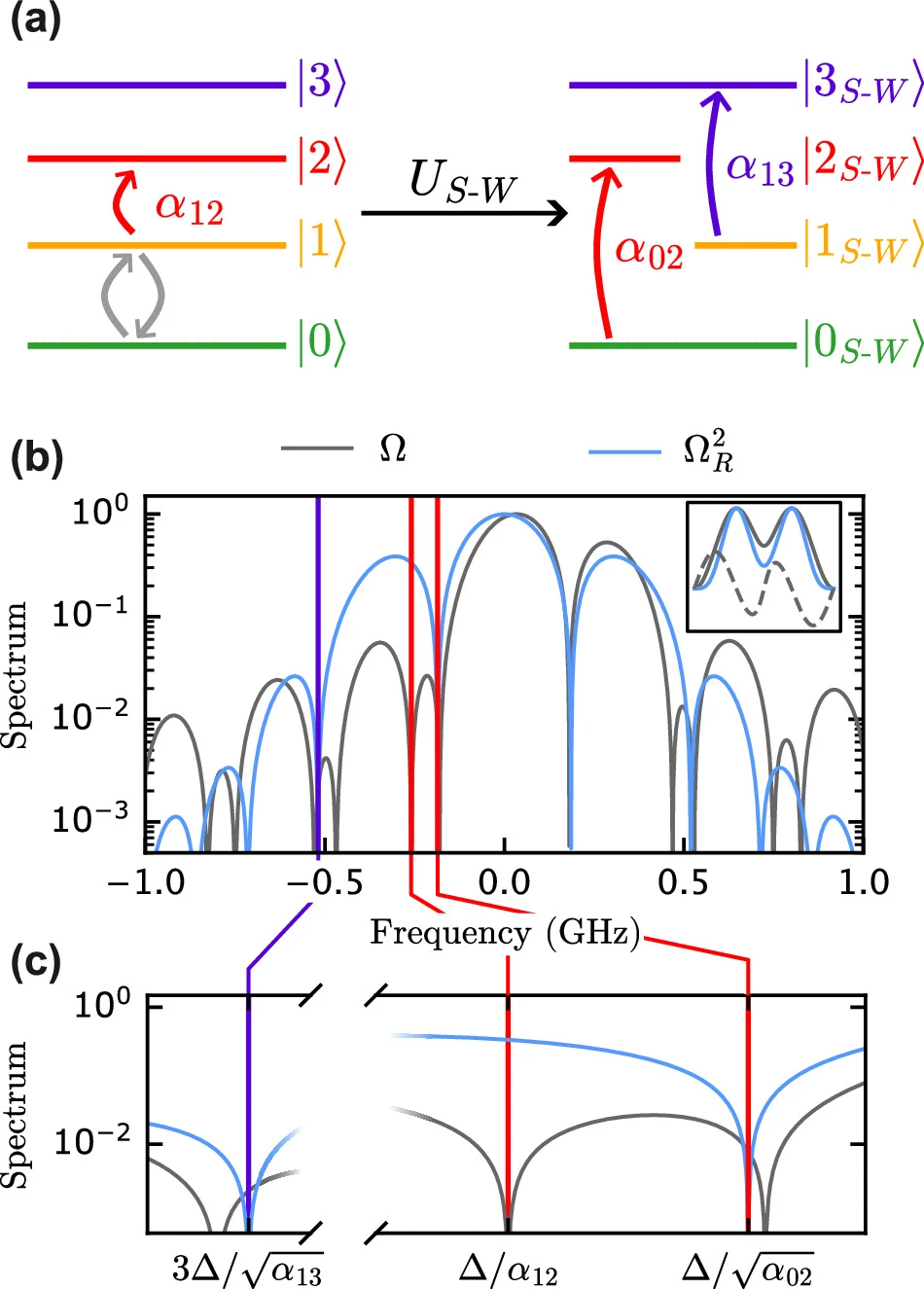
Physicists at Forschungszentrum Jülich, RWTH Aachen University, and the University of Cologne have achieved single-qubit gate operations lasting 6.8 nanoseconds with gate fidelities exceeding 99.98% on a superconducting transmon processor. Detailed in Nature Communications under the title Ultrafast single-qubit gates through multi-photon transition removal, the study introduces the “R2D” pulse-shaping method to suppress multi-photon leakage into non-computational states (|2⟩ and |3⟩) in the strongly driven regime. Conducted within the German national QSOLID project, the work sets a speed record for high-fidelity transmon operations by cutting unwanted leakage transitions by more than a factor of 20 compared to standard DRAG protocols.
| Forschungszentrum Jülich Ultrafast Transmon Gate Benchmarks | ||
|---|---|---|
| Gate Metric / Parameter | Demonstrated Value / Configuration | Physical & Control Significance |
| Gate Duration (tp) | 6.8 ns (for both X and X/2 gates) | Compresses microwave drive times down to the strongly driven regime (Ω / |Δ| = 0.33). |
| Average Gate Fidelity | 99.981% (X gate) / 99.989% (X/2 gate) | Characterized via interleaved randomized benchmarking; total error remains decoherence-limited. |
| Leakage Rate (εleak) | < 2.0 × 10⁻⁵ per gate operation | Suppresses coherent leakage to |2⟩ and |3⟩ below 0.002%, preventing correlated error-correction faults. |
| Pulse Correction Architecture | R2D (Double Recursive DRAG) | Uses second-derivative filtering to notch out two-photon spectral components in ΩR2. |
| Metrology Protocol | Amplified Leakage Error (ALE) | Coherently accumulates state leakage to quantify non-computational transitions down to 10−6. |
In weakly anharmonic superconducting transmons (operating here at Δ / 2π = −225 MHz), driving gates faster requires increasing microwave power. In this strongly driven limit, the drive field shifts the qubit’s dressed eigenstates, causing direct two-photon transitions (|0⟩ → |2⟩ and |1⟩ → |3⟩) that bypass traditional selection rules and degrade conventional Derivative Removal by Adiabatic Gate (DRAG) corrections. The Jülich team’s R2D method introduces a double recursive derivation that nulls spectral components at multi-photon transition frequencies using three in-situ optimized parameters (α12, α02, α13). Paired with an Amplified Leakage Error (ALE) sequence that isolates coherent leakage from thermal excitations, the protocol pushes gate speed while keeping coherent control errors well below the environmental decoherence floor (T1 = 40 μs, T2Echo = 56 μs).
While the 6.8-nanosecond gate addresses single-qubit limits on isolated transmons, scaling the technique across multi-qubit lattices introduces practical compiler hurdles. Operating at normalized drive strengths of Ω / |Δ| = 0.33 risks spectator-qubit dephasing, microwave cross-talk, and frequency crowding across densely packed planar chips. Adapting R2D to multi-qubit systems will require integrating multi-frequency spectral notch filters into automated calibration pipelines and evaluating whether similar recursive pulse corrections can mitigate leakage during nanosecond-scale two-qubit entangling gates.
The complete peer-reviewed paper is available in Nature Communications here, with institutional background provided by Forschungszentrum Jülich here.
In GQI Portal
The players behind the news
The team that writes QCR tracks every company, deal and technology in the GQI Factory, GQI's verified database of the quantum industry. Next up: every story linked to its players, coming to QCR's paid plans.
- Players Companies and institutions across the quantum industry, by segment.
- Scorecards How the players compare on hardware, software, funding and more.
Newsletter
QCR Alerts in your inbox
The latest reporting and analysis from Quantum Computing Report. Free, unsubscribe any time.