


Global technology services firm LTM (a Larsen & Toubro Group company) has deployed its proprietary AI-QEM (AI-powered Quantum Error Mitigation) software in the IBM Quantum Functions Catalog, becoming the first global systems integrator to publish a circuit function on the platform. Available to IBM Quantum Premium, Flex, and On-Prem Plan users via the ltm/ai-qem interface, the function integrates into Qiskit Estimator workflows to suppress hardware noise through classical deep-learning inference.
| LTM AI-QEM Circuit Function Specifications & Benchmarks | ||
|---|---|---|
| System Dimension | Technical Specification | Measured Benchmark / Platform Impact |
| Model Architecture | Graph Convolutional Network (GCN)-Transformer | Predicts per-Pauli correction factors (ζi) from circuit structure, backend topology, and qubit calibrations. |
| Hardware Overhead | Zero additional QPU runtime, circuit repetitions, or ancilla qubits | Matches native IBM EstimatorV2 QPU times (12 s commuting / 23 s non-commuting on ibm_kingston). |
| Hardware Benchmarks | Up to 100 qubits on IBM Heron r2 processors | Achieved 95.06% accuracy on 100-qubit Clifford circuits (depth 45) and 90.29% on 96-qubit 2D Ising runs. |
| Current Scope & Limits | IBM Heron processor family; applied when |⟨O⟩noisy| ≥ 0.1 | Targets non-trivial expectation values while avoiding noise amplification near zero. |
Physical quantum processors remain constrained by gate errors and environmental decoherence that bias expectation values as circuit depth and qubit counts increase. Conventional error-mitigation protocols such as zero-noise extrapolation (ZNE) and probabilistic error cancellation (PEC) compensate for noise by executing ensembles of modified circuits, introducing exponential sampling overheads that inflate quantum runtime costs.
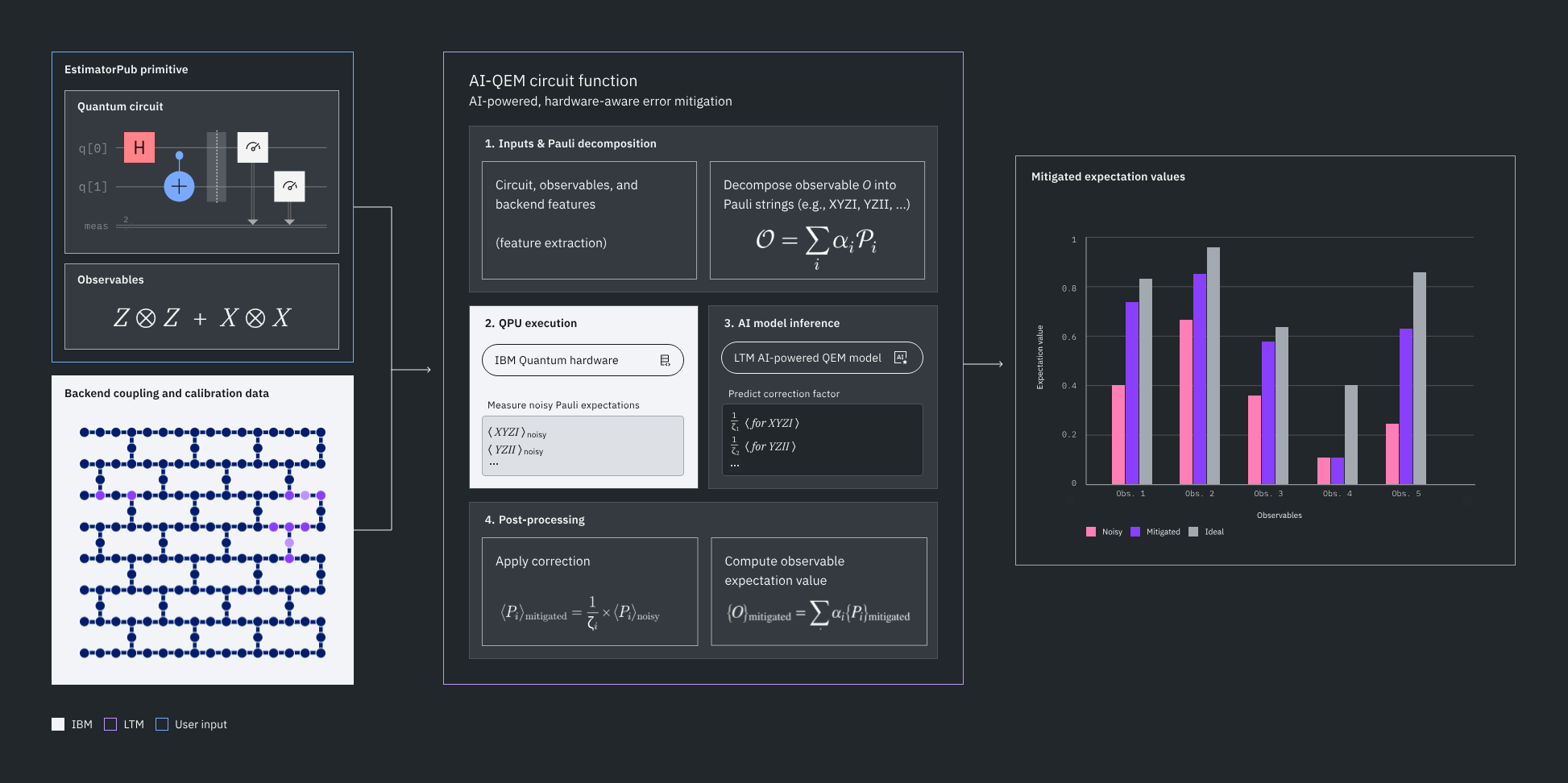
LTM’s circuit-agnostic approach bypasses additional quantum sampling by decomposing observables into Pauli operators and applying trained classical neural networks to rescale each noisy expectation value (⟨Pi⟩mitigated = ⟨Pi⟩noisy / ζi). Across 80- to 150-qubit validation suites, the GCN-Transformer architecture recorded a mean absolute error (MAE) of 0.343, outperforming random-forest mitigation baselines. The launch is accompanied by an IBM Quantum tutorial covering Trotterized time evolution of the 2D tilted-field Ising model.
Official release details are available via the LTM newsroom here. Catalog access, API documentation, and tutorials are accessible on the IBM Quantum Functions Catalog here, IBM Quantum Docs here, and the IBM Quantum Tutorials index here. Related QCR coverage of IBM’s Quantum Functions Catalog expansion at QDC 2026 is accessible here.
In GQI Portal
The players behind the news
The team that writes QCR tracks every company, deal and technology in the GQI Factory, GQI's verified database of the quantum industry. Next up: every story linked to its players, coming to QCR's paid plans.
- Players Companies and institutions across the quantum industry, by segment.
- Scorecards How the players compare on hardware, software, funding and more.
Newsletter
QCR Alerts in your inbox
The latest reporting and analysis from Quantum Computing Report. Free, unsubscribe any time.