

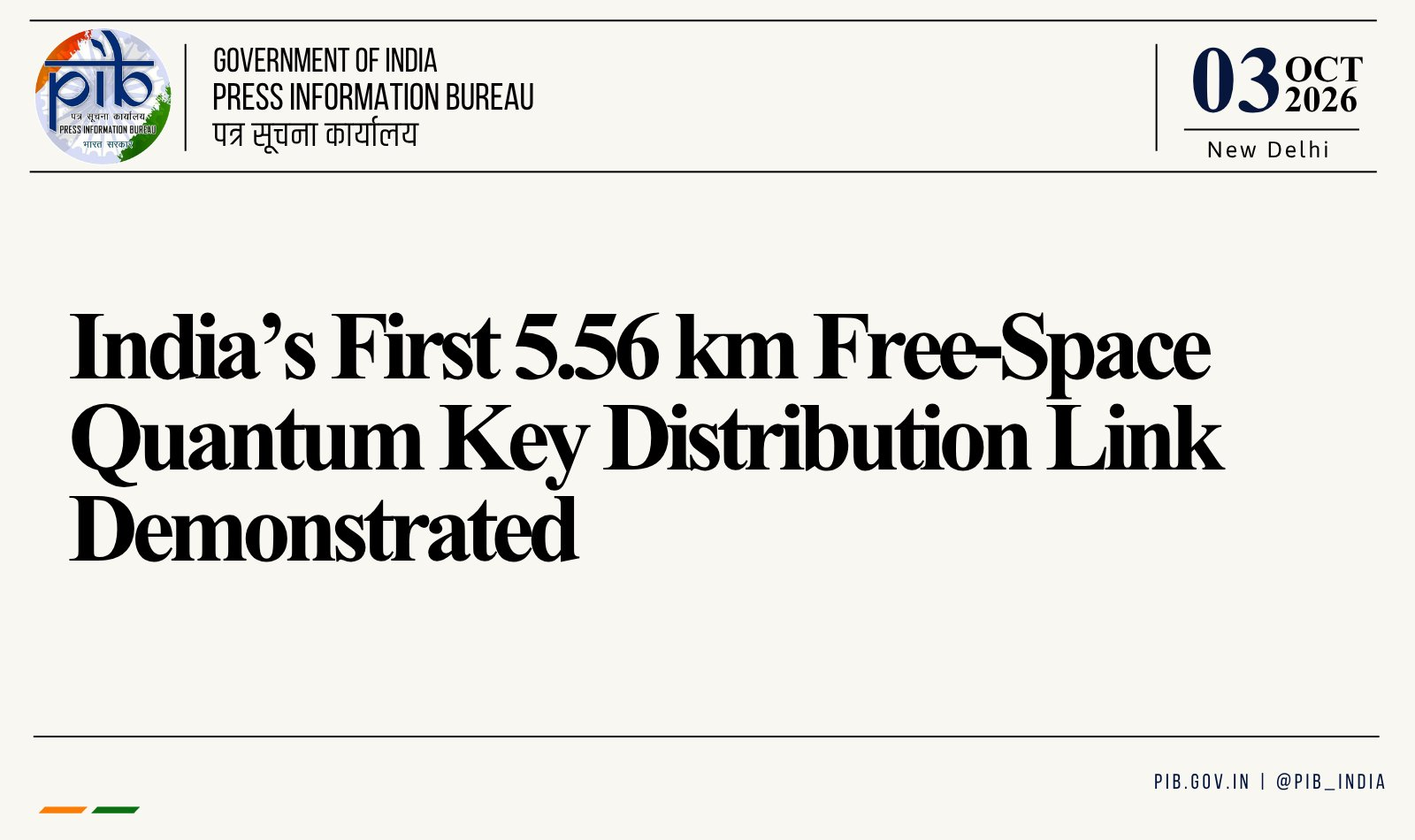
Indian quantum cybersecurity enterprise QNu Labs, in collaboration with the Bhaskaracharya National Institute for Space Applications and Geo-informatics (BISAG-N) and the Indian Institute of Technology (IIT) Gandhinagar, has completed a 5.56 km free-space Quantum Key Distribution (QKD) field trial. Conducted overnight on September 27–28, 2026, between BISAG-N and IIT Gandhinagar, the demonstration marks India’s first successful free-space QKD link at the 5 km scale.
The field trial utilized QNu Labs’ Pointing, Acquisition, and Tracking (PAT) optical system to maintain alignment over the 1550 nm quantum channel. Operating on the Differential Phase Shift (DPS)-Decoy QKD protocol, the link maintained a Quantum Bit Error Rate (QBER) below 5% and achieved a secure key rate of 230–260 bps (generating approximately one fresh 256-bit symmetric key per second). The PAT system combined gimbal-based coarse pointing (5 microradian accuracy) with fast fine steering at a 100 Hz tracking bandwidth (up to 0.1 microradian accuracy) to stabilize the optical beam against atmospheric turbulence.
| [ QNu Labs / BISAG-N Free-Space QKD Field Trial Benchmarks ] | ||
|---|---|---|
| Technical Metric / Parameter | Operational Field Benchmark | Engineering Impact & Architecture Scope |
| • Link Distance & Optics | • 5.56 km open-atmosphere optical link • 1550 nm quantum channel wavelength | • Demonstrates free-space line-of-sight QKD over multi-kilometer urban spans |
| • Key Rate & Error Bounds | • Secure key rate: 230–260 bps • Quantum Bit Error Rate (QBER): <5% | • Delivers ~1 fresh 256-bit key/sec; validates DPS-Decoy protocol under atmospheric noise |
| • PAT Optical Tracking | • Coarse pointing: 5 $\mu$rad accuracy • Fine steering: 0.1 $\mu$rad (100 Hz bandwidth) | • Mitigates thermal fluctuations and beam jitter along open-air propagation paths |
| • Hybrid Defense Integration | • Integration with BISAG-N Vedic Kavach • ETSI GS QKD 014 API delivery | • Pairs physical QKD keys with PQC software layers to maintain encryption during signal fade |
The trial demonstrated end-to-end integration with BISAG-N’s Vedic Kavach platform, a post-quantum cryptography (PQC) and quantum random number generation (QRNG)-enabled browser and web server environment. Using 256-bit keys delivered via the standard ETSI GS QKD 014 interface, test payloads were encrypted, transmitted, and decrypted across the hybrid optical-PQC layer. This dual-layer architecture ensures application security persists even if physical free-space optical channels experience temporary weather fade, establishing a technical baseline for terrestrial multi-node optical mesh networks and satellite-to-ground quantum communications.
Review the official release on the Press Information Bureau (PIB) Portal here.
In GQI Portal
The players behind the news
The team that writes QCR tracks every company, deal and technology in the GQI Factory, GQI's verified database of the quantum industry. Next up: every story linked to its players, coming to QCR's paid plans.
- Players Companies and institutions across the quantum industry, by segment.
- Scorecards How the players compare on hardware, software, funding and more.
Newsletter
QCR Alerts in your inbox
The latest reporting and analysis from Quantum Computing Report. Free, unsubscribe any time.