

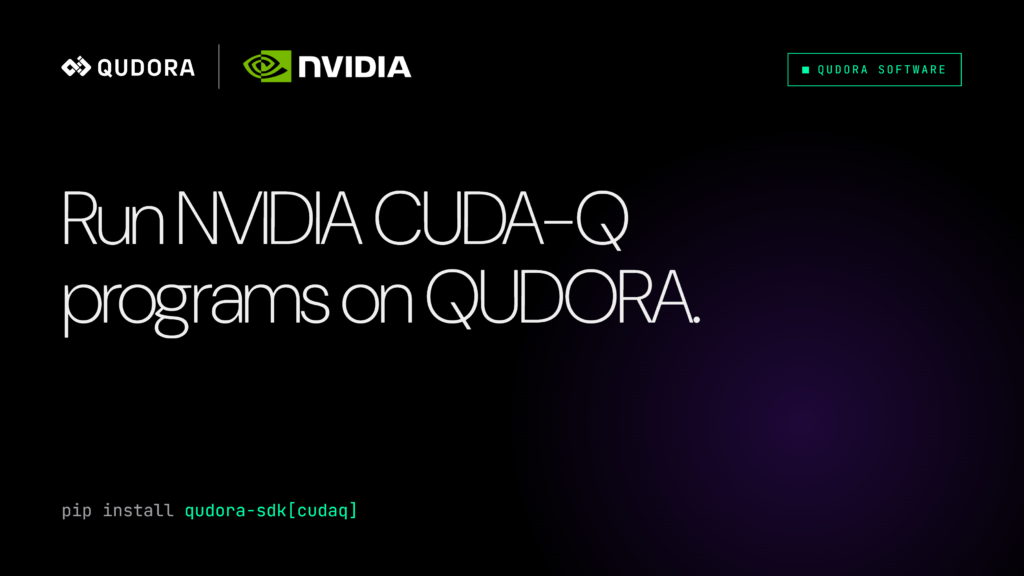
Braunschweig-based trapped-ion developer QUDORA Technologies has expanded its hybrid quantum-classical software stack through an integration with NVIDIA CUDA-Q alongside the launch of the three-year QUANDA (Quantum Anomaly Detection & Analysis) consortium. Together, the initiatives connect QUDORA’s Near Field Quantum Control (NFQC) microwave-addressed trapped-ion architecture with standard hybrid programming frameworks and supercomputing job pipelines ahead of physical processor deployment.
Through the CUDA-Q release, available via the qudora-sdk[cudaq] Python package and QUDORA Cloud, developers can execute hybrid quantum-classical workflows against Qamelion, QUDORA’s quantum emulator incorporating adaptive noise modeling. The environment enables researchers to benchmark measurement sensitivity and circuit behavior under realistic trapped-ion noise profiles before migrating identical CUDA-Q source code to physical hardware targets.
In parallel, QUDORA initiated the QUANDA project under the German Federal Ministry of Research, Technology and Space (BMFTR) Development of Digital Technologies program to automate trapped-ion access inside high-performance computing (HPC) centers. Working with GWDG, the joint computing center of the University of Göttingen and the Max Planck Society, alongside Leibniz University Hannover, Deggendorf Institute of Technology, UBT Future Energy Lab Wunsiedel, and ZukunftsEnergie Nordostbayern (ZENOB), the consortium will build an automated submission, transpilation, and execution pipeline evaluated across three energy-sector quantum machine learning anomaly detection workloads.
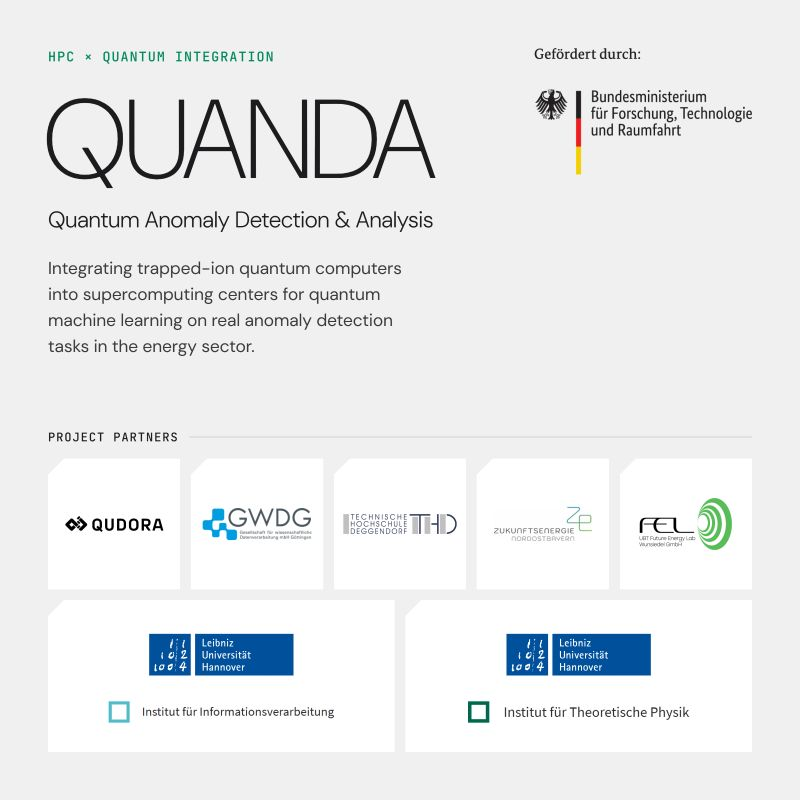
In parallel, QUDORA initiated the QUANDA project under the German Federal Ministry of Research, Technology and Space (BMFTR) Development of Digital Technologies program to provide standardized trapped-ion access within high-performance computing (HPC) centers without requiring users to manage underlying quantum hardware. Working with Gesellschaft für wissenschaftliche Datenverarbeitung mbH Göttingen (GWDG), the joint IT and computing center of the University of Göttingen and the Max Planck Society, alongside Leibniz Universität Hannover’s Institute of Information Processing and Institute for Theoretical Physics, Deggendorf Institute of Technology, UBT Future Energy Lab Wunsiedel GmbH, and ZukunftsEnergie Nordostbayern GmbH (ZENOB), the consortium is building an automated submission, compilation, and execution pipeline to test quantum machine learning across three energy-sector anomaly detection workloads spanning electricity consumption patterns, equipment sensor readings, and generation and distribution behavior.
Read QUDORA’s NVIDIA CUDA-Q announcement here, access the qudora-sdk package on PyPI here and QUDORA Cloud here, and read the QUANDA HPC project announcement here.
In GQI Portal
The players behind the news
The team that writes QCR tracks every company, deal and technology in the GQI Factory, GQI's verified database of the quantum industry. Next up: every story linked to its players, coming to QCR's paid plans.
- Players Companies and institutions across the quantum industry, by segment.
- Scorecards How the players compare on hardware, software, funding and more.
Newsletter
QCR Alerts in your inbox
The latest reporting and analysis from Quantum Computing Report. Free, unsubscribe any time.