

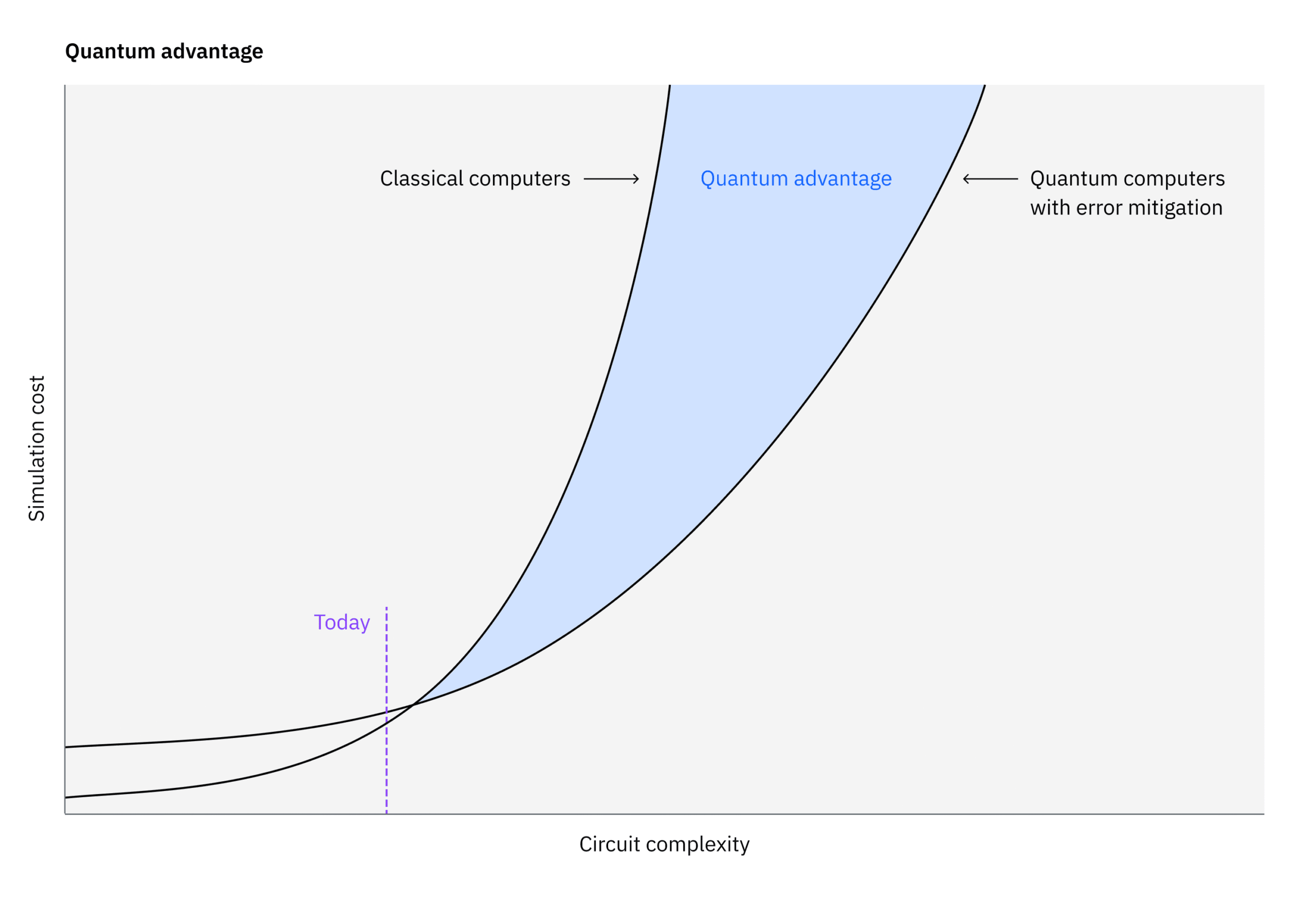
IBM and quantum startup Pasqal have released a new white paper on arXiv, titled A Framework for Quantum Advantage. This document provides a comprehensive framework for defining, validating, and achieving quantum advantage. Its release marks a critical moment in the quantum community, as it sets the stage for a period of rapid discovery and rigorous debate.
In an associated blog, IBM is stating they see a clear path for seeing the first applications to achieve quantum advantage before the end of 2026 with NISQ level machines and before Fault Tolerant Quantum Computers (FTQC) are available. They define quantum advantage as the ability to execute a task on a quantum computer more accurately, cheaply, or efficiently than on a classical computer. This definition is not a simple “quantum vs. classical” comparison; instead, it emphasizes a symbiotic relationship, where “quantum plus classical” outperforms classical computation alone. In addition, extensive use of error mitigation techniques will also be needed.
A key element of this definition is the concept of a “quantum separation,” which is the provable gap in algorithmic performance. The ideal separation is “unconditional,” grounded in complexity theory or direct comparisons with the best-known classical algorithms. While some potential separations have been identified, the paper notes that most existing results have yet to demonstrate the exponential performance gain that is the ultimate promise of quantum computing.
For a claim of quantum advantage to be considered valid, it must satisfy two essential criteria: the correctness of the quantum output must be rigorously validated, and it must demonstrate a superior performance metric over classical methods. This validation process is expected to be a collaborative and iterative scientific process, with the broader community attempting to either support or falsify initial hypotheses. This back-and-forth will continue until a consensus is reached, underscoring that quantum advantage will not be a singular event but a series of verified claims.
The authors predict that the initial claims of quantum advantage will likely emerge from three key problem areas: sampling problems, variational problems, and the calculation of expectation values of observables. The ability to rigorously validate results in variational problems and expectation value calculations makes them particularly promising candidates for the first proven advantages.
For additional information about this, you can view the full paper posted on arXiv here and a blog post that provides more on IBM’s perspective on quantum advantage here.
In GQI Portal
The players behind the news
The team that writes QCR tracks every company, deal and technology in the GQI Factory, GQI's verified database of the quantum industry. Next up: every story linked to its players, coming to QCR's paid plans.
- Players Companies and institutions across the quantum industry, by segment.
- Scorecards How the players compare on hardware, software, funding and more.
Newsletter
QCR Alerts in your inbox
The latest reporting and analysis from Quantum Computing Report. Free, unsubscribe any time.