

Guest post by Zeynep Koruturk, Dr. Kris Naudts, & Donald Harmitt of Firgun Ventures and Professor Bob Coecke of Relational Intelligence Limited
Few questions in the quantum sector are asked more often, or answered more loosely, than how many qubits a useful quantum computer will require. Press releases announce systems with hundreds of qubits, then thousands, and the implicit suggestion is that the field is approaching a finish line. The reality is more nuanced, and arguably more interesting. It is not as black and white as saying there is a single number of qubits that makes a quantum computer “useful”. The right number depends entirely on what you want the machine to do, on which type of machine you are using, and on how cleverly the underlying problem has been formulated.
Not all quantum bits (or qubits) are created equal. A qubit is the basic building block of a quantum computer, the equivalent of a bit in a classical machine, but qubits are fragile and error prone. To do any serious computation, many physical qubits must be bundled together to create one reliable “logical qubit” through a process called quantum error correction. The ratio between the two, depending on the technology and the target error rate, can range from roughly 2 to 1 at the optimistic end to over 2,000 to 1 at the demanding end.
Rather than asking how many qubits quantum computing needs in the abstract, we instead reframe the question to how many qubits each specific application needs on each specific type of machine and then organise the answers into three broad bands of ambition and difficulty.
Why Qubit Numbers Sometimes Mislead
A small chemistry calculation might need only a few dozen highly reliable qubits. Breaking modern encryption or proving advantage on hard optimisation problems (finding the best possible solution from an enormous number of alternatives) could require thousands of logical qubits. Between those extremes sits a wide commercial middle ground that is moving faster than most observers realise, largely because of algorithmic improvements coupled with hardware progress.
Headline qubit counts can sometimes be misleading: two systems can both claim “thousands of qubits” yet be nowhere near equivalent if one is counting raw hardware and the other is counting error-corrected logical qubits. The physical-to-logical ratio is, in many ways, one of the single most important variables for anyone estimating when quantum computing becomes commercially relevant.
Beyond that, qubit requirements vary for four practical reasons. The first is the type of problem itself, since simulating molecules places very different demands on a machine than solving a routing problem or factoring a large number. The second is how cleverly the problem is represented, as better mathematical reformulations have repeatedly shrunk benchmark resource estimates by large factors. The third is the hardware modality: gate-based fault-tolerant systems (which process information through a sequence of logical operations, much like a conventional computer runs step-by-step instructions), photonic-based architectures (use particles of light rather than matter to carry quantum information), and quantum annealers (purpose-built to find low-energy solutions to specific optimisation problems) do not measure resources in the same way, and their qubit counts are not directly comparable. The fourth is how complete the estimate is. Some studies count only the qubits needed for the core algorithm, while others include the full overhead of routing, error correction, and ancillary machinery, and the difference is often an order of magnitude.
With that grounding in place, the strongest pattern in the literature is that use cases fall into three broad bands, each with a meaningfully different timeline and a meaningfully different machine.
Band One: Early Scientific Applications Within Reach
The first band covers carefully chosen scientific problems, mainly in chemistry and materials science, that may become genuinely interesting with somewhere between tens and a few hundred logical qubits. Chemistry and materials are natural candidates because quantum computers are well suited to modelling electrons, bonds and strongly correlated materials which are quantum in nature. This is the territory where the first scientifically meaningful results from early fault-tolerant machines are most likely to appear.
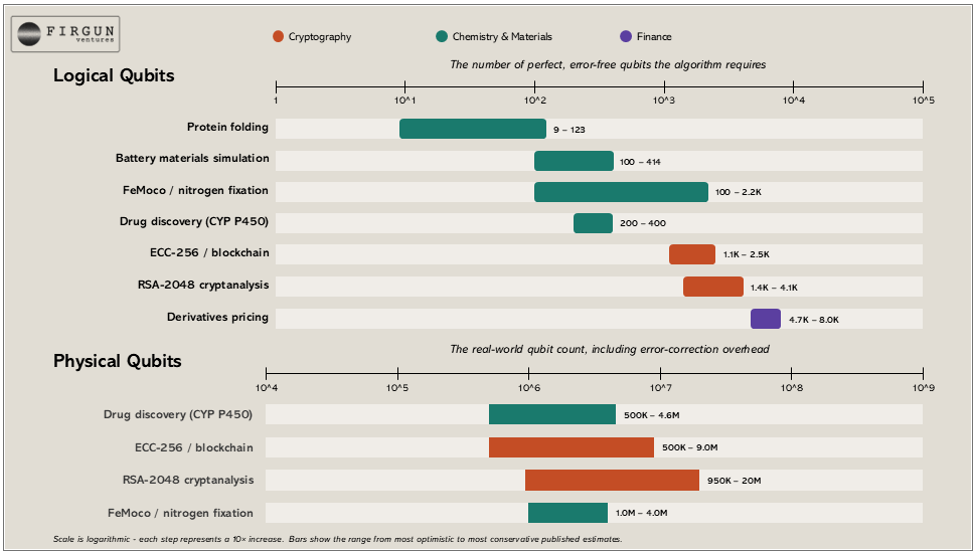
For small, well-chosen chemistry problems, recent work suggests useful early fault-tolerant simulations may be possible with roughly 25 to 100 logical qubits, and some compressed systems such as small iron-sulphur clusters, chromophores (the parts of molecules responsible for absorbing light, relevant to solar energy and photosynthesis research), or simple metal hydrides (compounds of a metal and hydrogen, studied for their role in hydrogen storage and catalysis) fit cleanly within this range. Protein folding and protein-ligand interactions sit in a similar bracket on noisy (error prone) near-term hardware. A 2019 IBM study folded a 10-amino-acid peptide on 22 qubits, and a more recent collaboration between Qubit Pharmaceuticals and Q-CTRL ran a hybrid protein-pocket hydration-site predictor on up to 123 noisy qubits. These are not yet drug-discovery breakthroughs, but they are credible early demonstrations of polynomial-scaling chemistry on real machines.
Materials science and condensed matter physics presents itself as one of the strongest early candidates, and in some cases, it appears cheaper than flagship chemistry problems. Studies of model systems such as the Fermi-Hubbard model (a simplified mathematical description of how electrons move through a lattice of atoms and widely used to study magnetism and electrical conductivity), and the uniform electron gas (used as a baseline for understanding metals and testing computational methods) have produced estimates in the hundreds of logical qubits. This signals a direction towards condensed matter being one of the first areas where fault-tolerant machines deliver scientifically meaningful results beyond minute-scale problems. There are already experimental hints surfacing in this direction. Quantinuum, a quantum computing company specialising in trapped-ion hardware, reported in 2026 that it had used 64 logical qubits to simulate quantum magnetism at a scale it described as exceedingly difficult for classical methods, using a low-overhead encoding on trapped ions. That single demonstration is one of the few public examples of a vendor tying error-corrected logical qubits to a recognisable many-body application (simulation of large groups of interacting particles). The strategic implication of this band is that the first useful fault-tolerant machine does not need to be particularly enormous but needs to be reliable.
The same low-resource pattern is showing up in commercially relevant materials-related work, particularly around next-generation batteries. Two recent studies, both led by researchers at Xanadu and collaborators, produced quantum resource estimates for simulating the X-ray spectra used to study how lithium-excess cathodes degrade as they charge and discharge. The first study, which simulated how a small piece of cathode material absorbs X-rays, came in at around 100 logical qubits. The second tackled a more demanding type of X-ray measurement used to track how cathodes break down over time, and came in at around 414 logical qubits. Both numbers sit comfortably within the band-one bracket for a domain where even modestly accurate simulations would be commercially valuable.
A use case that is unlikely to be top of mind for most when quantum is mentioned, but is hinting at early commercial prospects, is gaming. MOTH is a quantum technology company focused on the software layer, aimed at leveraging quantum systems to improve gaming development and experience, visual media, and music beyond the capabilities of classical systems. MOTH officially released the world’s first consumer product powered by live quantum hardware in May 2026, an open-access game called Quantum Backrooms, demonstrating early quantum commercialisation efforts within the gaming industry.
The general consensus from band one is that tens to hundreds of logical qubits will be enough to do scientifically recognisable work in carefully chosen areas where classical methods struggle. This is likely to be the first credible frontier of quantum value.
Band Two: Commercially Ambitious Applications
The second band covers more realistic chemistry, certain finance problems, and industrial materials simulations that tend to require thousands of logical qubits. This is the territory where commercial returns become plausible, and where the most striking algorithmic progress is happening.
The clearest example is the FeMoco (short for the iron-molybdenum cofactor) benchmark, a model of nitrogen fixation that has become the standard benchmark for demanding catalytic chemistry. A major 2021 study placed FeMoco at around 2,100 to 2,200 logical qubits and roughly four million physical qubits under specific assumptions, and a 2025 algorithmic improvement reduced the estimate further to roughly 1,500 logical qubits.
Cytochrome P450 enzymes, which mediate roughly 75% of human drug metabolism, sit in similar territory. A Google, Boehringer Ingelheim and collaborator study in PNAS assessed P450 models and found that, under one set of assumptions, the largest model could be assessed with around 200 to 400 logical qubits at the algorithmic layer, translating to roughly 4.6 million physical qubits and 73 hours of runtime at a 0.1 percent physical error rate. A March 2026 follow-up leveraged smarter ways to compress the mathematical problem and more efficient methods for organising the computation, shrinking both the time required and the number of qubits needed. As a proxy for the view on the general consensus, the prediction market platform, Kalshi, as of May 2026, has an implied probability of 36% before 2030 and 52% before 2035, using the ability to simulate FeMoco and CYP450 or crack 2048-bit RSA encryption as quantum advantage benchmarks.
Financial use cases belong in this band too. Despite the popular suggestion that it should be relatively easier than chemistry, the literature supports an alternative view. Rigorous end-to-end studies of derivative pricing have put credible thresholds around 4,700 to 8,000 logical qubits, along with demanding speed requirements.
Elliptic curve cryptography (ECC), which underpins many blockchain and digital signature systems, looks easier still in quantum terms, and is another member of this band. A 2026 Google white paper estimated that attacking the secp256k1 curve used in major blockchain systems could be done with around 1,200 to 1,450 logical qubits and fewer than 500,000 physical superconducting qubits, much lower than many would have assumed. Despite providing equivalent classical security to RSA-3072, a widely used encryption standard that protects sensitive data such as online banking and government communications, ECC is plausibly within reach of a 500,000 to 1,000,000-qubit machine consistent with the public 2030 to 2033 roadmaps of the likes of IBM, IonQ, and Diraq.
Band-two applications often sit somewhere between 1,000 and 10,000 logical qubits, depending on how realistic the molecule is and how aggressively the problem has been compressed.
Band Three: The Headline Tasks that Still Demand Very Large Machines
The third band covers the applications that dominate public discussion: breaking RSA encryption and proving a strong, generic advantage on hard optimisation problems. These require very large fault-tolerant systems, often into the millions of physical qubits, and remain the clearest examples of why hardware ambition still matters.
Cryptography is the cleanest illustration of how fast the picture is moving. For RSA-2048, a 2021 estimate suggested around 20 million noisy physical qubits could factor a key in about eight hours under specific surface code assumptions. A 2025 update, using better arithmetic and resource allocation under identical hardware assumptions, reduced that to fewer than one million noisy qubits in under a week. That is a roughly twenty-fold collapse in six years, achieved through software improvements alone. The trajectory has not slowed, as a February 2026 paper introducing a new error-correcting architecture based on quantum LDPC codes (a form of quantum error-correcting codes) pushed that figure down by another order of magnitude to fewer than 100,000 physical qubits, under identical hardware assumptions to the previous estimate.
Optimisation is the most commercially marketed but algorithmically most uncertain application class. Most published claims rely on the Quantum Approximate Optimisation Algorithm (QAOA), which has not yet proven generic quantum advantage, or on quantum annealing, which is a non-universal modality. For universal gate-based machines, the strongest recent rigorous study on hard optimisation found that crossover with classical methods could require roughly anywhere between the wide range of 8.9 million to 73.9 million physical qubits.
Quantum annealers tell a different story. D-Wave already offers systems with more than 4,400 physical qubits for specialised workflows, but those qubits are not directly comparable to logical qubits in a fault-tolerant gate-based computer, since many physical annealer qubits are typically tied together to represent one useful problem variable. The scientifically sound reading is that specialised optimisation may show value with thousands of annealer qubits today, while broad fault-tolerant optimisation advantage remains a multi-million physical qubit challenge, for now.
What This Means for Capital and Conviction
The trend that runs across each band is that resource estimates are collapsing rapidly through algorithmic improvement, outpacing even hardware progress which is improving in its own right. The direction of travel is consistently toward fewer qubits and shorter runtimes for the same outcome.
The future of quantum computing is not a single milestone but more akin to a staircase. Some commercially and scientifically interesting steps may be reached with machines on the order of 100 logical qubits, while others will require thousands. The hardest tasks will still require millions of physical qubits, and the spread between those steps is wide enough that conflating any two leads to faulty technical and commercial conclusions.
Different applications will mature at very different rates, and diligence has to interrogate not just the qubit headline but the logical-qubit translation, the modality assumptions, and the algorithmic compression behind any commercial claim. The right question is rarely how many qubits a company has. It is how many reliable qubits its target application actually needs, and how credibly its roadmap closes the gap.
Firgun Ventures is a VC firm investing in Series A/B quantum scale-ups globally. Views expressed by contributors on these pages are their own and may or may not be the same as the views held by GQI.
In GQI Portal
The players behind the news
The team that writes QCR tracks every company, deal and technology in the GQI Factory, GQI's verified database of the quantum industry. Next up: every story linked to its players, coming to QCR's paid plans.
- Players Companies and institutions across the quantum industry, by segment.
- Scorecards How the players compare on hardware, software, funding and more.
Newsletter
QCR Alerts in your inbox
The latest reporting and analysis from Quantum Computing Report. Free, unsubscribe any time.