

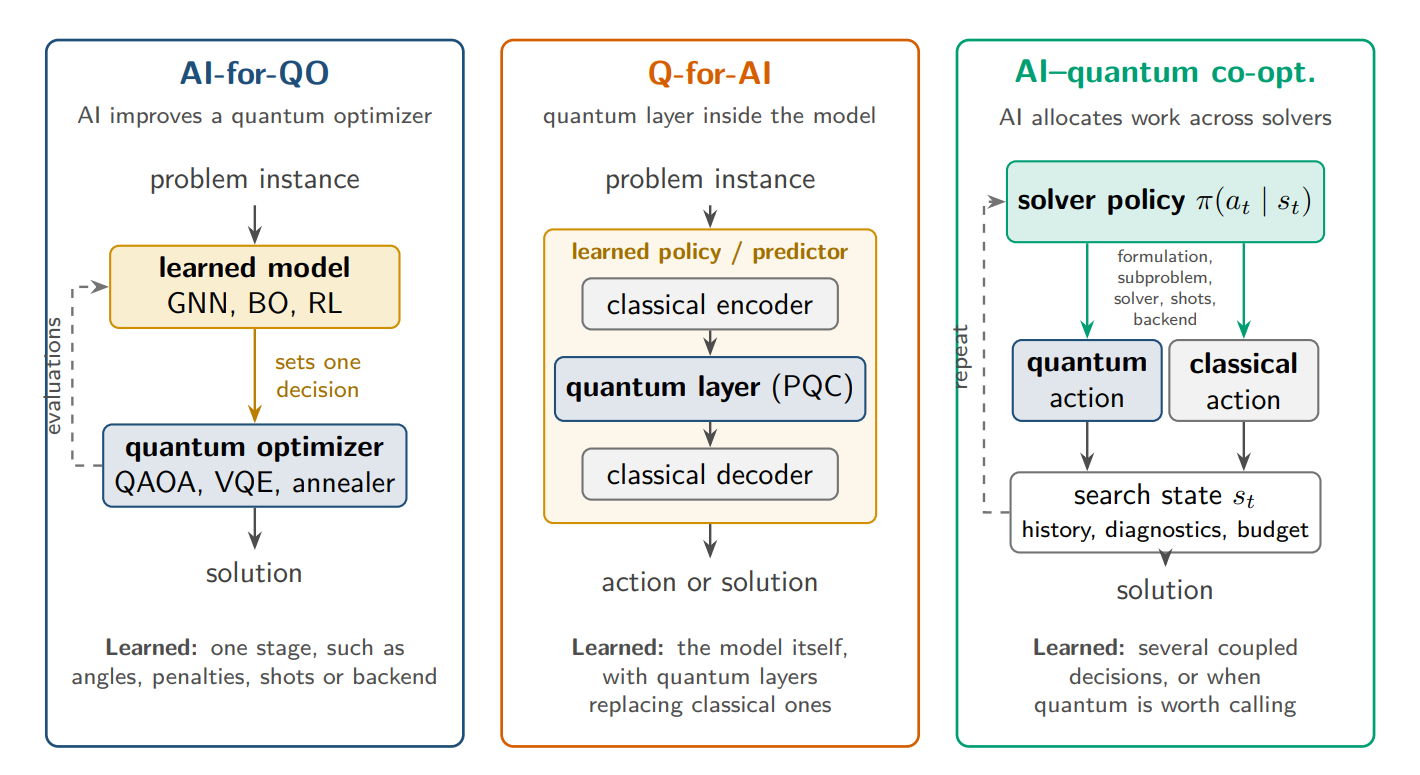
In a comprehensive review paper published on arXiv, Hoong Chuin Lau from the Singapore Management University has analyzed the intersection of artificial intelligence and quantum computing for combinatorial optimization, proposing a taxonomy and evidence hierarchy to evaluate adaptive hybrid workflows.
Titled “Beyond QAOA: A Review of AI and Quantum Computing for Adaptive Combinatorial Optimization“, the study evaluates 119 papers—coding 67 in detail—and concludes that while AI-assisted quantum optimization shows clear benefits in reducing hardware calls and managing constraints, quantum-assisted AI models remain largely unproven for practical advantage on current hardware.
| [ M0–M5 Evidence Hierarchy for Adaptive Quantum Optimization ] | ||
|---|---|---|
| Maturity Level | Evidence Requirements | Current Literature Status & Findings |
| • M0–M1 | • Conceptual mechanics & ideal statevector simulations | • Dominates Quantum for AI (Q-for-AI) studies (13 of 15 papers stay at M1–M2). |
| • M2–M3 | • Cross-size generalization & noisy/hardware component testing | • Most mature in AI for Quantum (AI-for-QO) (e.g., parameter transfer, noise mitigation). |
| • M4–M5 | • End-to-end hardware execution & matched-resource advantage | • Zero studies reach M5 in the screened corpus; median experiment size is 16 qubits. |
The review categorizes research into three distinct paradigms: AI-for-QO (AI tuning parameters, initialization, or execution settings of a quantum solver), Q-for-AI (embedding quantum layers inside machine learning models), and AI–Quantum Co-Optimization (learned policies that allocate work dynamically between classical and quantum routines). The analysis finds that 22 out of 52 core studies included no classical baseline, and only 10 out of 24 applicable studies isolated the quantum contribution via proper ablation tests.
The paper highlights that scaling quantum optimization is increasingly a systems engineering problem rather than a pure qubit-count challenge. Constraints, penalty weights, slack encodings, and transpiled two-qubit gate depths often dictate performance before circuit parameters are chosen. Consequently, the review emphasizes selective quantum use—developing learned controllers that predict whether the marginal benefit of invoking a quantum processor outweighs its computational, sampling, and queueing costs.
Review the full review paper on arXiv here.
In GQI Portal
The players behind the news
The team that writes QCR tracks every company, deal and technology in the GQI Factory, GQI's verified database of the quantum industry. Next up: every story linked to its players, coming to QCR's paid plans.
- Players Companies and institutions across the quantum industry, by segment.
- Scorecards How the players compare on hardware, software, funding and more.
Newsletter
QCR Alerts in your inbox
The latest reporting and analysis from Quantum Computing Report. Free, unsubscribe any time.