

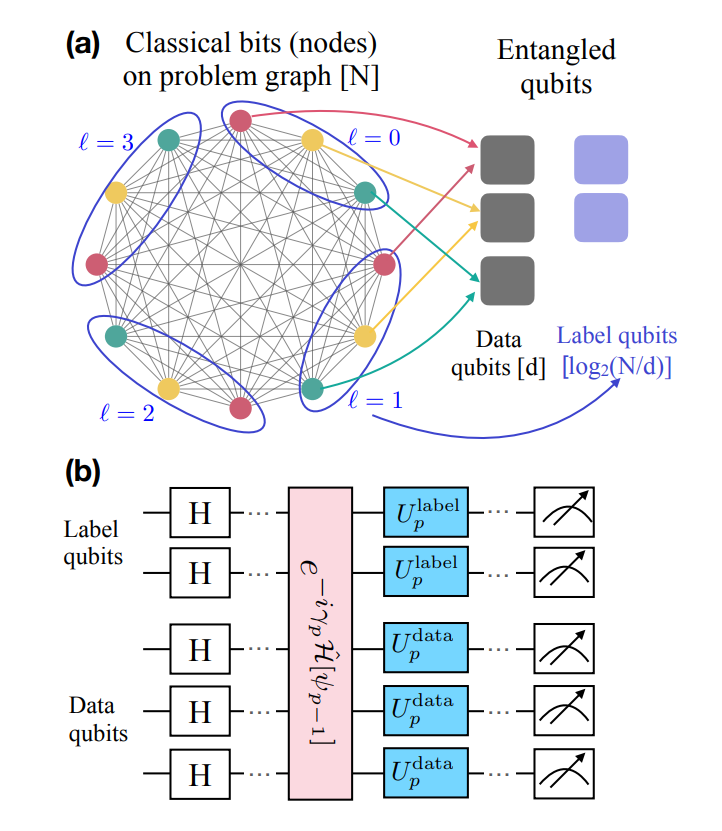
Researchers at Rigetti Computing (NASDAQ: RGTI) have developed and experimentally validated a qubit-efficient quantum optimization algorithm that reduces physical qubit requirements for solving large-scale combinatorial optimization problems. Detailed in a peer-reviewed publication in Physical Review Applied (DOI: 10.1103/s5jv-jh24), the technique maps N classical variables into an entangled quantum state of significantly fewer than N physical qubits, establishing a tunable tradeoff between qubit count and circuit depth.
Conventional quantum optimization algorithms, such as the standard Quantum Approximate Optimization Algorithm (QAOA), rely on a 1:1 mapping between problem variables and physical qubits. Rigetti’s variational approach partitions N classical variables into K groups of D bits, storing the problem configuration as a superposition across a reduced Hilbert space. The team benchmarked the algorithm on Sherrington-Kirkpatrick spin-glass models—a standard benchmark for hard classical optimization—and validated execution using a physical 9-qubit Rigetti superconducting quantum processor.
| [ Rigetti Qubit-Efficient Optimization Algorithm Benchmarks ] | ||
|---|---|---|
| Algorithmic Innovation | Experimental Validation | Operational Performance |
| • Sub-1:1 Variable-to-Qubit Encoding | • Executed on 9-Qubit Rigetti Superconducting QPU | • Parameter Concentration Across Problem Instances |
| • Entangled State Memory Storage | • Sherrington-Kirkpatrick Spin-Glass Models | • Solution Quality Approaching Standard 1:1 QAOA |
| • Tunable Depth vs. Width Tradeoff | • Supported by DARPA & DOE NERSC Resources | • Reduced Physical Qubit Overhead for FTQC Devices |
The experimental results demonstrated parameter concentration, allowing optimal circuit parameters to be reused across families of problem instances to reduce classical optimization runtime overhead. Developed with support from DARPA and the U.S. Department of Energy’s NERSC facility, the algorithm provides a structural framework to scale continuous optimization workloads on near-term hardware and early fault-tolerant systems constrained by physical qubit counts.
Review the technical summary on Rigetti Medium here, access the peer-reviewed research paper in Physical Review Applied here, and examine our previous analysis of Rigetti and Purdue University Demonstrate Quantum Preconditioning Framework for Constrained Optimization here.
In GQI Portal
The players behind the news
The team that writes QCR tracks every company, deal and technology in the GQI Factory, GQI's verified database of the quantum industry. Next up: every story linked to its players, coming to QCR's paid plans.
- Players Companies and institutions across the quantum industry, by segment.
- Scorecards How the players compare on hardware, software, funding and more.
Newsletter
QCR Alerts in your inbox
The latest reporting and analysis from Quantum Computing Report. Free, unsubscribe any time.