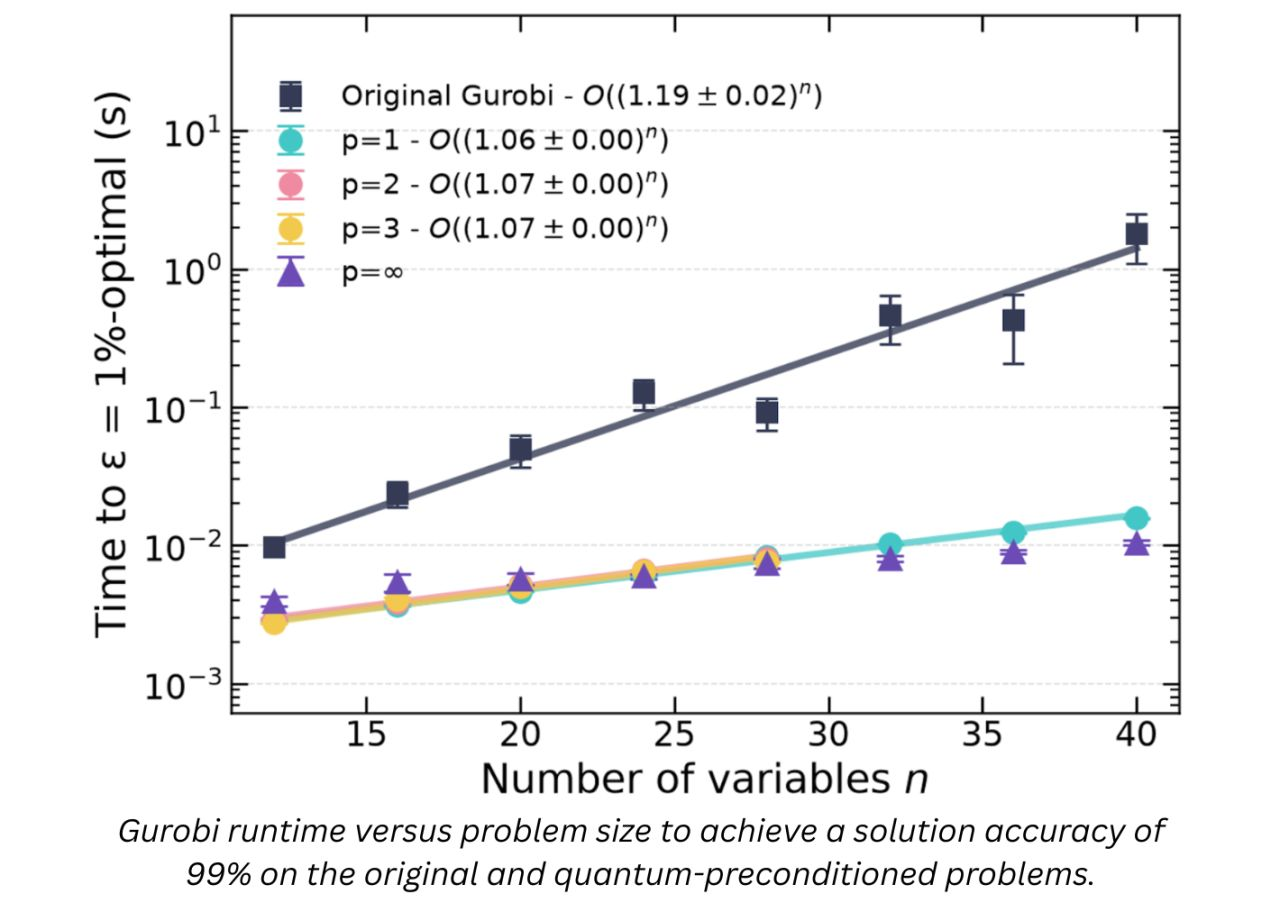
Quantum computing developer Rigetti Computing and researchers from Purdue University have published joint research extending Rigetti’s quantum preconditioning framework to hard-constrained combinatorial optimization problems. By using two-point variable correlations extracted from shallow Quantum Approximate Optimization Algorithm (QAOA) circuits to modify the objective function of commercial Mixed-Integer Programming (MIP) solvers, the team demonstrated that quantum preconditioning can guide classical branch-and-bound searches to near-optimal solution thresholds up to 100 times faster than unpreconditioned runs.
| [ Rigetti & Purdue Quantum Preconditioning Architecture ] | ||
|---|---|---|
| Quantum Feature Extraction | Classical MIP Solver Integration | Benchmark Performance & Scaling |
| • QAOA Two-Point Correlations (Zij) | • Retains Original Hard Balance Constraint | • Near-Optimal Threshold (ε = 0.01) Reached ~100× Faster |
| • Reshapes Objective Matrix (Wij → Zij) | • Solved via Commercial MIP Solvers (Gurobi) | • Major Acceleration Realized at Shallow Depth (p = 1) |
| • Soft Constraint Penalty (ρ) Tuning | • Incumbents Evaluated on Original Cost Function | • Lowers Fitted Exponential Base for Scaling |
Augmenting Branch-and-Bound via Quantum Correlation Matrices
Combinatorial optimization under hard constraints—such as graph partitioning for parallel scientific computing and logistics routing—remains NP-hard, forcing exact classical solvers like Gurobi to navigate massive search trees. The quantum preconditioning framework uses a gate-based QPU as a structure-learning pre-processor rather than a standalone solver:
- Correlation Matrix Generation: The algorithm runs a shallow QAOA circuit on the problem graph, enforcing balance constraints as a soft penalty parameter (ρ) within the cost Hamiltonian. Measuring the resulting quantum state yields a two-point correlation matrix (Zij) that captures pairwise decision-variable alignments.
- Hard-Constrained MIP Execution: The correlation matrix replaces the original edge-weight matrix (Wij) in the objective function. Gurobi then solves this preconditioned problem while enforcing the original balance constraint as an explicit, uncompromised hard constraint.
- Accelerated Incumbent Discovery: Callback trajectory data shows that the preconditioned objective allows the classical solver’s branch-and-bound algorithm to make better branching decisions and discover high-quality feasible solutions significantly earlier in the search process.
Benchmark Results and Parameter Transferability
Evaluated across 50 dense, all-to-all connected graph instances (n = 40), the framework enabled Gurobi to reach solutions within 1% of the baseline global optimum in under a second—compared to hours for unpreconditioned runs. Notably, the majority of the preconditioning advantage was captured at p = 1, minimizing circuit depth and exposure to quantum gate noise. To avoid high variational optimization costs as problem sizes scale, the team successfully transferred rescaled QAOA parameters (γℓ ∝ 1/√n) optimized at n = 20 to larger graph instances without performance degradation.
Review the full research paper on arXiv (arXiv:2608.28842) here.
September 2, 2026
