

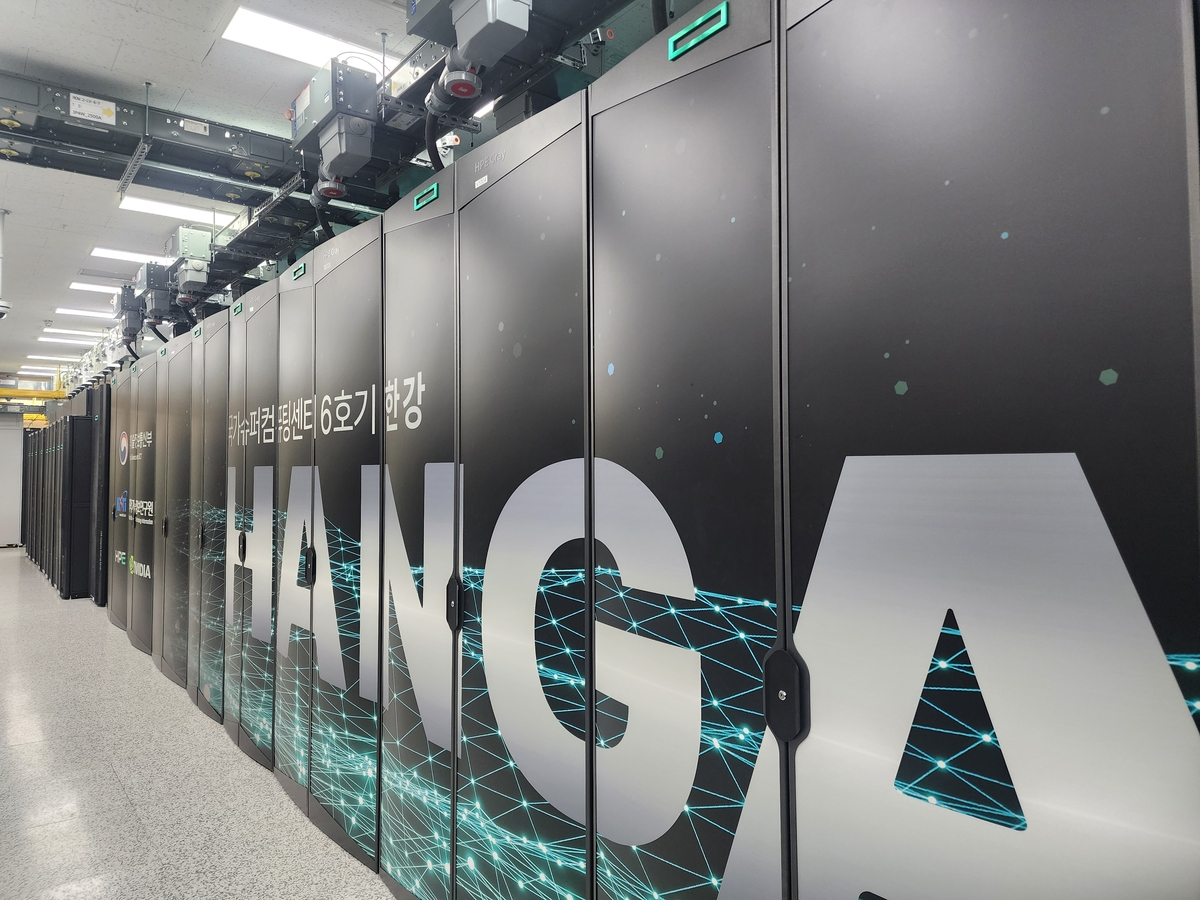
South Korea’s Ministry of Science and ICT (MSIT) and the Korea Institute of Science and Technology Information (KISTI) have officially inaugurated the country’s sixth national supercomputer, named Hangang (漢江). Installed at KISTI headquarters in Daejeon, the direct-liquid-cooled HPE Cray EX400 system achieves a theoretical peak performance of 614 petaflops—a 24-fold increase over its predecessor, Nurion. Crucially, Hangang is designed from inception to operate as the high-performance computing (HPC) backbone of South Korea’s first hybrid quantum-classical computing platform, scheduled to interface on-site with IonQ’s Tempo trapped-ion quantum processor by May 2027.
| South Korea Hangang Supercomputer & Quantum Integration Specifications | ||
|---|---|---|
| System Dimension | Technical Specification & Architecture | Operational Role & Strategic Target |
| Classical Compute Scale | 8,496 Nvidia GH200 Grace Hopper Superchips + 9,936 CPUs (HPE Cray EX400) | Delivers 614 PFLOPS peak compute; 205 PB storage; > 400 Gbps network fabric. |
| Memory Architecture | NVLink-C2C coherent unified memory (480 GB LPDDR5X + 96 GB HBM3 per node) | Eliminates PCIe bus bottlenecks; demonstrates 41.8× speedup over A100 GPUs in pilot trials. |
| Cooling & Infrastructure | 100% direct liquid cooling with PUE of 1.15 (down from 1.35 on Nurion) | Built under a ₩448.3 billion (~$336M USD) total procurement and 5-year maintenance contract. |
| Quantum Integration | IonQ Tempo trapped-ion processor (~100 physical qubits, #AQ 64) via Nvidia NVQLink | Enables low-latency hybrid execution via CUDA-Q; targeted go-live in May 2027. |
| Capacity Allocation | 55% general research, 30% national strategic R&D (K-Moonshot), 15% SMEs/startups | Official access opens December 14, 2026, across academic and industrial research tiers. |
Hangang’s core architecture leverages Nvidia’s GH200 superchips, combining an Arm-based Grace CPU and a Hopper GPU on a single coherent package via a 900 GB/s bidirectional interconnect. This architecture eliminates PCIe memory transfer bottlenecks by exposing a unified 576 GB address space to the operating system, allowing large-scale molecular simulations and materials calculations to reside entirely within chip memory. During early pilot benchmarks, research teams achieved up to a 41.8× performance speedup over prior-generation A100 GPU clusters on memory-bound workloads.
The system’s quantum interface realizes the trilateral agreement executed between KISTI, Nvidia, and IonQ in March 2026. Under the deployment roadmap, Hangang will connect to an on-site IonQ Tempo system using Nvidia’s NVQLink and the CUDA-Q programming environment. Tempo’s trapped barium-ion architecture provides all-to-all qubit connectivity, eliminating routing SWAP gate overheads when mapping non-local Hamiltonian terms. In practice, the hybrid environment will delegate classical data preparation, parameter updates, and post-processing to Hangang’s GH200 nodes while offloading structured quantum subroutines—such as molecular electronic structure ground states and combinatorial optimization phases—directly to Tempo.
Hangang anchors the South Korean government’s nationwide K-Moonshot initiative, a program supported by ₩10.1 trillion (~$7.5 billion USD) in 2026 AI R&D funding aimed at accelerating discoveries across 12 national challenges, including battery materials discovery, clean energy, and quantum computing. Following pilot trials serving approximately 190 projects, Hangang will open for full production access on December 14, 2026, dedicating 15% of its compute footprint to small and medium enterprises (SMEs) and commercial startups.
Full launch details are documented in coverage by TechTimes here, Maeil Business News Korea here, and the Seoul Economic Daily Announcement here.
In GQI Portal
The players behind the news
The team that writes QCR tracks every company, deal and technology in the GQI Factory, GQI's verified database of the quantum industry. Next up: every story linked to its players, coming to QCR's paid plans.
- Players Companies and institutions across the quantum industry, by segment.
- Scorecards How the players compare on hardware, software, funding and more.
Newsletter
QCR Alerts in your inbox
The latest reporting and analysis from Quantum Computing Report. Free, unsubscribe any time.