

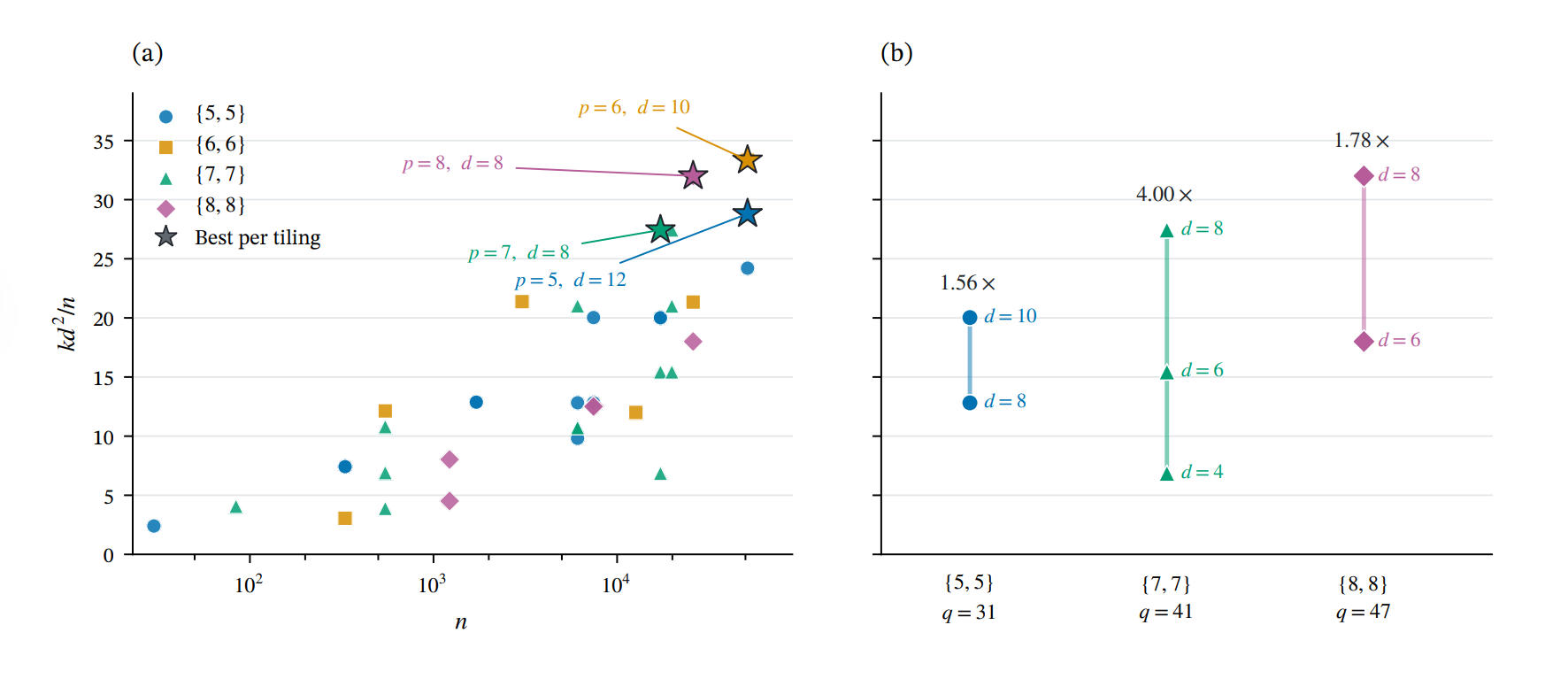
In a research paper published on arXiv, researchers Ahmed Adel Mahmoud and Dr. Steven Rayan from the Centre for Quantum Topology and Its Applications (quanTA) at the University of Saskatchewan have demonstrated explicit finite families of geometry-optimized hyperbolic surface codes that attain the optimal efficiency scaling limit set by Delfosse’s bound (η = kd2/n ∝ (log k)2).
By embedding quantum low-density parity-check (qLDPC) interactions onto compactified hyperbolic surfaces and optimizing periodic boundary conditions, the team doubled code distance and quadrupled efficiency without increasing qubit counts or check weights. Among the discovered families, the optimal {6, 6} code [[51330, 17112, 10]] encodes 17,112 logical qubits into 51,330 physical qubits with a record efficiency of η ≈ 33.34—a 33-fold gain over standard 2D toric codes.
To address physical hardware limits, the authors created a compiler that partitions these codes into planar modules of 80 or fewer qubits per chip. Circuit-level simulations under an SI1000-like noise model showed robust thresholds of approximately 0.22%, holding at 0.17% even when inter-module CNOT error rates were tripled.
| [ Key Quantum Error Correction Parameters ] | ||
|---|---|---|
| Parameter | Name | Definition & Operational Meaning |
| • n | • Physical Qubits | • The total count of raw hardware qubits built onto the processing chip. |
| • k | • Logical Qubits | • The number of error-protected qubits bundled together to run computations. |
| • d | • Code Distance | • The minimum physical errors needed to corrupt a logical qubit. Higher is better. |
| • η = kd2/n | • Code Efficiency | • The ratio measuring logical protection (k, d) achieved per physical qubit (n). |
What This Discovery Means in Plain English
Think of physical qubits as fragile glass ornaments and quantum noise as accidental bumps. Standard quantum error correction protects one ornament by wrapping it in a massive box of foam peanuts (physical qubits), making large systems resource-intensive. The Saskatchewan team designed a curved, multi-dimensional geometric “box” that wraps thousands of ornaments together using shared connections. They also developed a method to slice this curved pattern into tiny, flat 80-qubit microchips, letting future quantum computers run thousands of protected operations with a fraction of the hardware.
Review the full pre-print research paper on arXiv here and read author insights in Ahmed Adel Mahmoud’s post here.
In GQI Portal
The players behind the news
The team that writes QCR tracks every company, deal and technology in the GQI Factory, GQI's verified database of the quantum industry. Next up: every story linked to its players, coming to QCR's paid plans.
- Players Companies and institutions across the quantum industry, by segment.
- Scorecards How the players compare on hardware, software, funding and more.
Newsletter
QCR Alerts in your inbox
The latest reporting and analysis from Quantum Computing Report. Free, unsubscribe any time.