

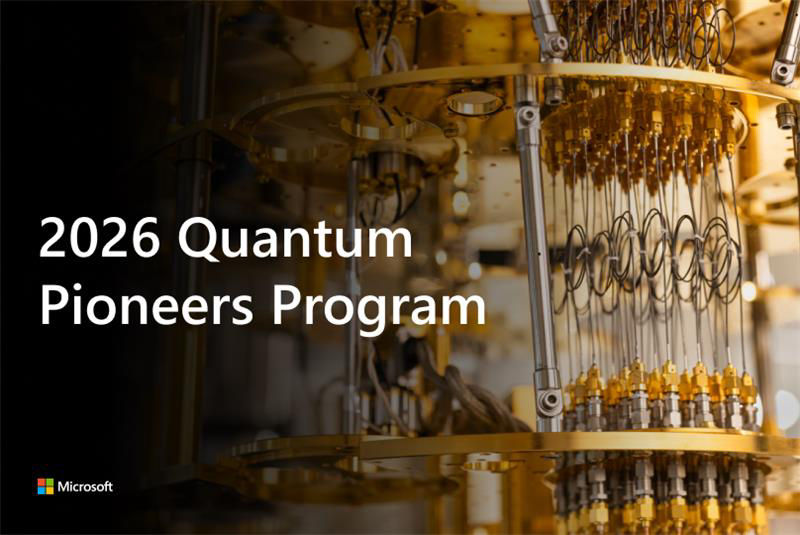
Microsoft has launched the 2026 Quantum Pioneers Program (QuaPP), a competitive research initiative designed to advance the development of measurement-based quantum computing (MBQC). Coordinated by Dr. Chetan Nayak, Technical Fellow and VP of Quantum Hardware, the program seeks to bridge the gap between theoretical topological physics and practical fault-tolerant hardware. Microsoft’s specific interest lies in leveraging adaptive measurements on entangled resource states to simplify control systems and enhance the robustness of topological qubits, which encode information in global properties of matter to provide inherent error resilience.
The program will select up to five research proposals, each eligible for an award of up to $200,000 USD delivered as a gift. The program is structured for a 12-month duration, with funding set to begin in August 2026. This initiative is part of Microsoft’s broader strategy to cultivate a “discovery-to-deployment” ecosystem by funding academic research that aligns with their internal roadmap for scalable, fault-tolerant architectures.
Technical focus areas for the 2026 cycle include novel simulation approaches for topological qubit dynamics, innovative readout and control components, and quantum error correction (QEC) tailored specifically for measurement-based paradigms. Additionally, Microsoft is seeking proposals for early fault-tolerant and NISQ experiments, as well as measurement-based methods for quantum characterization, verification, and validation (MB-QCVV). Proposals that envision active collaboration with the Microsoft Quantum team are explicitly welcomed.
The program is open to professors at global universities or degree-granting research institutions. Applications are being accepted through January 31, 2026, with selection decisions scheduled for announcement by March 15, 2026. Submissions require a five-page project description detailing the specific technical challenge addressed, the desired impact on the field, and the required facilities or materials needed to complete the research.
Read the official announcement and full submission guidelines on the Microsoft Quantum blog here.
In GQI Portal
The players behind the news
The team that writes QCR tracks every company, deal and technology in the GQI Factory, GQI's verified database of the quantum industry. Next up: every story linked to its players, coming to QCR's paid plans.
- Players Companies and institutions across the quantum industry, by segment.
- Scorecards How the players compare on hardware, software, funding and more.
Newsletter
QCR Alerts in your inbox
The latest reporting and analysis from Quantum Computing Report. Free, unsubscribe any time.