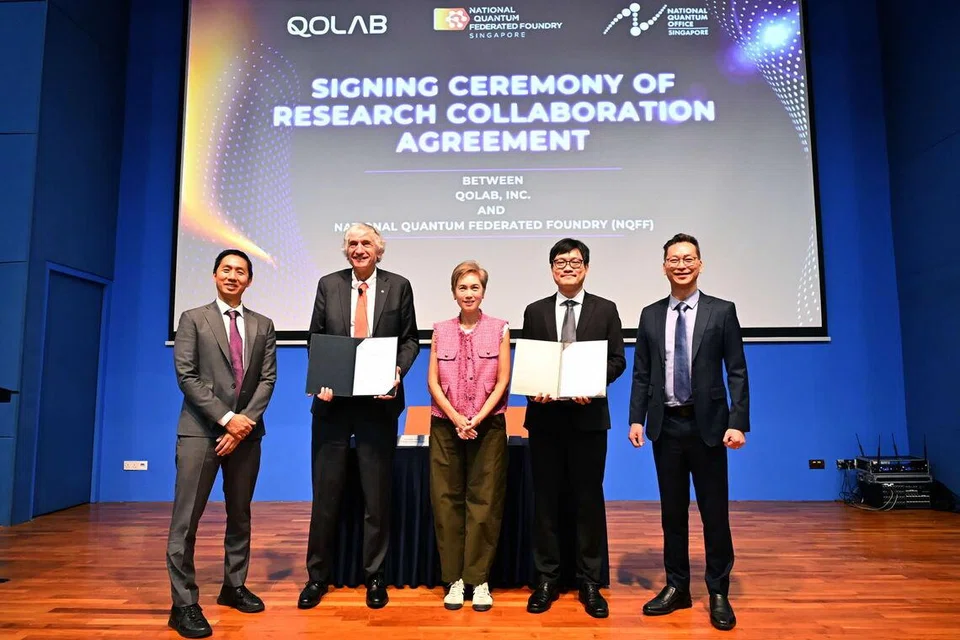
The National Quantum Federated Foundry (NQFF) and Qolab have entered into a research collaboration to develop integrated cryogenic low-pass filters for quantum processors. The project aims to resolve hardware bottlenecks in scaling superconducting and spin-qubit systems by transitioning from discrete, bulky filter components to semiconductor-wafer-scale manufacturing. These filters are essential for shielding qubits from high-frequency microwave noise, which otherwise induces decoherence at millikelvin temperatures.
The technical focus involves leveraging NQFF’s nanofabrication capabilities and Qolab’s systems expertise to produce filters directly on silicon wafers. This methodology allows for denser integration with qubit circuits and reduces the physical footprint within dilution refrigerators, facilitating the transition from dozens to millions of qubits. The resulting hardware is intended for deployment in quantum systems at the University of California, Los Angeles (UCLA).
The National Quantum Office (NQO), hosted by the Agency for Science, Technology and Research (A*STAR), facilitates the partnership as part of Singapore’s National Quantum Strategy. NQFF utilizes a federated network including the A*STAR Institute of Materials Research and Engineering (IMRE), the A*STAR Institute of Microelectronics (IME), and the National University of Singapore (NUS). Qolab, co-founded by 2025 Physics Nobel Laureate Professor John Martinis, focuses on the development of utility-scale, fault-tolerant superconducting quantum computers.
For further technical details on the collaboration, consult the official media release here.
February 23, 2026
