

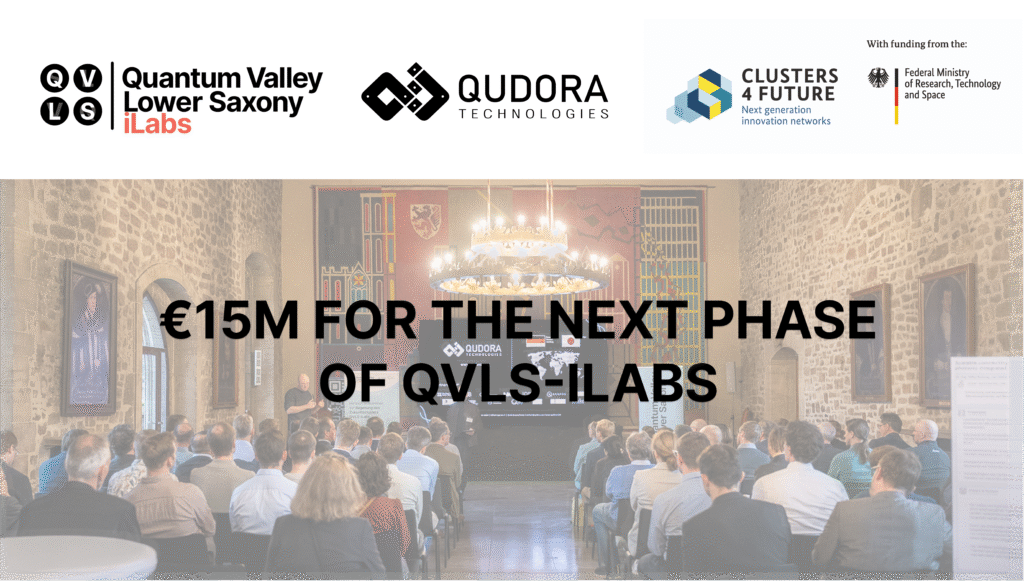
The German Federal Ministry for Research, Technology and Space Travel (BMFTR) has approved €15 million ($17.3 million USD) in second-phase funding for the QVLS-iLabs “Future Cluster.” When combined with €8 million ($9.2 million USD) contributed from the cluster’s own resources, the total investment reaches €23 million ($26.5 million USD) over the next three years. This funding supports the Hannover–Braunschweig region’s efforts to transition trapped-ion quantum computing and quantum metrology from academic research into market-ready industrial applications. QVLS-iLabs remains a cornerstone of the German government’s Clusters4Future initiative, focusing exclusively on establishing technological sovereignty in quantum hardware.
The cluster’s technical roadmap centers on building robust quantum components designed for seamless integration with existing High-Performance Computing (HPC) environments. A primary highlight of the first phase was the development of QUDORA Technologies’ trapped-ion system, which utilizes proprietary Near-Field Quantum Control (NFQC) to achieve high coherence times. According to cluster leadership, the QUDORA model is designed to compute more efficiently than competing superconducting systems from industry giants like Google and IBM. Beyond computation, the second phase will emphasize quantum sensors optimized for battery manufacturing, providing high-precision analysis to improve the sustainability and performance of electromobility.
Operational success is anchored in the 350-square-meter deep-tech laboratory located in Braunschweig’s Rolleiwerke. This facility serves as a physical incubator for startups and a site for industrial-grade system building. The transition to the second phase has been strengthened by the addition of three new industrial partners: WIKA Alexander Wiegand SE & Co. KG, Laseroptik GmbH, and Optomech GmbH. These companies join a network of 25 partners that have already produced six new patents and invention disclosures, including improved atom sources and stable optical solutions for quantum chips.
Led by Prof. Dr. Christian Ospelkaus (PTB and Leibniz Universität Hannover), the cluster is now professionally managed by the newly formed QVLS Innovation GmbH. This entity oversees technology transfer and facility management, coordinating collaboration between the Physikalisch-Technische Bundesanstalt (PTB), TU Braunschweig, Leibniz Universität Hannover, and the German Aerospace Center (DLR). By focusing on “on-premise” quantum-classical hybrid solutions, QVLS-iLabs aims to provide German medium-sized businesses and startups with a secure, local alternative to cloud-based quantum services, ensuring that the economic value of quantum innovation remains within the region.
For more information on the QVLS-iLabs roadmap and partner network, consult the official QUDORA announcement here and the cluster overview here.
In GQI Portal
The players behind the news
The team that writes QCR tracks every company, deal and technology in the GQI Factory, GQI's verified database of the quantum industry. Next up: every story linked to its players, coming to QCR's paid plans.
- Players Companies and institutions across the quantum industry, by segment.
- Scorecards How the players compare on hardware, software, funding and more.
Newsletter
QCR Alerts in your inbox
The latest reporting and analysis from Quantum Computing Report. Free, unsubscribe any time.