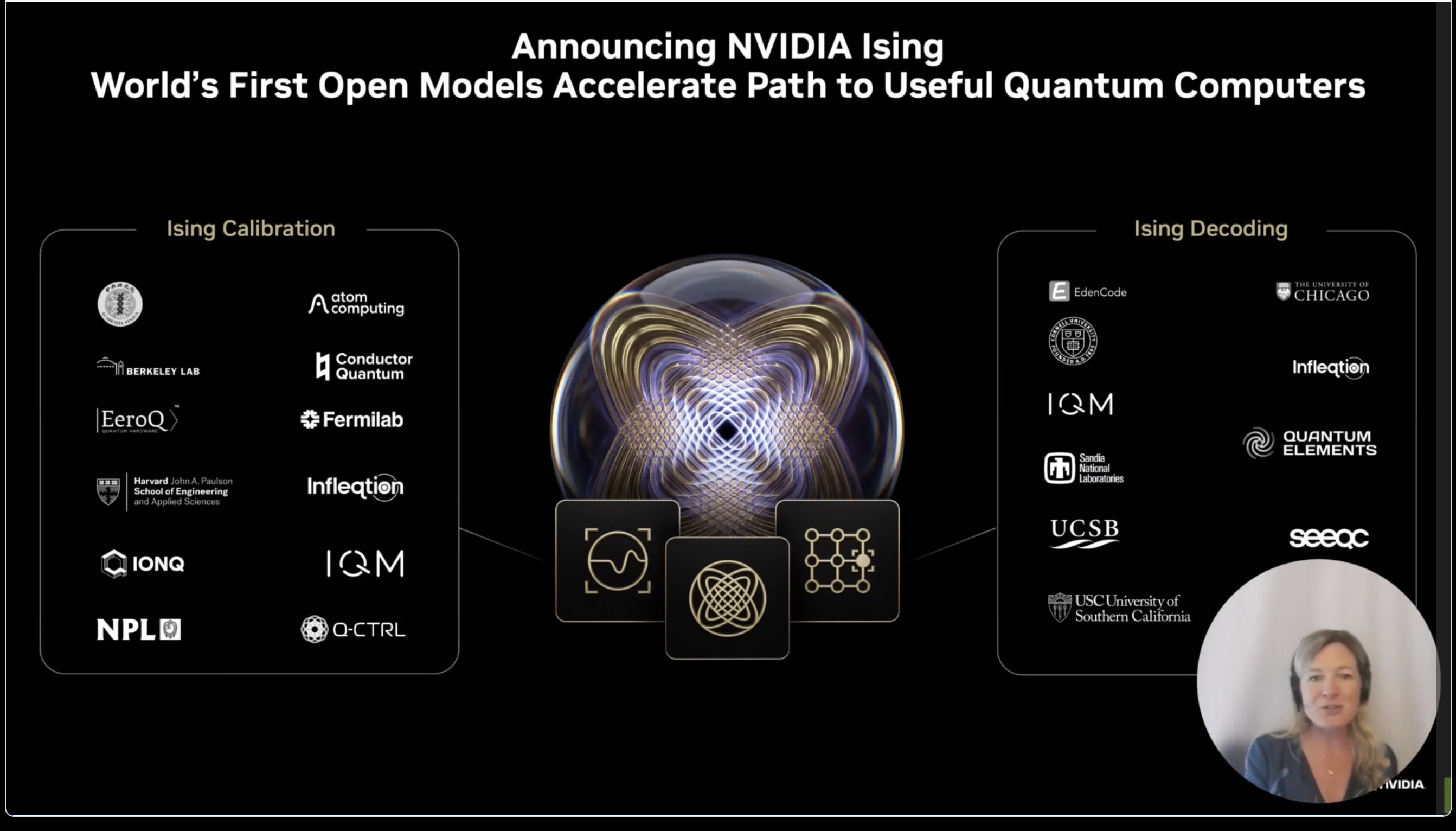
NVIDIA has announced the release of NVIDIA Ising, the world’s first family of open-source AI models designed to address the primary engineering bottlenecks of quantum processor calibration and error correction. Named after the foundational Ising mathematical model, these tools act as a high-performance AI control plane, intended to transform noisy qubits into reliable, large-scale quantum-GPU supercomputers. The open-source nature of the release allows researchers to run these models locally, ensuring data privacy while optimizing hardware infrastructure.
The Ising family consists of two primary models:
- Ising Calibration: A vision language model (VLM) that interprets measurements from quantum processors to automate continuous calibration. This reduces hardware tuning time from days to hours, significantly increasing operational efficiency.
- Ising Decoding: A 3D convolutional neural network (CNN) that performs real-time error-correction decoding. It achieves performance up to 2.5x faster and 3x more accurate than existing open-source standards like pyMatching.
The adoption of these models spans a diverse ecosystem of quantum enterprises and research institutions. Ising Calibration is currently utilized by organizations such as Atom Computing, IonQ, Infleqtion, and Lawrence Berkeley National Laboratory’s Advanced Quantum Testbed. Meanwhile, Ising Decoding has been deployed by the University of Chicago, Sandia National Laboratories, SEEQC, and IQM Quantum Computers. This broad integration highlights an industry-wide shift toward AI-driven control systems to manage the complexities of scaling quantum processors.
NVIDIA is supporting the deployment of these models with a “cookbook” of quantum workflows, training data, and NVIDIA NIM microservices, allowing for architecture-specific fine-tuning with minimal setup. The models are designed to integrate with the NVIDIA CUDA-Q software platform and the NVIDIA NVQLink interconnect, providing a unified stack for real-time quantum-classical control. This release positions AI as the “operating system” for quantum machines, an evolution necessary for a market projected to reach $11 billion by 2030.
Partner Implementations & Technical Deep-Dives
As part of our comprehensive coverage of the NVIDIA Ising launch, we have detailed specific implementations across the quantum stack:
- Hardware & Middleware: IQM has implemented agentic calibration to support enterprise data centers, while Infleqtion is utilizing the models for leakage-aware error correction in neutral-atom systems.
- Autonomy & Software: Q-CTRL has integrated Ising into its Boulder Opal software for physics-informed autonomy, and EdenCode has demonstrated its utility on general Tanner graphs.
- Academic Research: Northwestern and Fermilab are using underground NEXUS data to build AI benchmarks, and UC San Diego is evaluating pre-decoding for both surface and bivariate bicycle codes.
For the full technical announcement, consult the NVIDIA newsroom here and the developer portal here.
April 14, 2026
