

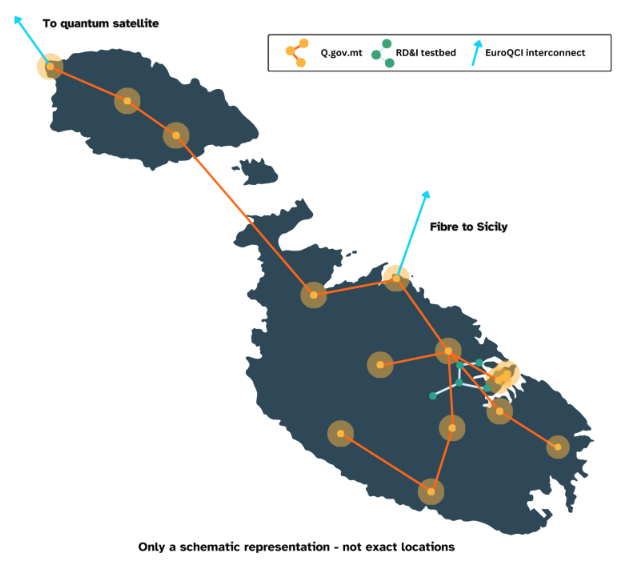
Luxquanta Technologies S.L. and Merqury Cybersecurity have published a joint operational white paper evaluating the production architecture of Physical Security for Public Infrastructure in Malta (PRISM), the country’s national quantum communications initiative. Formulated under the broader European Quantum Communication Infrastructure (EuroQCI) mandate, the deployment links five distinct socio-economic verticals—encompassing national government registries, law enforcement networks, state healthcare facilities, national research and education infrastructure, and commercial data hubs—under a unified quantum-secure framework. The publication provides real-world telemetry data demonstrating how Continuous-Variable Quantum Key Distribution (CV-QKD) hardware and enterprise Key Management System (KMS) software layers integrate to protect data in motion on active, multi-tenant commercial telecom networks.
Technical Architecture & Specifications / Operational Implementation
The core infrastructure layer utilizes Luxquanta’s Nova lq platform, a commercial CV-QKD system that implements a Gaussian-modulated coherent-state protocol backed by finite-size effect security proofs. Unlike conventional Discrete-Variable QKD systems that rely on specialized, temperature-sensitive superconducting single-photon detectors, Luxquanta’s architecture employs coherent homodyne detection techniques. This makes the quantum signal highly resistant to phase noise and light leakage originating from adjacent classical transmission channels. As a result, the Nova lq endpoints achieve stable co-propagation, allowing quantum keys and classical data streams to coexist on Melita Ltd.’s standard, lit Dense Wavelength Division Multiplexing (DWDM) fiber infrastructure without requiring dedicated dark fiber.
The hardware layer interfaces directly with Merqury Cybersecurity’s automated KMS orchestration engine via standards-compliant REST API pipelines matching ETSI GS QKD 014 and SKIP specifications. This abstraction layer enables the network to function across two distinct structural topologies:
- Point-to-Point (P2P): Securing dedicated high-throughput pipelines, such as the backhaul connection between twin Melita Business data center nodes.
- Point-to-Multipoint (P2MP): Utilizing a time-multiplexed optical switch controlled by the KMS to distribute entropy from a single central transmitter node to up to five dynamic receiver units. This significantly reduces expansion costs by requiring only one additional receiver per newly deployed campus node.
To ensure continuous service delivery, the system includes physical-layer tracking handled via Optical Time-Domain Reflectometry (OTDR) and continuous loss measurement metrics. Real-time telemetry—including Secret Key Rate (SKR), excess noise parameters, transmittance fluctuations, and link-state changes—is routed natively into enterprise network monitoring suites via SNMPv2c/v3. If a physical fiber disruption is detected, the Nova lq software triggers an automated self-healing cycle, executing automated laser realignment and noise floor re-calibration to re-establish the cryptographic link without manual intervention.
Strategic Positioning & Ecosystem Integration
The PRISM consortium brings together a specialized group of domestic and international stakeholders to advance regional digital sovereignty. Project operations are managed through local integrations with RSM Malta, data analytics firm UMNAI, the University of Malta, the Malta Information Technology Agency (MITA), and the national Critical Infrastructure Protection Department. By standardizing key delivery at the KMS software layer, the architecture delivers keys seamlessly across layers 1, 2, and 3 of the OSI stack. This allows existing IPsec, MACsec, and bulk optical encryptors to ingest quantum-safe keys without requiring a complete overhaul of pre-existing routing hardware. This implementation establishes a scalable framework for critical infrastructure operators looking to mitigate “harvest now, decrypt later” threats, transforming raw physics-based entropy into an auditable, governed network service.
A web page describing the Nova lq Quantum Key Distribution (QKD) system is available here. For the complete strategic deployment breakdown and multi-sector topology roadmaps, download the official Luxquanta and Merqury collaborative white paper here.
In GQI Portal
The players behind the news
The team that writes QCR tracks every company, deal and technology in the GQI Factory, GQI's verified database of the quantum industry. Next up: every story linked to its players, coming to QCR's paid plans.
- Players Companies and institutions across the quantum industry, by segment.
- Scorecards How the players compare on hardware, software, funding and more.
Newsletter
QCR Alerts in your inbox
The latest reporting and analysis from Quantum Computing Report. Free, unsubscribe any time.