

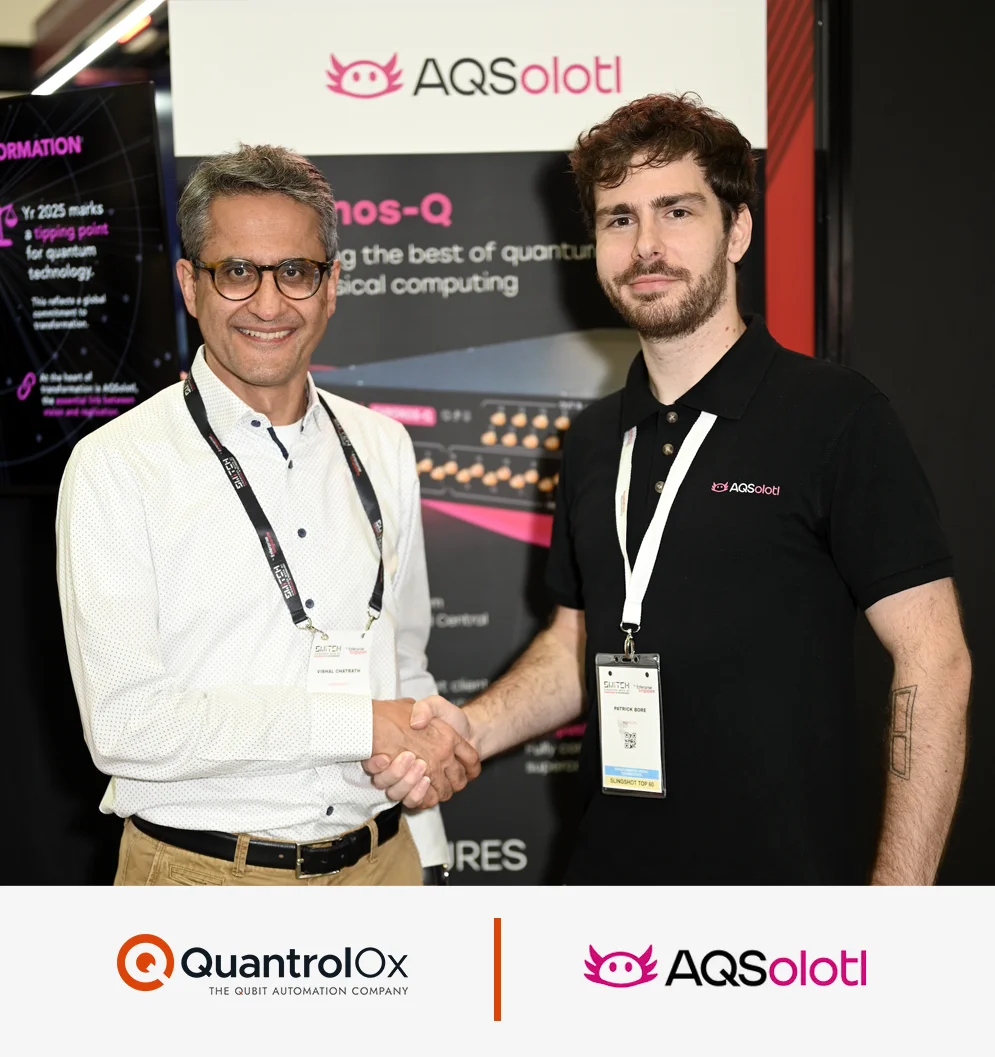
Quantum infrastructure startup AQSolotl and automation developer QuantrolOx have announced a strategic partnership to integrate their hardware and machine learning software layers. The collaboration focuses on linking AQSolotl’s Chronos-Q quantum control system directly with QuantrolOx’s Quantum EDGE automation software platform. By unifying the control and calibration stacks, the companies aim to transition noisy quantum processors from slow, manual laboratory tuning loops toward automated, machine learning-driven execution frameworks designed for scalable, production-ready infrastructure.
Machine Learning-Driven Low-Latency Control Topologies
As quantum processing units (QPUs) scale beyond isolated laboratory prototypes, tracking multi-qubit error intersections and performance drifts through manual tuning becomes physically impractical. The joint architecture places automated calibration scripts directly into the physical control layer. AQSolotl’s Chronos-Q controller—originally spun off from academic research teams at Nanyang Technological University (NTU) and the National University of Singapore (NUS) working inside the Centre for Quantum Technologies (CQT)—serves as a low-latency translation bridge between classical computing terminals and fragile quantum states.
The control assembly features up to 16 specialized physical channels for high-frequency qubit manipulation alongside 32 distinct lines for localized flux bias adjustments. Operating with real-time feedback loops and modular, upgradable firmware, the integration optimizes state classification latency and supports active qubit reset functions. By routing these high-density hardware parameters through QuantrolOx’s Quantum EDGE measurement platform, the system automates repetitive characterization tasks, suppressing system downtime while stabilizing qubit operations against ambient phase fluctuations.
System Benchmarking and Multi-Phase Commercialization Timeline
Under the terms of the strategic agreement negotiated by AQSolotl CEO Patrick Bore and QuantrolOx CEO Vishal Chatrath, the system integration roadmap will execute across two discrete phases:
- Immediate Technical Integration Phase: Deploys Chronos-Q hardware straight onto the QuantrolOx Quantum Testbed to build a unified user interface. Initial benchmarks will quantify physical gate fidelity improvements, calibration cycle speeds, and operational resource metrics compared to traditional manual synthesis methods.
- Longer-Term Bilateral Co-Design Phase: Establishes a hardware-software co-design pipeline to optimize terminal interfaces for enterprise clients, particularly targeting repetitive, high-stability workloads like quantum artificial intelligence training loops.
The unified commercial bundles are structured to expand the market footprint for both companies by serving researchers, defense contractors, and computing foundries working with multi-qubit superconducting hardware setups.
The technical hardware specifications, control loop latency profiles, and corporate integration milestones can be reviewed in the official QuantrolOx Press Room Report here.
In GQI Portal
The players behind the news
The team that writes QCR tracks every company, deal and technology in the GQI Factory, GQI's verified database of the quantum industry. Next up: every story linked to its players, coming to QCR's paid plans.
- Players Companies and institutions across the quantum industry, by segment.
- Scorecards How the players compare on hardware, software, funding and more.
Newsletter
QCR Alerts in your inbox
The latest reporting and analysis from Quantum Computing Report. Free, unsubscribe any time.