Sovereign neutral-atom hardware developer Taiyi Quantum Technology Co., Ltd. (Shanghai)—alternatively known as Taiyi Liangsheng—has closed a heavily oversubscribed 300 million yuan ($44 million USD) strategic financing round. The capital injection adds to a previous 100 million yuan angel round closed in March 2026, bringing the startup’s total capital raised since its founding in January 2026 to over 400 million yuan ($59 million USD).
The late-stage transaction was co-led by institutional venture firms Gaorong Ventures and IDG Capital, alongside prominent domestic strategic backers including SAIC Financial, Hengxu Capital (the venture arm of SAIC Motor), and CETC Fund (defense electronics). The multi-tiered capitalization round incorporates a comprehensive roster of market-oriented financial institutions, state-backed entities, and industrial players, including:
- Shanghai Future Industry Fund (Shanghai Science & Technology Investment Group)
- iFlytek Venture Capital (the corporate venture capital arm of iFlytek)
- Huakong Fund (Huakong Capital / T-Capital)
- Yunqi Capital (Yunqi Partners)
- Dachen Caizhi (Fortune Capital)
- Boyuan Capital (the market-oriented CVC platform under the Bosch Group)
- Yarui Capital
- Qifu Capital
- Jinko Solar Holdings
- Galaxy General Robot (Galbot)
- Yaben Chemical
- Houxue Investment (Houxue Capital)
- Tsinghua Holdings Capital
- Kexun Ruijin Capital
                           ┌──► Crypto-Defense Verification Protocols
                           ├──► Molecular Dynamics & Chemical Simulations
[ Ytterbium Application ] ─┼──► Non-Linear Quantum Machine Learning (QML)
                           └──► Real-Time Erasure Fault Detection (Physical State Leaks)
Ytterbium Alkaline-Earth Topologies and Erasure Error Management
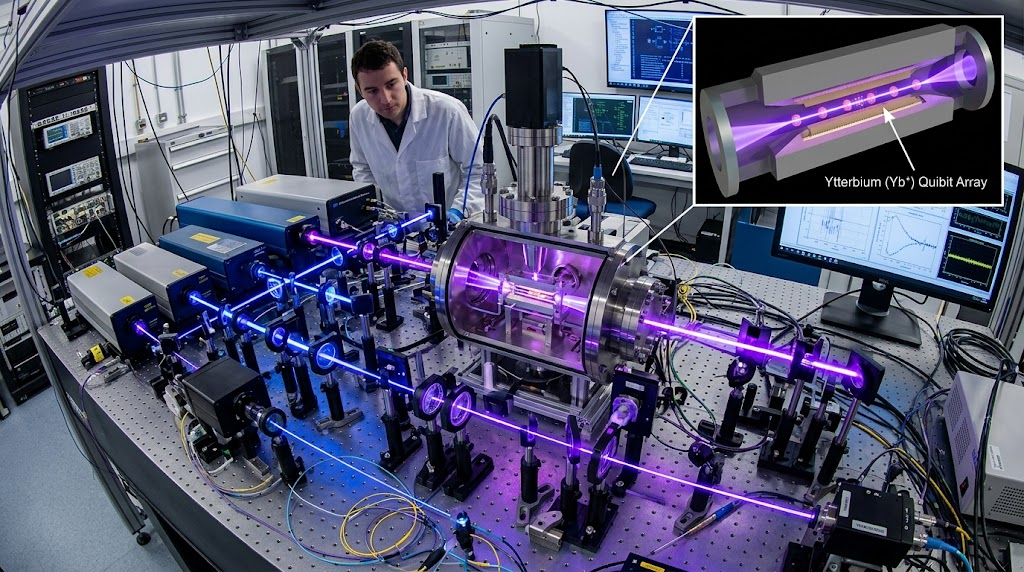
Taiyi Quantum is engineering a general-purpose quantum computing platform centered on neutral-atom configurations, specifically isolating the rare-earth alkaline-earth element ytterbium (171Yb) as its physical qubit vector. While the broader neutral-atom ecosystem has predominantly scaled using alkali metals like rubidium, ytterbium’s complex internal electronic shell configuration offers a significant advantage for scalable quantum error correction (QEC): erasure channel conversion.
When an atomic state transition failure occurs during laser-driven entangling gate operations, the affected ytterbium atom physically escapes the optical trap assembly entirely. This physical leakage makes operational errors immediately visible as a vacant site in the trapping matrix. By converting hidden phase or bit flips into explicit, detectable erasure errors, Taiyi bypasses the “silent errors” that plague superconducting transmon loops.
The architecture operates via low-power optical trapping mechanics, where roughly one watt of continuous laser output coordinates approximately 1,000 active atoms inside a high-vacuum chamber. This decoupling of qubit density from cryogenic wiring constraints allows the firm to prioritize three baseline R&D targets:
- High-Speed Gate Synthesis: Compressing neutral-atom gate execution latencies to minimize phase decoherence from background thermal radiation.
- Complex Multi-Qubit Intersections: Designing multi-body Rydberg blockade protocols to support arbitrary non-local gate connectivity.
- High-Efficiency QEC Software: Architecting custom topological codes tailored to execute over real-time atomic erasure coordinates.
                                  [ Global Corporate Ytterbium Targets ]
Google Quantum AI Roadmap  ──■■■■ Neutral-Atom Architectural Variant Added March 2026
Microsoft Infrastructure  ──■■■■ 50-Logical-Qubit Machine Target (Scheduled for 2027)
Taiyi Quantum Technology   ──■■■■ Year-End 2026 Demonstration Threshold (Active Physical Tracing)
Operating out of a newly commissioned 1,000-square-meter cleanroom facility in the Xuhui District of Shanghai, Taiyi has compiled a 50-person core engineering team consisting of researchers recruited from MIT, JILA, NIST, and the Centre for Quantum Technologies (CQT) in Singapore. The company’s short-term technical roadmap mandates the physical demonstration of initial logical qubits using its ytterbium platform by the end of 2026. Long-term scaling benchmarks target the stabilization of 50,000 physical neutral atoms on a centralized platform, with an optimization framework designed to map those states into 300 highly stable logical qubits to demonstrate absolute quantum advantage across cryptographic, chemical simulation, and quantum machine learning (QML) applications.
                                  [ Funding Round Allocation Demands ]
Original Funding Target    ──■■■ $29 Million (¥2 Billion Initial Market Demand Driven in Eight Days)
Final Capitalization Cap   ──■■■■■■ $44 Million Locked Asset Round (10:1 Capital Oversubscription)
Supply Chain Nationalization and Geopolitical Friction
The closing of the funding round highlighted significant capital tension within the regional deep-tech ecosystem. The company originally entered the market seeking a modest 200 million yuan ($29 million USD) target, but generated over 2 billion yuan ($293 million USD) in investor demand within eight days, resulting in a 10:1 oversubscription before closing at 300 million yuan.
This capital concentration underscores institutional bets on Taiyi’s ability to localize the production of precision ytterbium quantum hardware within mainland China. The strategic inclusion of defense and automotive capital via CETC and SAIC highlights an overt push to build a fully domestic hardware supply chain independent of Western sourcing.
The primary hurdle for Taiyi will be replicating ultra-precise laser controllers, high-vacuum chambers, and cryogenic systems within Shanghai, especially as international export controls increasingly target quantum computing hardware components in a manner mirrored after the enterprise AI semiconductor restrictions.
Comprehensive market positioning data and executive transitions can be tracked via the breaking Jiemian News Taiyi Pre-A Round Report here. Local business registration records can be analyzed via the translated Baidu Encyclopedia Taiyi Corporate Profile here.
June 26, 2026
