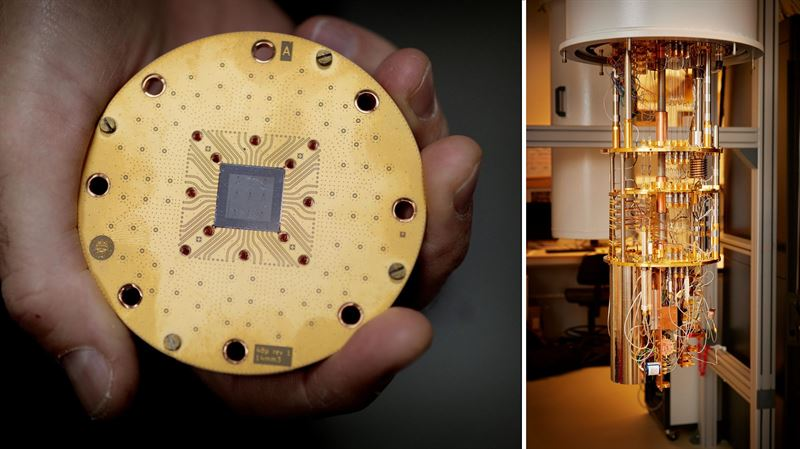
Physicists at Chalmers University of Technology have developed a theoretical and computational method that executes complex continuous-variable (CV) quantum operations on bosonic codes up to 1,000 times faster than existing adiabatic techniques. Published in Physical Review Letters (DOI: 10.1103/tnb8-3m8m), the breakthrough addresses a major bottleneck in quantum error correction (QEC) by completing state synthesis and logical gate operations within a single Floquet driving period rather than thousands of repeated cycles.
Instead of encoding information in individual physical transmons, bosonic quantum codes store qubits within the continuous-variable microwave fields of superconducting resonators, offering built-in protection against decoherence. However, controlling continuous-variable states traditionally requires slow adiabatic ramps that expose fragile quantum states to environmental noise. By employing Quantum Lattice Gates (QLGs)—which utilize the non-perturbative non-linearity of Josephson junctions alongside Noncommutative Fourier Transformations (NcFT)—the Chalmers team synthesized arbitrary unitaries directly from the vacuum state in a single period, effectively eliminating the need for multi-period adiabatic driving.
| [ Single-Period Floquet Control Performance Metrics ] | ||
|---|---|---|
| Target Bosonic Code | Preparation & Gate Fidelities | Operational Advantages |
| • Gottesman-Kitaev-Preskill (GKP) | • State Infidelity: < 10-3 (from vacuum) | • Execution Time: 1 Floquet Period (∼1000× faster) |
| • Binomial & 4-Component Cat Codes | • Logical Gate Errors ({h, s, t}): ∼ 10-3 | • Hardware: Compatible with Existing Superconducting Circuits |
| • Haar-Random State Sampling | • Linear Hilbert Space Scaling O(D) | • Noise Robustness: 3 Orders of Magnitude Higher than AR |
When combined with Optimal Pulse Engineering (OPE), the single-period Floquet method demonstrated high-fidelity state preparation for Binomial, Cat, and GKP codewords from the vacuum state with infidelities below 10-3. Furthermore, universal single-qubit logical gate sets—including Hadamard (h), Phase (s), and π/8 (t) gates—achieved average gate errors on the order of 10-3 within microsecond execution windows. The technique scales linearly with Hilbert-space dimension D, providing a hardware-compatible blueprint for the 100-qubit superconducting quantum processor currently under construction at the Wallenberg Centre for Quantum Technology (WACQT).
Review the university announcement on EurekAlert! here, access the peer-reviewed research paper in Physical Review Letters here, and examine hardware research initiatives at the Wallenberg Centre for Quantum Technology (WACQT) here.
September 10, 2026

Leave A Comment