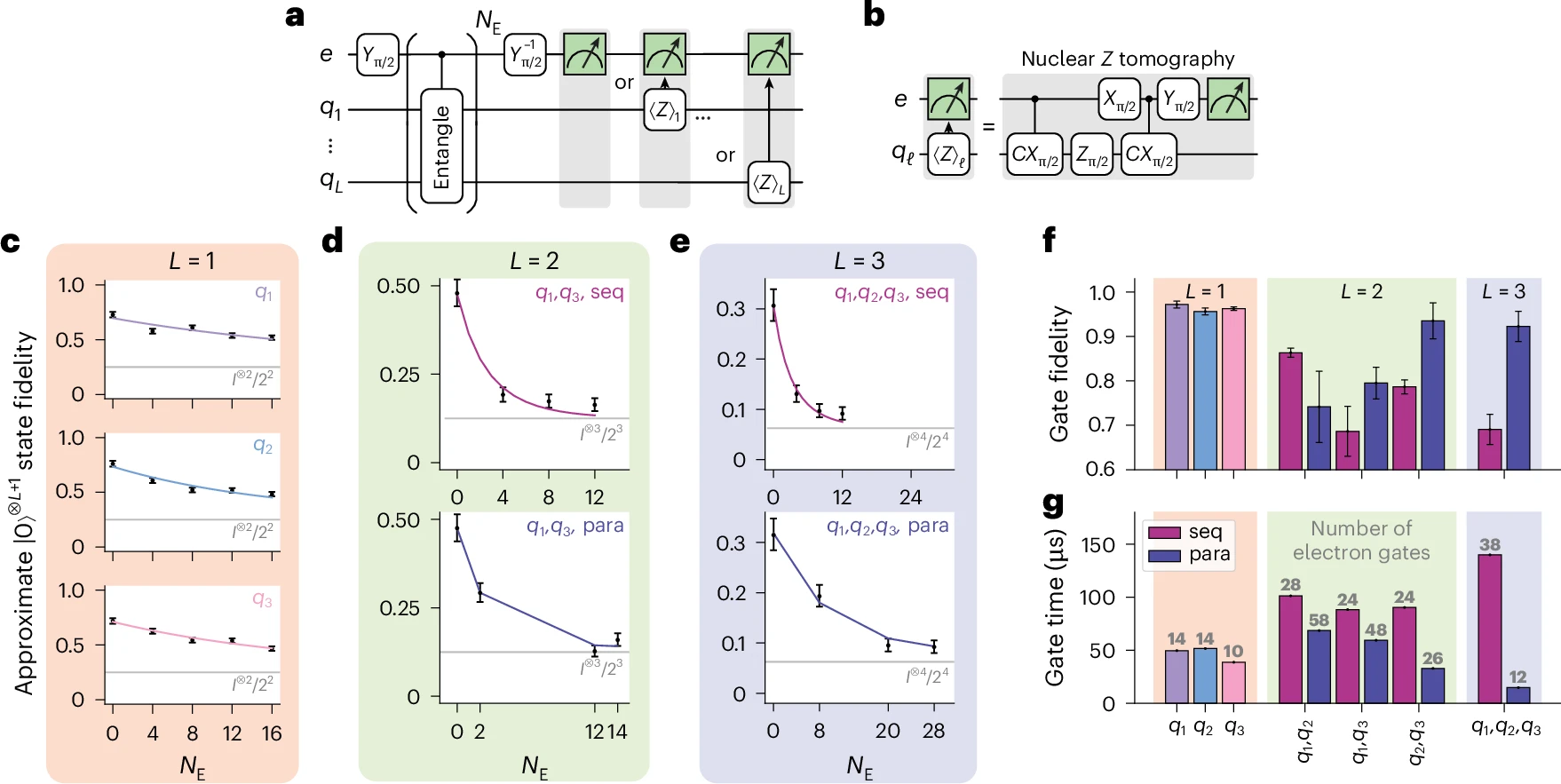
Quantum researchers at the University of Pennsylvania have demonstrated single-gate, parallelized multipartite entanglement on a solid-state quantum register operating under ambient room-temperature conditions. Detailed in a study published in Nature Nanotechnology, the team generated a four-qubit Greenberger–Horne–Zeilinger (GHZ) state—entangling the central electron spin of a nitrogen-vacancy (NV) center in diamond with three surrounding 13C nuclear spin memory qubits—in 14.8 microseconds using a single dynamical decoupling (DD) control sequence.
Traditional solid-state central spin registers rely on sequential, pairwise two-qubit gates to entangle the central electron with individual nuclear memory qubits. This sequential approach incurs significant gate latency and introduces unwanted phase crosstalk on non-targeted nuclear spins. The UPenn framework harnesses this inherent crosstalk, tuning the unit-pulse timing (t) and repeat count (N) of an XY8 dynamical decoupling sequence to execute conditional rotations across multiple weakly coupled nuclear qubits simultaneously. The resulting 14.8 μs gate duration represents a 10-fold speedup over sequential gate protocols and operates near the physical interaction limit dictated by the perpendicular hyperfine coupling frequencies (A⊥ ≈ 60 kHz).
| [ Room-Temperature Solid-State Entanglement Gate Comparison ] | ||
|---|---|---|
| Entanglement Metric / Parameter | Sequential Pairwise Gate Protocol | Single-Gate Parallel DD Protocol |
| • 4-Qubit Gate Duration | • ~145 μs (Long pulse sequences) | • 14.8 μs (~10× execution speedup) |
| • 4-Qubit Gate Fidelity | • 0.69(3) | • 0.92(4) |
| • 3-Qubit Gate Fidelity | • 0.77(3) | • 0.88(3) |
| • Crosstalk Mitigation | • Accumulates phase errors across spins | • Converts crosstalk into parallel conditional gates |
The multipartite entangled states were experimentally verified using Multiple Quantum Coherence (MQC) phase-amplification measurements, confirming genuine four-qubit entanglement. Statistical simulations of 500 randomly sampled, weakly coupled central spin registers confirmed that parallel entangling sequences exist across a majority of naturally occurring solid-state configurations. The control methodology is generalizable to other color centers in diamond (such as SiV or ST1) and defect registers in silicon carbide (SiC) or silicon, offering a scalable template for quantum error correction (QEC) protocols, quantum memory nodes, and room-temperature quantum sensing.
Review the open-access paper on Nature Nanotechnology here, inspect experimental datasets via Zenodo here, and access open-source simulation code on GitHub here.
September 19, 2026

Leave A Comment