

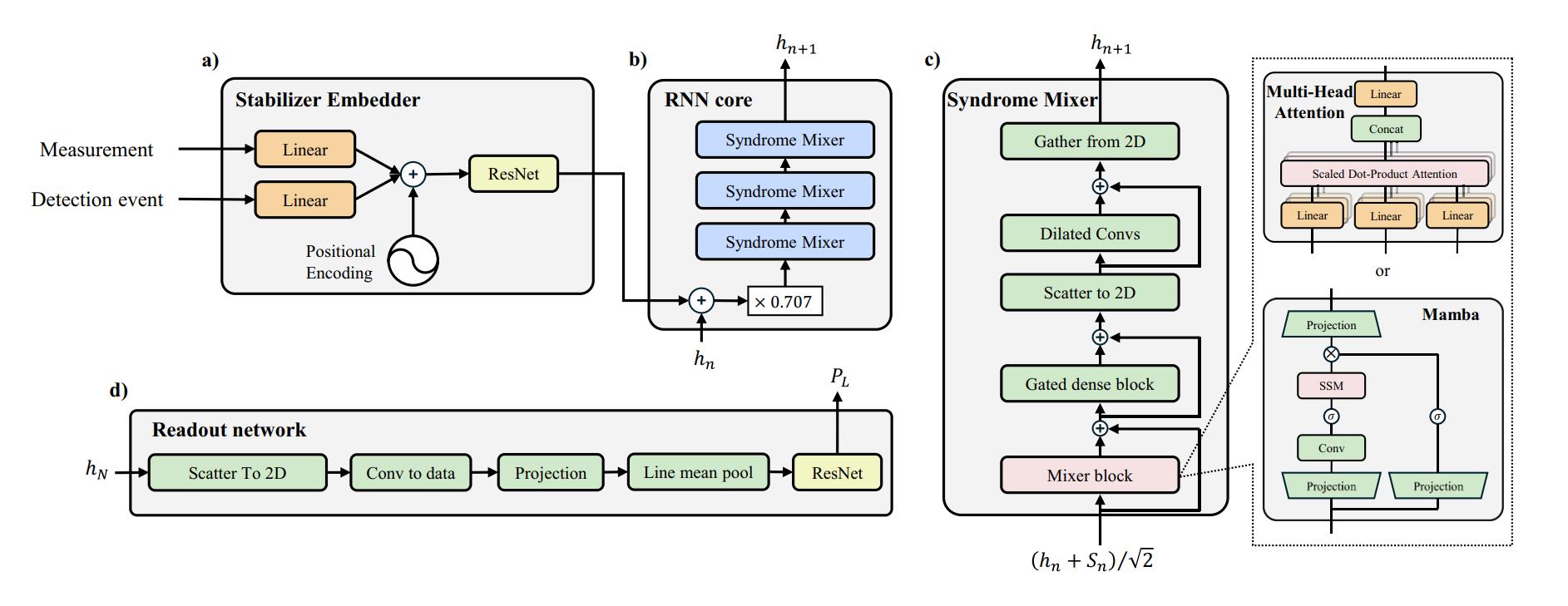
Researchers from Yonsei University have developed a neural quantum error correction (QEC) decoder based on the Mamba structured state-space architecture, reducing the computational complexity of deep-learning decoding from O(d4) to O(d2) in code distance d. In peer-reviewed research published in npj Quantum Information, the team demonstrated that the state-space model matches the accuracy of Transformer-based models such as AlphaQubit on experimental memory benchmarks while eliminating the quadratic self-attention bottlenecks that prevent real-time feedback on physical quantum hardware.
State-Space Syndrome Processing and Real-Time Decoding Metrics
In planar surface codes, syndrome extraction generates sequences scaling with the number of stabilizers (Nstab = d2 − 1). Standard Transformer neural decoders utilize multi-head self-attention mechanisms that perform pairwise comparisons between all stabilizer tokens, yielding an O(d4) scaling that accumulates latency backlogs well beyond microsecond superconducting coherence limits. The Mamba decoder replaces explicit multi-head attention with selective state-space layers, utilizing input-dependent linear scans to maintain historical syndrome contexts within compressed hidden states. Evaluated on the Google Quantum AI Sycamore hardware dataset, the state-space architecture matched Transformer accuracy in static memory benchmarks and maintained an error-suppression advantage when accounting for decoder-induced latency noise.
| Decoding Performance and Scaling Metrics across Surface Code Benchmarks | ||
|---|---|---|
| Evaluation Metric | Mamba Decoder | Transformer Decoder (AlphaQubit Baseline) |
| Core Computational Complexity | O(d2) (Linear in syndrome tokens) | O(d4) (Quadratic pairwise self-attention) |
| Sycamore Memory LER (d = 3) | 2.981 × 10⁻² | ∼ 2.98 × 10⁻² |
| Sycamore Memory LER (d = 5) | 2.916 × 10⁻² | ∼ 2.91 × 10⁻² |
| Real-Time LER at d = 9 (With Latency Noise) | 1.59 × 10⁻⁵ | 6.82 × 10⁻⁵ |
| Effective Threshold Crossings (d = 7 to d = 9) | pth ≈ 0.0067 | pth ≈ 0.0043 |
Inference Latency Limits and Hardware Deployment Constraints
The performance divergence under simulated real-time conditions underscores a foundational constraint in fault-tolerant quantum computing: when decoders cannot process syndromes within the physical cycle time (typically 200 to 1,000 ns on superconducting hardware), idling physical data qubits accumulate uncorrected environmental noise. Under the circuit-level depolarizing SI1000 model, the latency-induced error gap between the two neural models expanded monotonically from d = 3 through d = 9. However, while Mamba resolves the attention-scaling bottleneck, translating neural state-space decoders into physical control stacks requires overcoming edge-compute limitations. Practical implementation requires porting the recurrent core, dilated convolutions, and ResNet feature embedders onto low-latency field-programmable gate arrays (FPGAs) or custom application-specific integrated circuits (ASICs) to execute inference within sub-microsecond cycle budgets.
The peer-reviewed paper is available in npj Quantum Information, with open-source numerical datasets hosted on GitHub.
In GQI Portal
The players behind the news
The team that writes QCR tracks every company, deal and technology in the GQI Factory, GQI's verified database of the quantum industry. Next up: every story linked to its players, coming to QCR's paid plans.
- Players Companies and institutions across the quantum industry, by segment.
- Scorecards How the players compare on hardware, software, funding and more.
Newsletter
QCR Alerts in your inbox
The latest reporting and analysis from Quantum Computing Report. Free, unsubscribe any time.