

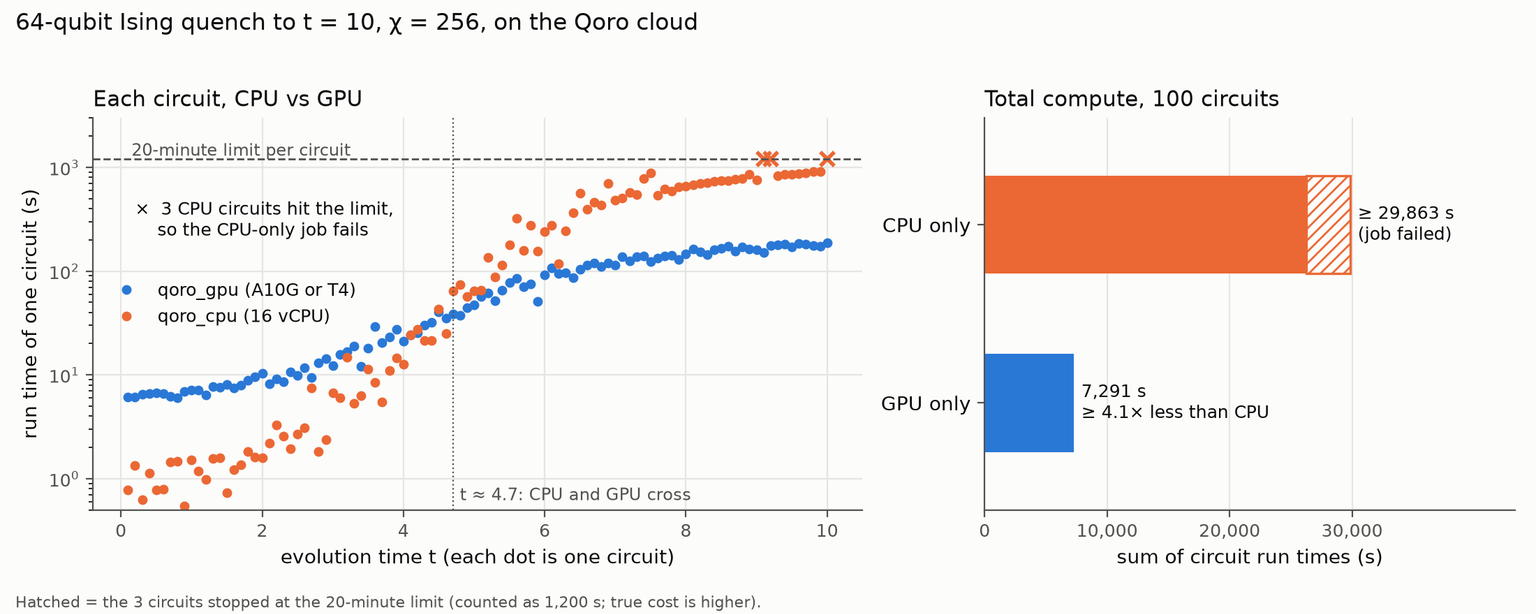
Quantum software and middleware developer Qoro Quantum has launched its cloud-based GPU simulation tier for general availability, providing managed high-performance compute infrastructure designed to run tensor-network and noisy quantum circuit simulations without manual cluster administration. Integrated directly into Qoro’s Python framework, Divi (qoro-divi), the managed environment allows researchers to dispatch circuit workloads from local scripts to remote NVIDIA A10G and T4 GPU clusters.
| Qoro Quantum Cloud Simulation Benchmarks | ||
|---|---|---|
| Simulation Workload | Compute Configuration | Demonstrated Runtime & Scaling Performance |
| 64-Qubit Ising Quench (100 time points, ~60,000 gates/circuit) | Matrix Product State (MPS), bond dimension χ = 256 | GPU completed late-time entangled circuits ~5× faster than 16-vCPU instances (~3 min vs. 11–15 min per circuit). |
| High-Fidelity MPS Scaling (χ = 512, halving late-time energy drift) | NVIDIA A10G / T4 GPU cluster | All 100 circuits finished on GPU in < 9 min each (4.0 GPU-hours total); CPU instances timed out at 20-min limit. |
| Parallel Noise Sweep (2,560 circuits across 8 two-qubit error rates) | Parallelized 16-vCPU nodes | Finished full batch in 43 minutes on cloud CPUs, achieving ~22× wall-clock compression vs. 15.6 hours of sequential compute. |
Algorithm development often encounters a classical memory wall as qubit numbers and entanglement scale beyond statevector limits (where 64 qubits require approximately 295 exabytes of RAM at double precision). Transitioning to cluster-based tensor-network methods typically forces algorithm developers to configure Slurm schedulers, containers, and CUDA drivers manually. Qoro’s platform automates this infrastructure routing through Divi, abstracting hardware provisioning behind a single backend declaration while managing resource allocation dynamically based on the workload’s entanglement profile.
In technical validation benchmarks, the team simulated a 64-qubit non-integrable transverse and longitudinal Ising chain where non-local Jordan-Wigner terms rule out free-fermion classical shortcuts. While parallel CPU nodes handled low-entanglement circuits efficiently, GPU acceleration was required to sustain higher matrix product state (MPS) bond dimensions (χ = 512) to curb late-time energy drift. Free developer accounts receive 1,000 compute credits upon onboarding to evaluate hybrid workflows.
Benchmark data and code examples are detailed in Qoro’s Technical Blog here, with developer documentation available on the Divi Documentation Portal here.
In GQI Portal
The players behind the news
The team that writes QCR tracks every company, deal and technology in the GQI Factory, GQI's verified database of the quantum industry. Next up: every story linked to its players, coming to QCR's paid plans.
- Players Companies and institutions across the quantum industry, by segment.
- Scorecards How the players compare on hardware, software, funding and more.
Newsletter
QCR Alerts in your inbox
The latest reporting and analysis from Quantum Computing Report. Free, unsubscribe any time.