
Researchers from IBM Quantum, the Joint Center for Quantum Information and Computer Science (QuICS / NIST / UMD), and MIT have developed a neuro-symbolic search framework that pairs large language model (LLM) agents with deterministic solvers to map uncharted magic-state distillation protocols. Detailed in a preprint titled Symmetry and AI-assisted discovery of magic-state factories, the team uncovered 699 factory classes—including 564 previously unknown protocols—delivering non-Clifford states with record-low physical resource footprints.
| Key Magic-State Factory Milestones Discovered | ||
|---|---|---|
| Factory Class [[n, k, d]] | Output Gate & Metrics | Technical & Efficiency Significance |
| [[63, 11, 3]] | 11 pure T states (γ = 1.589) | Lowest known overhead exponent among pure-T distillation protocols consuming ≤ 100 inputs (5.73 inputs/output). |
| [[850, 128, 6]] | 128 pure T states (γ = 1.057) | Lowest reported overhead exponent for any known distillation protocol with ≤ 1,000 inputs. |
| [[1715, 287, 6]] | 287 pure T states (γ = 0.998) | Smallest known pure-T distillation factory to break the γ < 1 sub-linear overhead barrier. |
| Entangled Target States | Combinations of T, CS, and CCZ | Enables direct synthillation of multi-qubit non-Clifford gates, bypassing multi-stage decomposition. |
Universal fault-tolerant quantum computers running planar CSS or surface codes cannot execute non-Clifford operations natively through transversal gates alone. Standard architectures rely on distillation factories to purify noisy ancilla states via gate teleportation, a routine historically projected to consume up to 90% of a machine’s physical qubits and runtime. While exhaustive classification historically stalled at small input sizes (n ≤ 54), the researchers made larger searches tractable by proving that achieving code distance d ≥ 3 is mathematically equivalent to selecting nonzero, pairwise distinct syndromes within a binary-matrix representation.
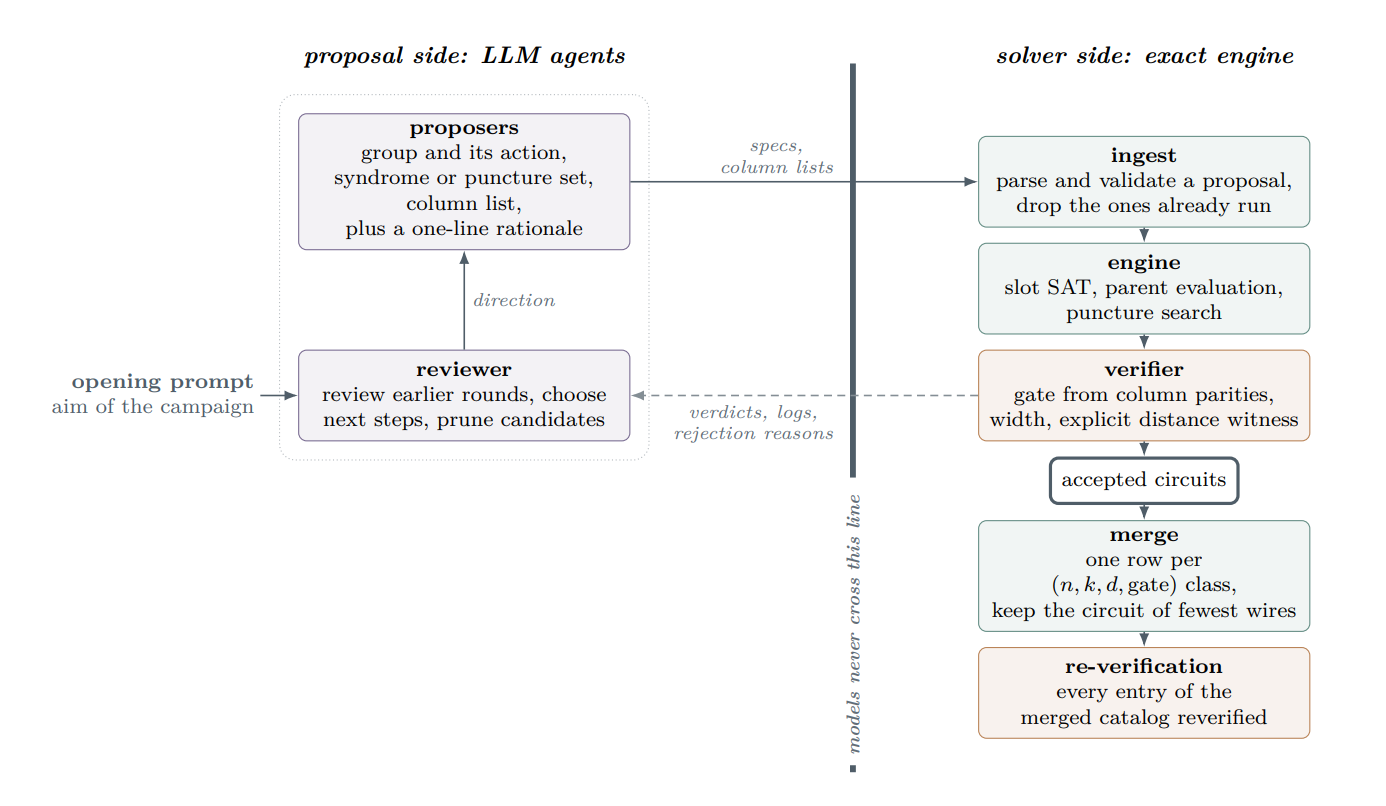
To navigate the expanded search space, the team deployed an automated multi-agent loop: language-model agents propose targeted subgroup symmetry orbits, an integer-programming solver constructs candidate circuit matrices, and an independent verification engine validates gate identities and code distances. A reviewing agent evaluates solver logs to redirect subsequent rounds toward productive geometries. In addition to pure-T states, the framework yielded factories outputting entangled states such as CCZ⊗2 and T ⊗ CCZ⊗4, directly lowering the gate depth needed during algorithm synthesis.
To support community resource estimation, the authors released the verified circuits in an open-access repository indexed with Clifford correction rules and matrix export formats.
The research paper is accessible on arXiv here, with executive commentary shared in Jay Gambetta’s LinkedIn Post here, circuit models hosted on the GitHub Repository here, and the interactive Magic State Factory Catalog here; related QCR reporting on non-Clifford state generation includes Google Quantum AI’s Willow hardware cultivation demonstration here and NVIDIA and Jülich’s exascale cultivation simulation on JUPITER here.
In GQI Portal
The players behind the news
The team that writes QCR tracks every company, deal and technology in the GQI Factory, GQI's verified database of the quantum industry. Next up: every story linked to its players, coming to QCR's paid plans.
- Players Companies and institutions across the quantum industry, by segment.
- Scorecards How the players compare on hardware, software, funding and more.
Newsletter
QCR Alerts in your inbox
The latest reporting and analysis from Quantum Computing Report. Free, unsubscribe any time.