

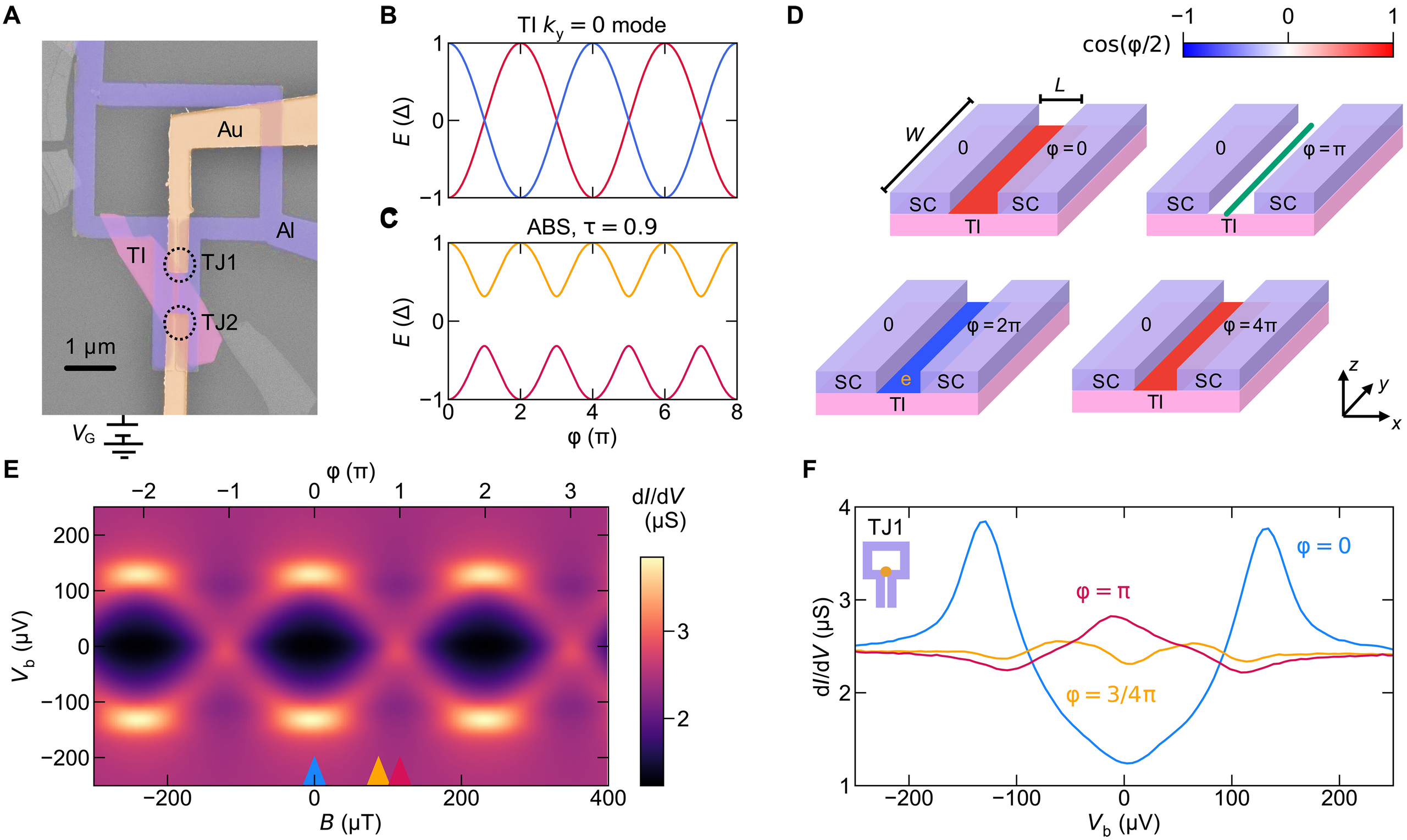
Physicists at the University of Cologne’s Topological Matter Laboratory, in collaboration with theoretical researchers at RWTH Aachen University, have conducted tunneling spectroscopy on topological insulator Josephson junctions, revealing signatures of phase-controlled energy gap closing and reopening. Published in Science Advances under the title Tunneling spectroscopy of topological insulator Josephson junctions, the study delivers direct local spectroscopic support for the foundational 2008 Fu-Kane theoretical model, offering a physical pathway toward topological superconductivity and Majorana zero modes without relying on destructive Zeeman magnetic fields.
| Topological Insulator Josephson Junction Spectroscopy Metrics | ||
|---|---|---|
| Parameter Dimension | Experimental Specification | Architectural Significance |
| Material Platform | Exfoliated BiSbTeSe2 flakes with Al contacts | Bulk-insulating 3D topological insulator ensuring electrical transport is confined to topological surface states (TSS). |
| Junction Geometry | 50 nm length within an RF-SQUID loop | Operates in the short-junction limit below the surface coherence length to host discrete 1D Andreev modes. |
| Spectroscopic Probes | Dual Au/Al2O3 tunnel electrodes (TJ1, TJ2) | Measures local density of states (LDOS) at 50 mK base temperature across independent spatial positions. |
| Phase Dispersion | Coherence peaks at ±130 μeV merge at φ = π | Consistent with spin-momentum locking forbidding normal backscattering, forcing gap closing and ground-state parity reversal. |
| Vortex Localization | Magnetic fields between 5 mT and 6 mT | Spatially resolves individual Josephson vortex cores entering the junction, matching theoretical mode confinement. |
| Gate Stability | Back-gate sweeps from −20 V to +20 V (Δμ ≥ 40 meV) | Demonstrates that high-transmission states persist across chemical potentials, ruling out fine-tuned quantum dot artifacts. |
Topological quantum computation aims to encode information non-locally within Majorana zero modes to achieve hardware-level protection against local charge noise and magnetic fluctuations. Most experimental efforts have historically targeted 1D semiconductor Rashba nanowires, an approach that requires intense in-plane magnetic fields that can suppress superconductivity and generate false-positive zero-bias conductance peaks from trivial defect states. The Cologne experiment bypasses this limitation by leveraging the natural spin-momentum locking of the topological surface state in BiSbTeSe2, where normal backscattering is strictly suppressed for perpendicular trajectories, enforcing highly transmissive Andreev reflection (τ ≈ 1).
By embedding the 50 nm planar junction into an RF-SQUID loop, the team systematically adjusted the superconducting phase difference (φ) using weak out-of-plane flux. Differential conductance measurements at 50 mK showed an induced superconducting gap of 130 μeV at zero phase that closed into a zero-bias feature as φ approached π. In higher fields where multiple Josephson vortices nucleated, dual tunnel contacts recorded distinct phase periodicities (230 μT versus 200 μT) tracking the physical passage of vortex cores across the probes, confirming that zero-energy modes localize at spatial phase gradients.
The authors note critical engineering milestones that remain before topological qubits can be realized. Because the measurement setup has an energy resolution of approximately 30 μeV, the apparent gap closing establishes a transmission lower bound of τ ≥ 0.95 rather than definitive proof of a gapless transition. Furthermore, the presence of long quasi-classical electron trajectories produces an incompletely proximitized “soft gap.” To overcome these challenges on the roadmap to braiding, the researchers propose transitioning to high-critical-field niobium (Nb) electrodes and implementing charge-sensing electrometry to verify the 4π-periodic fermion parity flip.
The research was conducted within the Matter and Light for Quantum Computing (ML4Q) Cluster of Excellence, with full experimental datasets available via the Science Advances Research Paper here and institutional commentary detailed in the University of Cologne News Release here.
In GQI Portal
The players behind the news
The team that writes QCR tracks every company, deal and technology in the GQI Factory, GQI's verified database of the quantum industry. Next up: every story linked to its players, coming to QCR's paid plans.
- Players Companies and institutions across the quantum industry, by segment.
- Scorecards How the players compare on hardware, software, funding and more.
Newsletter
QCR Alerts in your inbox
The latest reporting and analysis from Quantum Computing Report. Free, unsubscribe any time.