
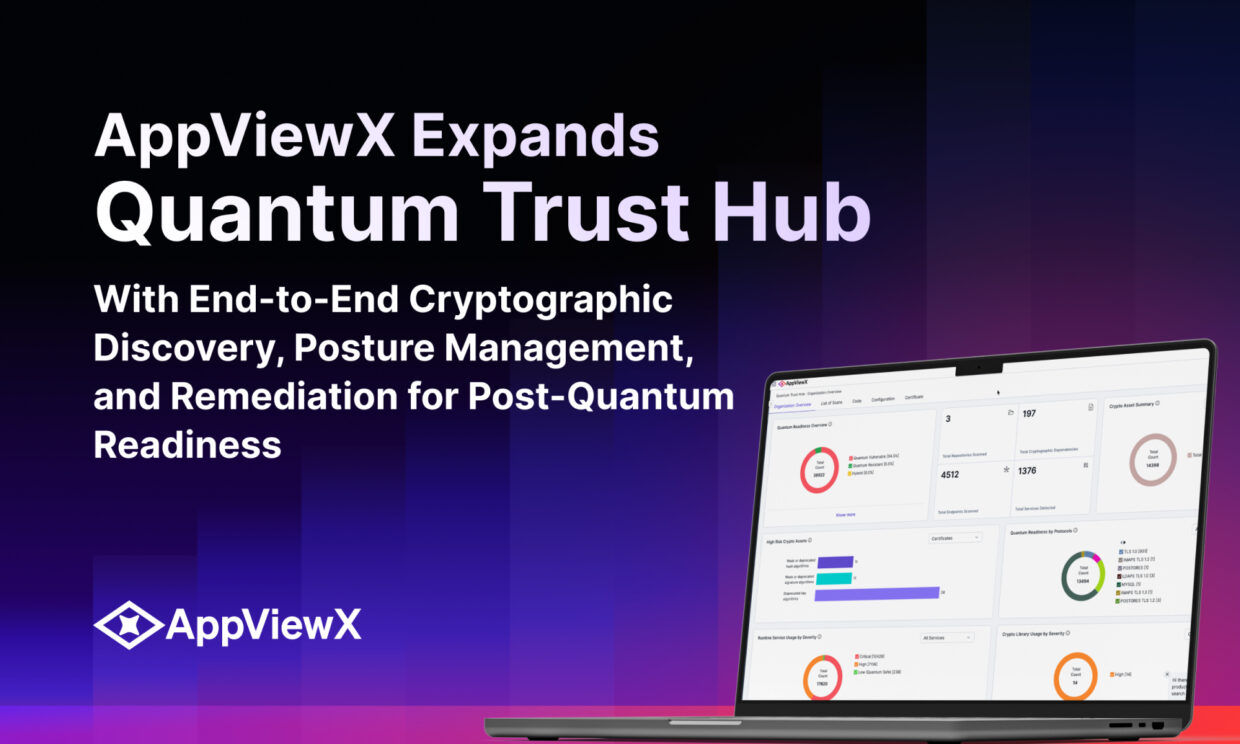
Machine and agent identity security provider AppViewX has launched its Quantum Trust Hub as a standalone enterprise platform, expanding automated cryptographic discovery, risk posture assessment, and ticketed remediation workflows. The release directly targets enterprise and federal compliance mandates enforced under Executive Order 14412 and updated National Institute of Standards and Technology (NIST) guidance, which set a 2030 deadline for federal agencies to transition high-value systems to post-quantum cryptography (PQC) for key establishment and a 2031 deadline for digital signatures. Designed to mitigate “harvest now, decrypt later” (HNDL) exfiltration risks, the platform moves beyond traditional public key infrastructure (PKI) audits by establishing multi-layer cryptographic visibility across certificates, cipher suites, TLS configurations, and application source code.
Agentless Discovery, CBOM Aggregation, and ITSM Orchestration
Traditional cryptographic migrations often stall because legacy certificate management tools fail to detect hardcoded keys, obsolete cipher suites, or deep software dependencies. To eliminate the overhead of deploying proprietary host agents, Quantum Trust Hub employs an agentless-first discovery architecture that ingests telemetry directly from established enterprise vulnerability scanners, adding a native integration with Qualys alongside existing support for Tenable. The platform consolidates third-party Cryptographic Bills of Materials (CBOMs) and Software Bills of Materials (SBOMs) into a unified inventory, categorizing assets as quantum-vulnerable or quantum-resistant against NIST severity benchmarks. For operational execution, identified exposures automatically generate structured, context-rich remediation tickets in ServiceNow, routing mitigation tasks directly into existing IT service management (ITSM) pipelines.
| AppViewX Quantum Trust Hub Architecture and Operational Specifications | ||
|---|---|---|
| Platform Capability | Technical Architecture & Integration | Operational Role in PQC Migration |
| Agentless Discovery | Native connectors for Qualys, Tenable, and existing security tools. | Discovers certificates, TLS endpoints, and cipher suites without deploying endpoint sensors. |
| Unified Cryptographic Inventory | Direct ingestion of external CBOMs, SBOMs, and application code libraries. | Builds a continuous, multi-layer inventory of all active algorithms, keys, and dependencies. |
| Risk Prioritization Engine | NIST-aligned vulnerability ratings weighted by business-application context. | Classifies assets (PQC-ready vs. vulnerable) to highlight high-value targets facing HNDL risks. |
| ITSM-Driven Remediation | Bi-directional integration with ServiceNow ticketing workflows. | Converts posture audits into actionable remediation tickets grouped by system scope and ownership. |
| Machine & AI Agent Security | Integration with AppViewX Certificate and SSH Key Lifecycle Management modules. | Automates replacement of exposed credentials and issues quantum-resilient identities for AI agents. |
Federal Deprecation Timelines and Cryptographic Agility Constraints
The transition toward commercial cryptographic posture management tools reflects an evolving regulatory landscape as standard-setters outline the formal phaseout of RSA and Elliptic Curve Cryptography (ECC) starting in 2030. While centralized visibility and automated ticketing resolve early discovery bottlenecks, achieving end-to-end cryptographic agility across sprawling legacy enterprises introduces significant friction. Security teams must replace hardcoded cryptographic libraries embedded in custom enterprise code, resolve protocol mismatches across legacy embedded appliances, and manage bandwidth or memory overheads introduced by larger post-quantum key sizes (such as ML-KEM) and signatures (such as ML-DSA). Sustained migration will require continuous posture validation to ensure that updated cipher suites and certificate renewals do not disrupt critical production services.
Platform details are documented in the official AppViewX Product Announcement here, with architectural migration strategies detailed in the AppViewX Quantum Readiness Briefing here.
In GQI Portal
The players behind the news
The team that writes QCR tracks every company, deal and technology in the GQI Factory, GQI's verified database of the quantum industry. Next up: every story linked to its players, coming to QCR's paid plans.
- Players Companies and institutions across the quantum industry, by segment.
- Scorecards How the players compare on hardware, software, funding and more.
Newsletter
QCR Alerts in your inbox
The latest reporting and analysis from Quantum Computing Report. Free, unsubscribe any time.