Author: Mohamed Abdel-Kareem
-
-
QuIC Publishes Position Paper Calling for Harmonized EU Dual-Use Controls on Quantum Technologies
The European Quantum Industry Consortium (QuIC) has published a position paper urging the European Commission to harmonize EU dual-use controls on quantum technologies. They warn that fragmented national implementations of export controls on quantum technologies are causing administrative difficulties, shipment delays, and revenue loss for European quantum companies. QuIC proposes reforms focusing on single market harmonization, expanded allied trade, clearer rules for intangible transfers and cloud access, and differentiated scrutiny for supply chain components to ensure European competitiveness.
-
NVision Quantum Technologies Expands into Molecular Quantum Computing with Photonic Integrated Architecture
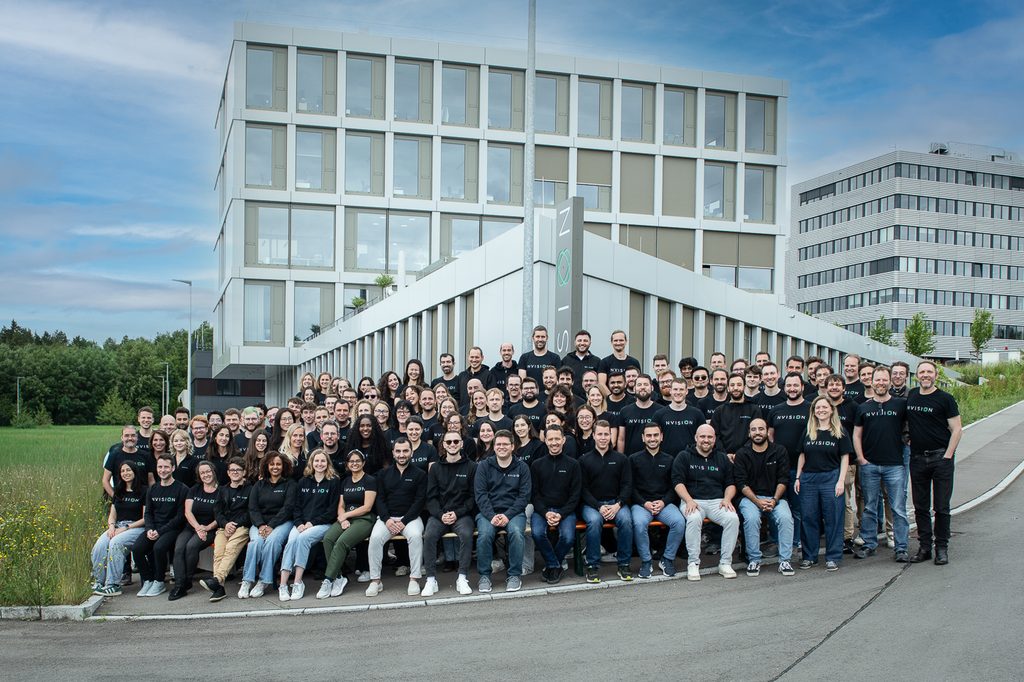
NVision Quantum Technologies is expanding from its commercial hyperpolarized MRI platform into quantum computing hardware with its new PIQC (Photonic Integrated Quantum Chip) molecular architecture. This strategy utilizes synthetic organic molecules with optically addressable spin states deposited on silicon photonic chips, aiming for a scalable, photonically-entangled gate architecture for fault-tolerant quantum computing. This expansion builds on their commercial success with their Polaris MRI systems and recent significant financing and project involvement.
-
-
-
EMode Photonix Raises $1M Pre-Seed Round Led by Ground State Ventures for Photonic Circuit Simulation Stack
EMode Photonix, a quantum integrated photonics software startup, has successfully raised $1 million in pre-seed funding. This investment, led by Ground State Ventures, will enable the company to expand its engineering team and accelerate the development of its enterprise software. EMode Photonix specializes in a multi-physics simulation platform for non-linear integrated photonic circuits, offering significantly faster modeling capabilities for various applications including quantum computing and optical sensing.
-
Google Quantum AI Demonstrates Magic State Cultivation on Willow Processor in Science Milestone
Google Quantum AI has successfully demonstrated magic state cultivation on its Willow quantum processor, achieving a 40-fold error reduction and producing T-states with 99.99(1)% logical fidelity. This breakthrough addresses a major bottleneck in fault-tolerant quantum computing by significantly reducing the physical qubit footprint required for generating these essential states, directly validating Google's 2024 cultivation theory framework.
-
Google Quantum AI & DeepMind Demonstrate Modular Hyperbolic Codes for Over 30x QEC Overhead Reduction
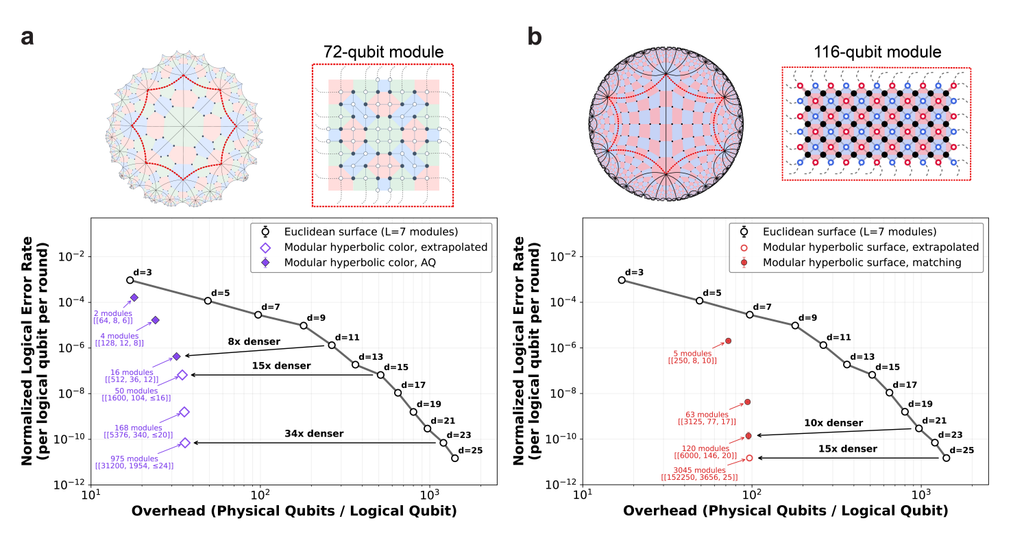
Researchers from Google Quantum AI, Google DeepMind, and MIT have developed a modular quantum error correction (QEC) architecture that significantly reduces the physical qubit overhead required for quantum computing. This new approach, detailed in a technical manuscript on arXiv, utilizes modular hyperbolic codes to achieve over 30x savings in qubit overhead compared to standard 2D surface codes. The architecture allows for high encoding rates without complex on-chip wiring, demonstrating high tolerance to noise in simulations.
-
Germany Issues Joint Federal PQC Migration Guidelines to Align with EU Post-Quantum Roadmap
Germany has released national guidelines for migrating to Post-Quantum Cryptography (PQC), aligning with the EU's roadmap. The strategy, driven by advancements in AI and threats to classical encryption, outlines a three-phase migration timeline, prioritizing high-risk systems by 2030 and aiming for full migration by 2035. This initiative mandates hybrid cryptographic mechanisms and PQC readiness in risk management for critical infrastructure.
-
IBM Research Automates QEC Decoder Chip Design Using Open AI Agent Factories at 11.5x Lower Inference Cost
IBM Research has developed an AI agent factory to automate the design of QEC decoder chips, achieving up to 204x hardware speedup and 11.5x lower AI inference costs. This system utilizes autonomous multi-agent search and open-weight models, making QEC chip design more economically practical for fault-tolerant quantum systems. The agent factory explores architectural transformations to optimize decoding algorithms for high-rate qLDPC codes.
-
FirstQFM Foundation Model Cuts Quantum Gate Times by 33% on QuantWare QPU via NVIDIA Computing
FirstQFM AB has achieved a 33% reduction in single-qubit gate execution times on QuantWare’s 21-qubit Contralto-D21 superconducting quantum processor, without compromising gate fidelity. This was accomplished using their patented quantum foundation model technology, which integrates with Quantum Machines’ OPX control hardware and QUA calibration stack. The model, developed with NVIDIA’s accelerated computing infrastructure, also improved two-qubit Bell-state fidelities.
-
Classiq Partners with FreeYa Mind Campus to Launch Quantum Applications Hub in Romania
Classiq has partnered with FreeYa Mind Campus to open a Quantum Applications Hub in Iași, Romania, which will serve as Classiq's regional headquarters. This hub integrates Classiq's quantum software platform with the campus's IBM Quantum System Two. The collaboration aims to drive quantum software development, education, and enterprise projects across Eastern Europe.
-
Anderon Releases First Superconducting Quantum PDK for 300mm Wafer Fabrication
Anderon, a quantum foundry operator, has released its first Superconducting Quantum Process Design Kit (PDK) for 300mm wafer fabrication. This PDK provides standardized design rules and building blocks for manufacturing superconducting quantum devices on their 300mm wafer line at the Albany NanoTech Complex. Anderon, backed by $2 billion in funding, offers various superconducting wafer types, including qubit, I/O signal, and amplifier/filter wafers.
-