

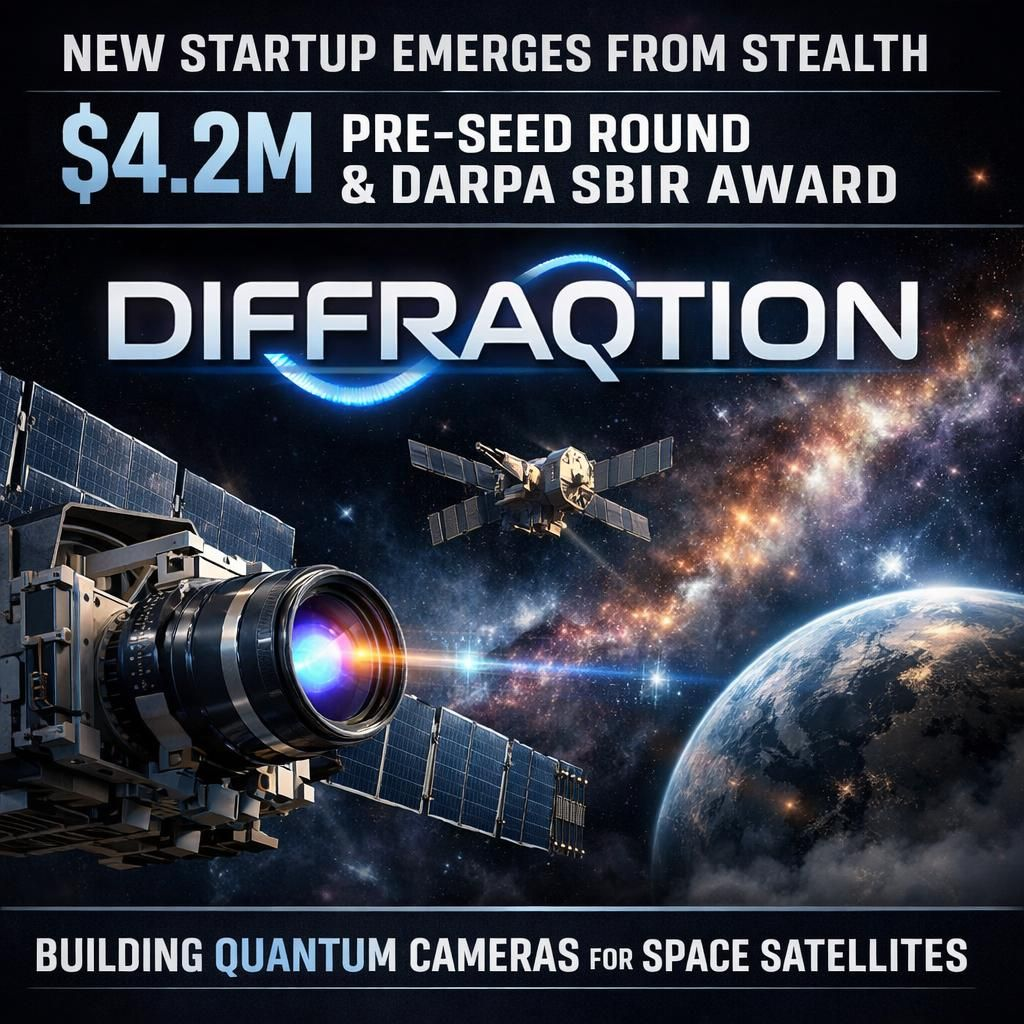
Diffraqtion, an MIT and University of Maryland spinout, has announced the closure of a $4.2 million pre-seed funding round to develop and deploy satellite constellations powered by its proprietary quantum camera technology. The round was led by QDNL Participations, with additional investment from milemark•capital, Aether VC, ADIN, and Offline Ventures. The total includes a non-dilutive DARPA SBIR Direct-to-Phase 2 contract valued at approximately $1.5 million, specifically targeted at enhancing space situational awareness (SSA) and detecting small, high-velocity objects in orbit.
The company’s core technology is the Galileo 1 quantum camera, which aims to bypass the “diffraction limit”—the physical boundary that dictates the maximum resolution a lens can achieve based on its aperture size. By utilizing photon-counting sensors and advanced artificial intelligence, Diffraqtion claims its system can deliver up to 20 times higher resolution and 1,000 times faster processing than conventional CMOS or CCD systems. This hardware-software co-design allows for ultra-high-resolution imaging using significantly smaller and lighter payloads, potentially reducing the cost of satellite constellations by an order of magnitude while maintaining the performance of much larger ground-based telescopes.
Strategically, Diffraqtion is positioning its sensor for both national security and commercial applications. The technology is being refined through the U.S. Space Force’s Apollo Accelerator, where it is evaluated for its ability to track “stealthy” orbital debris and identify spacecraft maneuvers in real time. Beyond defense, the company targets Earth observation markets, providing high-cadence, high-precision data for agriculture, disaster response, and environmental monitoring. The founding team—Johannes Galatsanos (CEO), Dr. Christine Wang (CTO), and Professor Saikat Guha (CSA)—brings deep expertise from Harvard, MIT, and DARPA-backed research to move quantum sensing into operational reality.
Looking ahead, Diffraqtion plans to conduct “on-sky” demonstrations with the University of California Observatories in early 2026 to validate sensor performance through atmospheric turbulence. This will be followed by dedicated space-based trials to demonstrate autonomous orbital edge processing. The company’s long-term roadmap envisions a global network of quantum-enabled satellites that provide continuous, high-fidelity visibility above and below the atmosphere, creating a new standard for the space domain awareness (SDA) industry.
Read the official announcement from Diffraqtion here.
January 16, 2026
In GQI Portal
The players behind the news
The team that writes QCR tracks every company, deal and technology in the GQI Factory, GQI's verified database of the quantum industry. Next up: every story linked to its players, coming to QCR's paid plans.
- Players Companies and institutions across the quantum industry, by segment.
- Scorecards How the players compare on hardware, software, funding and more.
Newsletter
QCR Alerts in your inbox
The latest reporting and analysis from Quantum Computing Report. Free, unsubscribe any time.