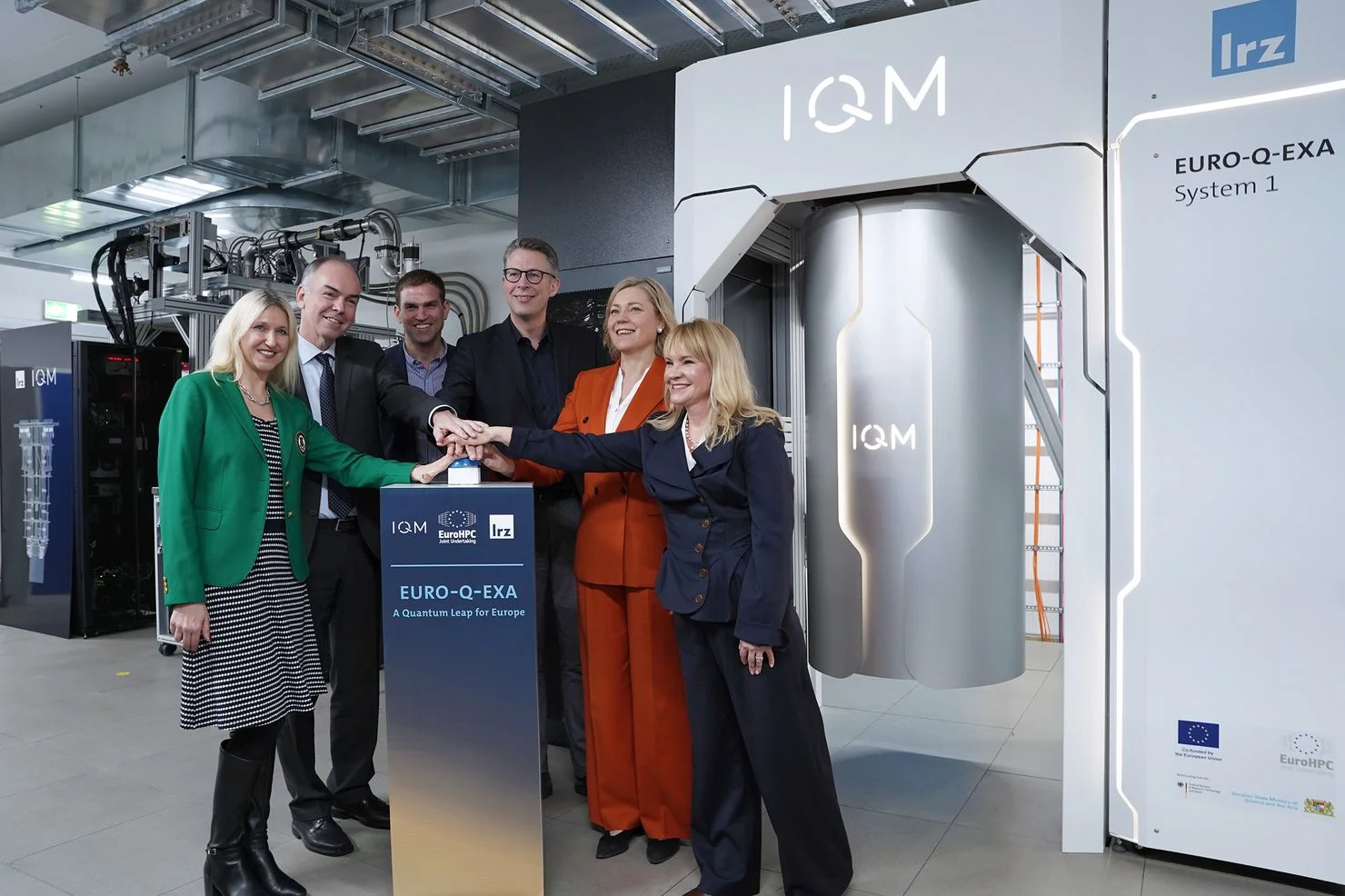
The European Commission and the EuroHPC Joint Undertaking have officially launched Euro-Q-Exa, the first EuroHPC quantum computer deployed in Germany. Hosted at the Leibniz Supercomputing Centre (LRZ) in Garching, Munich, the system represents a critical milestone in Europe’s strategy to establish a sovereign digital infrastructure. Unlike traditional cloud-access models, Euro-Q-Exa is a locally owned and operated facility, allowing European researchers and industrial partners to develop hands-on operational expertise. The project is co-funded by the EuroHPC JU (€10 million), the German Federal Ministry of Research, Technology and Space (BMFTR) (€12 million), and the Bavarian State Ministry of Sciences and the Arts (StMWK) (€3 million).
Developed by IQM Quantum Computers using its Radiance platform, the system initially features 54 superconducting qubits and is engineered for deep integration with LRZ’s high-performance computing (HPC) environment. The architecture utilizes tunable couplers and high-fidelity gates in a lattice topology, specifically optimized to minimize latency and maximize throughput in hybrid quantum-classical workflows. A significant expansion is already planned, with a second, more powerful processor exceeding 150 qubits expected to be integrated by the end of 2026, followed by a further substantial upgrade in early 2027.
The system is integrated with the Munich Quantum Software Stack (MQSS), supporting widely used packages such as Qiskit and PennyLane to facilitate the development of hybrid algorithms. By coupling the quantum processor directly with LRZ’s SuperMUC-NG supercomputer, researchers are targeting complex applications in climate modeling, computational pharmacology, and neurodegenerative disease research. Euro-Q-Exa is one of six quantum systems being deployed across Europe’s most advanced supercomputing centers (including sites in Czechia, France, Italy, Poland, and Spain) to foster a coordinated ecosystem for industrial and scientific innovation.
Read the official announcement from IQM Quantum Computers here and the Leibniz Supercomputing Centre here.
February 12, 2026

Leave A Comment