
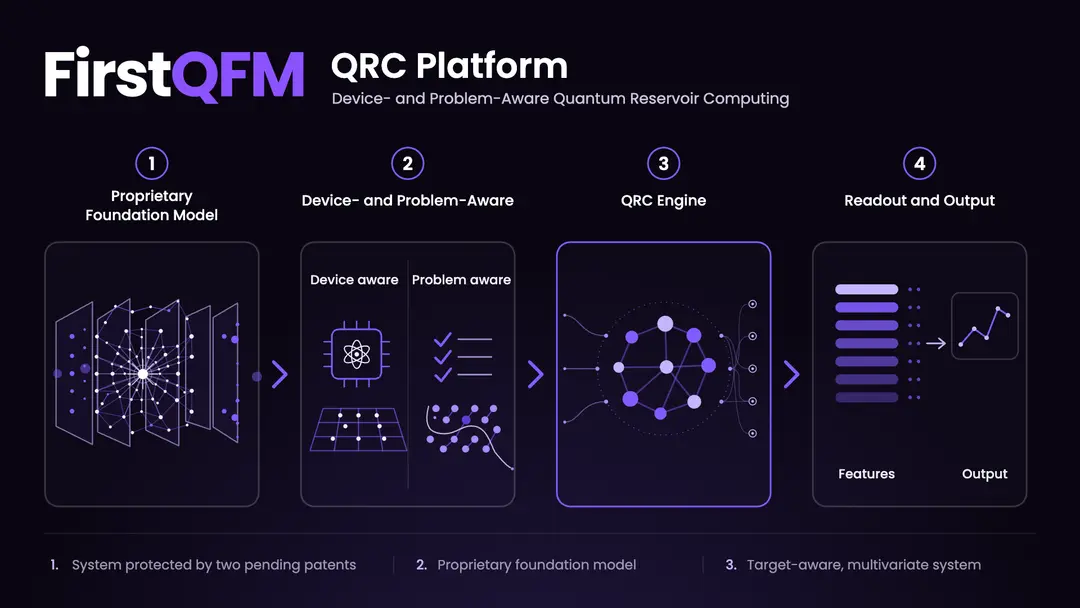
Stockholm-based startup FirstQFM has unveiled a machine learning platform that utilizes patent-pending quantum foundation models (QFMs) to optimize Quantum Reservoir Computing (QRC) systems for high-value enterprise forecasting. Announced at the ISC High Performance 2026 conference in Germany, the breakthrough demonstrates an immediate application for Noisy Intermediate-Scale Quantum (NISQ) devices. By moving beyond traditional, fixed-reservoir designs that are prone to environmental drift and hardware vulnerabilities, FirstQFM’s platform generates localized, task-specific quantum feature layers. This system achieved a 56.1% series-level win rate in zero-shot predictive accuracy when benchmarked against leading classical time-series models.
[ Financial Time-Series ] ──► [ Problem-Aware QFM ] ──► [ Device-Aware QRC Reservoir ] ──► [ Linear Readout Layer ]
                               (Data Structure Context)   (Rigetti Superconducting QPU)    ( 56.1% Zero-Shot Win Rate )
Device-Aware and Problem-Aware Generative Workflows
Quantum Reservoir Computing operates as a hybrid sequence-modeling framework where a low-depth quantum circuit serves as a high-dimensional feature generator. The quantum system receives an input sequence, evolves under complex multi-body reservoir dynamics, and undergoes spatial measurement to supply a rich feature map to a lightweight classical readout layer. Unlike standard implementations that rely on a single static reservoir, FirstQFM utilizes learned contextual information to tailor reservoirs to the physical state of the underlying processor and the specific characteristics of the forecasting problem:
- Problem Awareness: The foundation model analyzes the mathematical structure of the data stream, shifting its internal memory and non-linearity profiles depending on whether the series is autoregressive, bound to leading indicators, or influenced by sudden structural regime changes. Yahoo! Finance Canada
- Device Awareness: The system explicitly monitors the operating environment of the live quantum processor, adapting the reservoir to account for physical qubit topologies, gate calibration constraints, background cross-talk, and real-time noise vectors. BriefGlance
Supercomputing Scale and Commercial Utility Benchmarks
The alpha-version system was evaluated on 41 daily financial return forecasting tasks spanning individual equities, global indices, crypto assets, and commodities. In a strict zero-shot evaluation on series entirely excluded from training to prevent data leakage, FirstQFM’s QRC architecture delivered a lower mean Mean Squared Error (0.000485 MSE) and higher directional accuracy than leading time-series foundation models developed by Google, Amazon, and Salesforce. The initial reservoirs were generated at the edge of classical simulability using the NVIDIA cuQuantum SDK and cuTensorNet libraries on the Leonardo Supercomputer, a high-performance system backed by the EuroHPC Joint Undertaking.
                                  [ Mean MSE Across 41 Held-Out Series ]
FirstQFM Alpha QRC Model ──■■■■■■■■■ 4.85 (Scaled x10,000)
Classical AI Baselines   ──■■■■■■■■■■■■■■■■■■■ 9.20+ (Scaled x10,000)
To validate the model on larger, non-simulable reservoirs, the team deployed final benchmarking runs on Rigetti Computing’s multi-chip superconducting quantum hardware. This physical implementation boosted average directional forecasting accuracy further to 54.74%, reporting a peak single-series MSE reduction of 52.95% on major indices like the DAX 30 and Dow 30.
Hardware-Aware Stabilization and Enterprise Deployments
Following these alpha results, FirstQFM has opened beta system applications for selected pilot partners to address multi-variable enterprise time-series that feature irregular data sampling, missing variables, and shifting operational constraints. To protect down-stream performance from hardware drift—where shifting physical qubit properties can destabilize the generated feature representations—the beta architecture incorporates a hardware-aware stabilization layer that dynamically retunes the feature extraction loop to match changing device states. For enterprise deployment, the company is following a dual cloud and on-premises go-to-market strategy. On-premises modules will leverage NVIDIA NVQLink to establish a low-latency, high-throughput connection directly between localized GPU servers and quantum system controllers, allowing corporate operators to toggle between direct forecasts or reusable feature layers via simple natural language controls.
The technical benchmarking metrics, product-level enterprise controls, and pilot partner deployment schedules can be reviewed in the official FirstQFM Press Release here, while the comprehensive mathematical workflows and architectural diagrams are hosted via the FirstQFM Research Blog here, with broader multi-provider software context available through the NVIDIA Ecosystem Updates here.
June 23, 2026
