
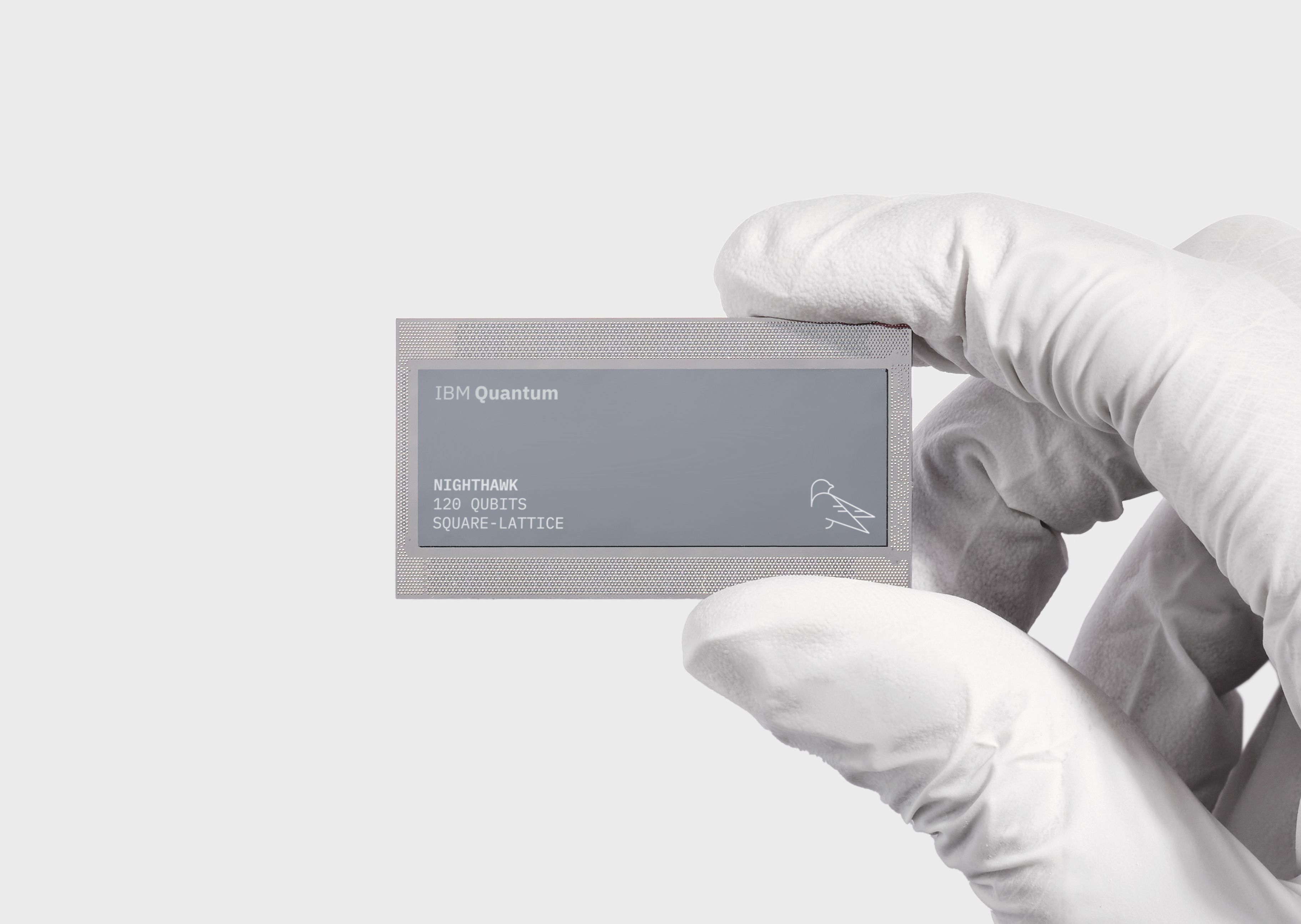
IBM (NYSE: IBM) has announced significant progress across its quantum roadmap, including the debut of the IBM Quantum Nighthawk processor and a shift in quantum processor fabrication to a 300mm wafer facility. The company is advancing both its roadmap toward achieving quantum advantage by the end of 2026 and Fault-Tolerant Quantum Computing (FTQC) by 2029.
The IBM Quantum Nighthawk processor is designed with an architecture to complement high-performing quantum software. It features 120 qubits linked by 218 next-generation tunable couplers to their four nearest neighbors in a square lattice. This increased qubit connectivity is intended to allow users to accurately execute circuits with 30% more complexity than on IBM’s previous processor. This architecture will support computationally demanding problems requiring up to 5,000 two-qubit gates.
The shift of primary quantum processor fabrication to the Albany NanoTech Complex‘s advanced 300mm wafer facility is intended to accelerate the quantum roadmap. This scale allows IBM to double the speed of its research and development efforts and achieve a ten-fold increase in the complexity of its quantum chips. This process enables multiple designs to be researched and explored in parallel, increasing the speed at which 300mm quantum wafers can be transformed into deployable quantum processors.
In a parallel path toward FTQC, IBM unveiled the experimental IBM Quantum Loon processor, which demonstrates all key processor components needed for fault-tolerant quantum computing, including multiple low-loss routing layers for long-range, on-chip connections (c-couplers). Additionally, IBM demonstrated the accurate, real-time decoding of qLDPC codes in under 480 nanoseconds, which achieves a 10× speedup over current leading approaches and was completed a full year ahead of schedule.
Read the full press release here, the related blog post here, and more on the 300mm Fab here.
November 12, 2025
