

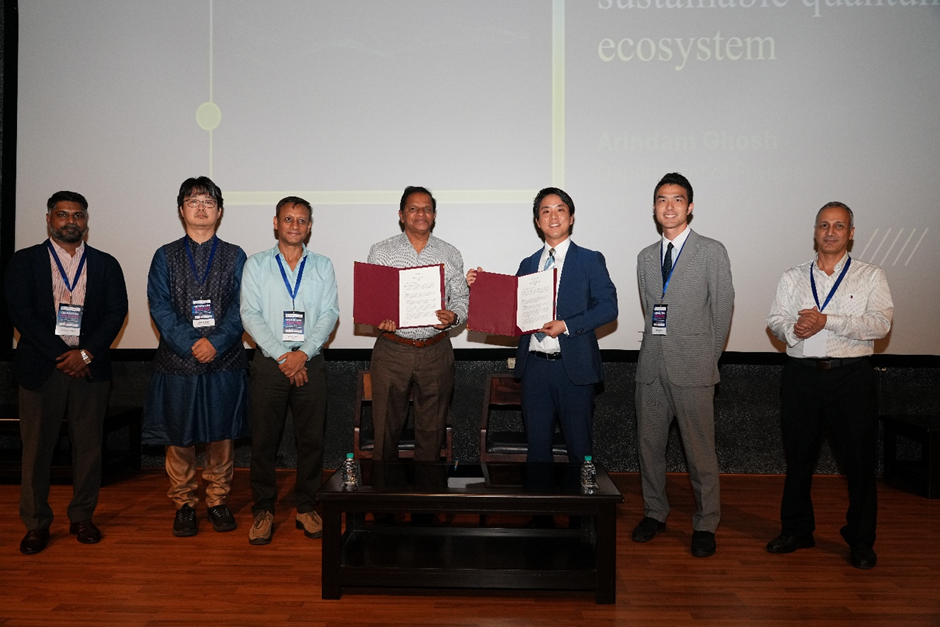
The Indian Institute of Science (IISc) in Bengaluru and Tokyo-based startup Yaqumo Inc. have signed a formal Letter of Intent (LoI) to establish a strategic research and development partnership in quantum technologies. This cross-border collaboration is engineered to accelerate the validation, demonstration, and future industrial deployment of scalable quantum computing frameworks across both nations. The agreement acts as an extension of the newly active India-Japan Digital Partnership 2.0 and the foundational bilateral Letter of Intent on Quantum Science, Technology, and Innovation signed on May 4, 2026, between the Cabinet Office of Japan and India’s Department of Science and Technology (DST).
Technical Architecture & Neutral-Atom Co-Design Infrastructure
The joint research roadmap directly tackles the engineering scaling limits of current quantum processing units (QPUs). While early quantum computers rely heavily on superconducting circuits or trapped-ion arrays that face significant wiring crosstalk and laser alignment complexities as qubit counts increase, Yaqumo’s core hardware architecture relies on neutral-atom technology. Originating out of pioneering cold-atom research labs at Kyoto University (Prof. Yoshiro Takahashi Laboratory) and the Institute for Molecular Science (Prof. Kenji Omori Laboratory), the platform utilizes optical tweezers—highly focused laser beams—to isolate, trap, and organize individual neutral atoms into dense, multi-dimensional grids. By adjusting laser intensity and geometry, the neutral-atom approach allows thousands of uniform physical qubits to coexist within a single vacuum chamber without a linear increase in control-wiring overhead. The IISc-Yaqumo collaboration will focus on a hardware-software co-design loop split across critical technical domains, including high-speed spatial light modulators and ultra-stable optical switches to increase gate-operation fidelities, while simultaneously engineering hardware-aware compiler passes and tailored optimization algorithms to automate active quantum error correction (QEC) decoding with fast clock rates directly on neutral-atom configurations.
Strategic Positioning & National Quantum Mission Alignment
The bilateral initiative integrates Yaqumo’s physical hardware development pipeline with IISc’s prominent positioning within India’s National Quantum Mission (NQM). Backed by a sovereign budget allocation from the Ministry of Electronics and Information Technology (MeitY), the NQM operates dedicated national research hubs designed to foster a domestic deep-tech supply chain and support place-based innovation ecosystems. By using IISc’s research laboratories and high-performance cleanrooms as validation testbeds for Yaqumo’s neutral-atom prototypes, the partnership secures an immediate real-world validation pathway for the Japanese startup, which recently raised $4.4 million in seed extension funding from global quantum VC Quantonation. This distributed ecosystem strategy provides India with verified access to next-generation quantum hardware, while offering Japanese deep-tech ventures an active international validation corridor, preparing both nations to eventually offload dense computational subroutines for core industrial verticals—including materials science engineering, pharmaceutical synthesis, and quantitative finance.
You can review the official corporate cross-border expansion brief via the Yaqumo Inc. news archive here. For contextual details regarding the startup’s underlying technology assets and prior seed extension capital distributions, read our previous coverage here.
May 28, 2026
In GQI Portal
The players behind the news
The team that writes QCR tracks every company, deal and technology in the GQI Factory, GQI's verified database of the quantum industry. Next up: every story linked to its players, coming to QCR's paid plans.
- Players Companies and institutions across the quantum industry, by segment.
- Scorecards How the players compare on hardware, software, funding and more.
Newsletter
QCR Alerts in your inbox
The latest reporting and analysis from Quantum Computing Report. Free, unsubscribe any time.