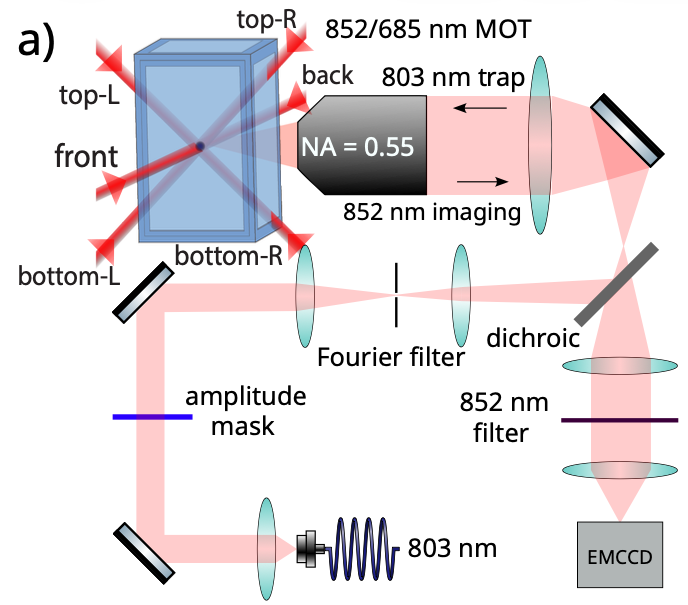
Infleqtion and the University of Wisconsin–Madison have demonstrated a nondestructive measurement technique for neutral-atom qubits, achieving a readout fidelity of 99.93% and an atom retention rate of 99.54%. The research, published in Physical Review Letters, utilizes a “forbidden” electric-quadrupole (E2) transition in cesium (Cs) atoms to perform background-free imaging while simultaneously cooling the qubit array. This approach addresses the scalability bottleneck of measurement-induced atom loss in neutral-atom architectures.
The technical architecture utilizes the 685 nm transition from the 6s1/2 ground state to the 5d5/2 excited state. Unlike traditional dipole transitions (D2 line), the 5d5/2 state possesses a significantly higher ratio of hyperfine splitting to radiative linewidth. This property enables high-fidelity, state-selective imaging with a suppressed rate of Raman depumping into the dark hyperfine ground state. Furthermore, the protocol integrates 3D laser cooling during the measurement cycle, maintaining the atoms at a temperature of 5.3 μK. This prevents heating-induced trap loss and enables repeated, low-loss measurements within the same computational circuit.
While the experimental integration time was recorded at 200 ms, the researchers provided a theoretical framework to reduce this to 60 μs. This speedup is achieved by quenching the long-lived 5d5/2 state using an auxiliary field at 3491 nm to stimulate emission to the 6p3/2 state. Numerical simulations indicate that this quenching method can increase the photon scattering rate by a factor of 50, potentially reaching a measurement fidelity of 99.95% at microsecond timescales. This temporal optimization is a prerequisite for executing the fast cycles required for quantum error correction (QEC).
This milestone supports Infleqtion’s technical roadmap as the company prepares for its public listing via a merger with Churchill Capital Corp X (NASDAQ: CCCX). By converging high-fidelity readout with continuous atom retention, the platform moves toward the “mid-circuit” measurement capabilities necessary for fault-tolerant operation. The research was supported by the National Science Foundation (NSF) and the U.S. Department of Energy (DOE) as part of the Q-NEXT center.
Read the official announcement from Infleqtion here and the full technical paper in Physical Review Letters here.
February 3, 2026
