
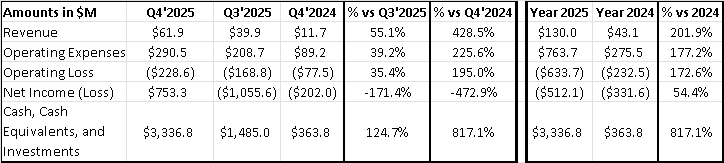
IonQ has announced its financial results for the fourth quarter and full year ending December 31, 2025. The company achieved a historic milestone as the first pure-play quantum computing firm to exceed $100 million in annual GAAP revenue. The table below summarizes key financial metrics for Q4 2025 compared with the prior quarter (Q3 2025) and the year-ago quarter (Q4 2024).
Financial and Strategic Inflection Point
The company reported $130.0 million in full-year revenue, a 202% increase over 2024. Notably, 60% of this revenue came from commercial customers, signaling that trapped-ion technology is moving beyond academic and government experimentation into industrial utility.
The Q4 GAAP Net Income of $753.7 million was primarily driven by a $949.6 million non-cash gain related to the change in fair value of warrant liabilities. On an adjusted basis, the company reported an Adjusted EPS of ($0.20) for the quarter.
Strategic liquidity reached an unprecedented $3.3 billion by year-end, bolstered by a $2 billion equity offering in October. This “war chest” has already been deployed toward aggressive vertical integration, most notably the pending acquisition of SkyWater Technology.
Roadmap Acceleration and Full-Stack Evolution
IonQ transitioned in 2025 from a hardware developer to a “Full-Stack Quantum Platform Company.” Key technical and operational milestones included:
- SkyWater Technology Acquisition: IonQ announced an agreement to acquire SkyWater, the leading U.S. quantum chip foundry. This move secures IonQ’s supply chain, providing onshore, merchant-supplier capabilities for quantum chips—a critical factor for government and defense contracts.
- 100-Qubit Milestone: The company sold its first fifth-generation, 100-qubit system to KISTI in South Korea. This system serves as the anchor for a national hybrid AI/HPC platform, integrating NVIDIA acceleration.
- AQ 64 Achievement: The IonQ Tempo system achieved its performance target of #AQ 64 three months ahead of schedule. IonQ claims this performance level provides a computational space significantly larger than any existing commercial superconducting system.
- Networking and Sensing: Following the acquisitions of Lightsynq and Capella, IonQ deployed operational national quantum networks in Switzerland, Slovakia, and Romania. The Capella integration specifically targets the development of a space-based Quantum Key Distribution (QKD) network.
Strategic Leadership Shifts
The quarter saw a major consolidation of leadership, with CEO Niccolo de Masi unanimously appointed as Chairman of the Board, succeeding Peter Chapman. The company continues to aggressively hire domain experts, adding Dr. Rick Muller (former IARPA Director) as VP of Quantum Systems and Marco Pistoia (formerly of JPMorgan Chase) as SVP of Industry Relations.
2026 Outlook
IonQ provided robust guidance for 2026, projecting revenue of between $225 million and $245 million not including the impact of the Skywater acquisition, nearly doubling its 2025 results. For Q1 2026, the company expects revenue in the range of $48 million to $51 million. The focus for the coming year will be the integration of SkyWater and the continued rollout of the Tempo system to commercial hubs like QuantumBasel, which recently expanded its agreement with IonQ to over $60 million.
The full press release for IonQ’s Q4 and Full Year 2025 results can be found here. A recording of IonQ’s webcast of its fourth quarter and full year 2025 earnings call can be found here. A Q4 2025 business and financial highlights investor presentation is available here. And the company’s annual 10-K report filed with the U.S. Securities and Exchange Commission can be accessed here.
February 25, 2026
