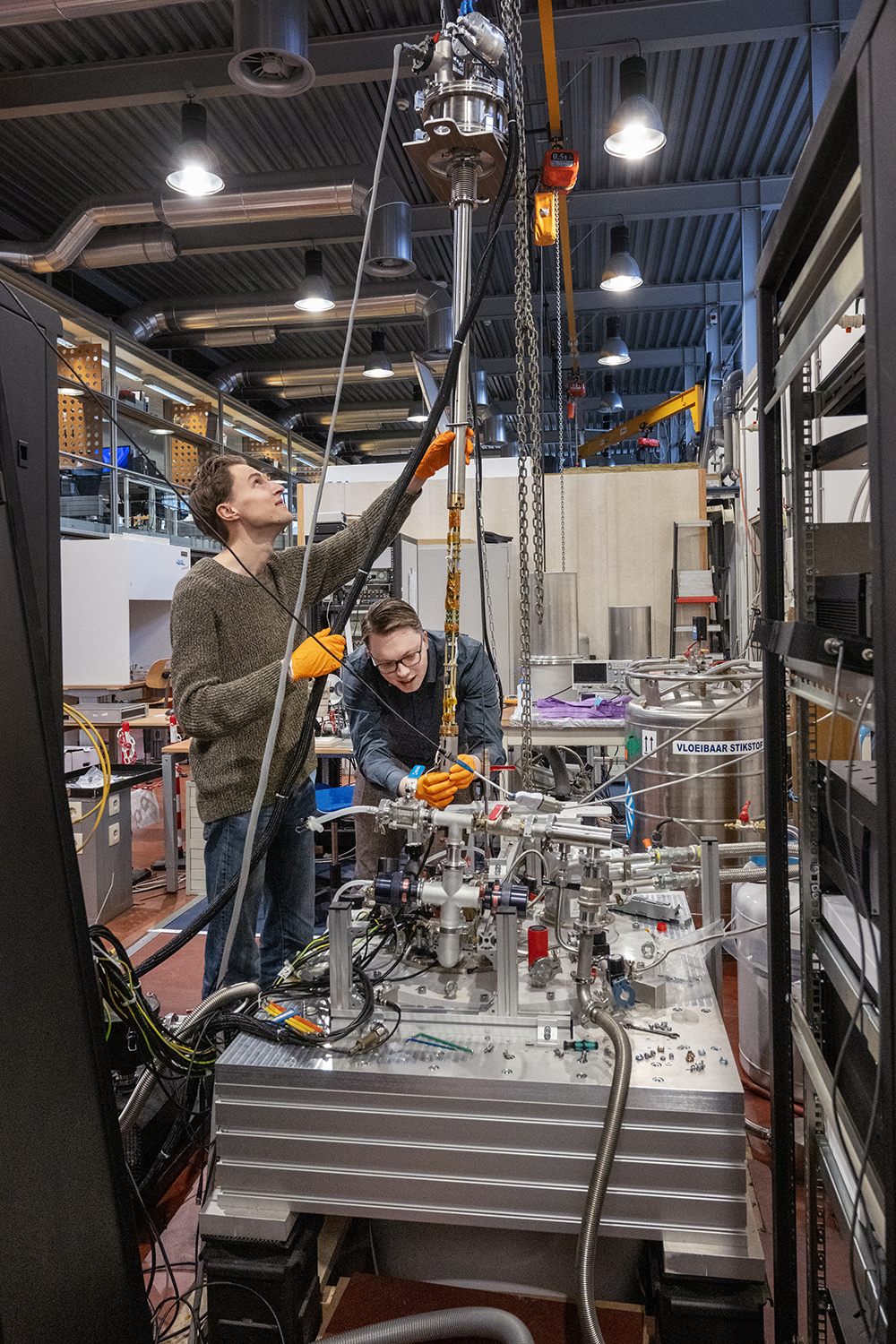
Physicists at Leiden University, in collaboration with the startup QuantaMap, have unveiled a breakthrough microscope specifically engineered for the “quantum age.” Published in Nano Letters on February 12, 2026, the Tapping-Mode SQUID-on-Tip (TM-SOT) microscope, affectionately nicknamed “Tortilla,” is the first industrial-grade tool capable of simultaneously imaging four critical material properties—temperature, magnetism, structure, and electrical behavior—with nanoscale precision in a single scan.
The technical core of the instrument is a nanoSQUID (Superconducting Quantum Interference Device) sensor integrated into the very tip of an atomic force microscope (AFM) probe. By utilizing tapping-mode feedback, the microscope maintains extreme stability even when scanning highly corrugated or “bumpy” surfaces, such as fully fabricated quantum chips. This non-invasive technique allows researchers to resolve nanoscale currents as small as 100 nA without the need for lasers or external radiation, which could otherwise disturb delicate quantum states.
The commercialization of this technology is being led by QuantaMap, a Leiden-based startup co-founded by Kaveh Lahabi. The company aims to solve a primary bottleneck in quantum manufacturing: the lack of localized diagnostic tools. While traditional testing can take weeks to determine if a finished chip works, QuantaMap’s system enables root-cause analysis at any fabrication stage. This allows developers to pinpoint why specific qubits underperform—whether due to thermal dissipation, magnetic impurities, or structural defects—thereby accelerating the design-fabrication-test cycle for scalable quantum processors.
For further details, read the official announcement from Leiden University here, explore the industry impact at Quantum Delta NL here, and access the technical paper, “Tapping-Mode SQUID-on-Tip Microscopy with Proximity Josephson Junctions,” in Nano Letters here.
February 14, 2026
