

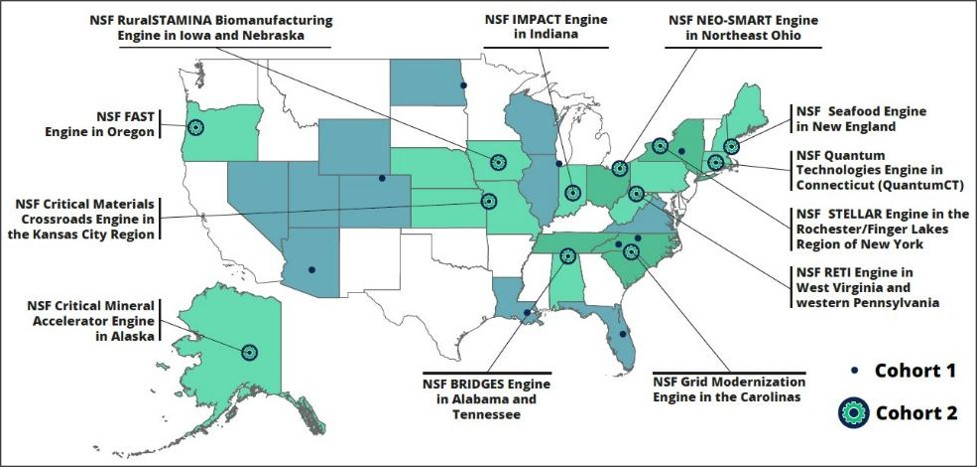
The U.S. National Science Foundation (NSF) has officially named Connecticut one of 12 regional winners in its highly competitive second cohort of NSF Regional Innovation Engines. Led by a robust public-private coalition, the NSF Quantum Technologies Engine in Connecticut (colloquially known as the QuantumCT Engine) will initially receive a two-year, $15 million award to accelerate the translation of quantum research into marketplace innovations.
By demonstrating sustained progress against rigorous performance milestones over the first two years, the regional tech cluster can unlock up to $160 million in federal funding from the NSF over the next decade.
                         [ QuantumCT Engine Matrix ]
  Lead Academic Hubs  ──► University of Connecticut (UConn) and Yale University.
  Initial Funding     ──► $15 Million over 2 years (potential for $160 Million over 10 years).
  State Co-Investment ──► $121 Million total state capital commitment ($60M newly unlocked).
  Operational Core    ──► Trapped-ion and superconducting hardware testbeds, deep-tech incubator.
  Industrial Targets  ──► National defense, aerospace, biotechnology, and financial services.
A $121 Million Public-Private Development Ecosystem
Among the 12 newly funded nationwide clusters, QuantumCT stands as the only engine dedicated exclusively to quantum technology information science. To maximize the impact of the federal award, Governor Ned Lamont confirmed that the State of Connecticut has pledged $121 million in matching state funds—comprising $60 million previously invested and an additional $60 million unlocked by the NSF selection. Administered alongside Connecticut Innovations and ConnCORP, this state funding will anchor a central quantum incubator and convening hub in New Haven to support early-stage startup creation.
The project transitions quantum discoveries from isolated laboratories into commercial infrastructure by uniting foundational research with mature industry ecosystems:
- Hardware & Testbed Partners: Tech innovators Quantinuum and D-Wave are actively partnering with the engine to deploy physical quantum computing testbeds. These facilities will allow developers to run hardware-calibrated experiments, such as testing Yale’s recent ERASE project (focused on erasure qubits and dynamic circuits for quantum advantage) and exploring topological decoders.
- Corporate Technology Adopters: Market leaders based in Connecticut—including RTX, Pfizer, Microsoft, Travelers, Amphenol, and Boehringer Ingelheim—are collaborating on applied research projects to embed quantum sensing, quantum materials, and secure cryptographic layers directly into their advanced product lines.
- Workforce Pipeline Integration: Southern Connecticut State University (SCSU) will lead the regional workforce development strategy. Operating through the CSCU Center for Quantum and Nanotechnology (QNT), this initiative establishes a technical talent conduit spanning UConn, Yale, and the Connecticut State Community College System. The program aims to train a diverse workforce and provide small and medium-sized regional manufacturing, biotech, and photonics businesses with quantum-ready operators.
With local technology adopters already supporting over 270,000 jobs and generating more than $28.7 billion in nationwide GDP, the QuantumCT Engine aims to secure the domestic quantum supply chain, expand venture backing, and transform the region into an operational epicenter for the global quantum market.
Review the nationwide cohort announcement here, and explore the technical focus areas of the second cohort profiles here. You can read the institutional launch perspectives via the UConn Today press feed here, or browse ongoing program specifications at the official QuantumCT portal here. For specific physics department updates and cross-institutional development history, read the Yale Department of Physics brief here and the primary YaleNews research hub analysis here.
In GQI Portal
The players behind the news
The team that writes QCR tracks every company, deal and technology in the GQI Factory, GQI's verified database of the quantum industry. Next up: every story linked to its players, coming to QCR's paid plans.
- Players Companies and institutions across the quantum industry, by segment.
- Scorecards How the players compare on hardware, software, funding and more.
Newsletter
QCR Alerts in your inbox
The latest reporting and analysis from Quantum Computing Report. Free, unsubscribe any time.