Osaka University’s Center for Quantum Information and Quantum Biology (QIQB) and Fixstars Corporation have established a new benchmark in classical quantum simulation, utilizing 1,024 NVIDIA H100 GPUs to surpass the traditional 40-qubit “glass ceiling.” By leveraging the ABCI-Q system at Japan’s National Institute of Advanced Industrial Science and Technology (AIST), the joint team successfully executed one of the world’s largest state-vector-based simulations of quantum chemistry circuits. This achievement provides a critical high-fidelity testbed for the development and validation of algorithms intended for future Fault-Tolerant Quantum Computers (FTQC).
The team’s technical methodology focused on Iterative Quantum Phase Estimation (IQPE), a core subroutine in quantum chemistry designed to extract precise energy eigenvalues while minimizing the required number of ancillary qubits. The researchers implemented this algorithm within the “chemqulacs-gpu” simulator, an optimized version of the Qulacs library tailored for GPU clusters. Because IQPE is significantly more resource-efficient than standard QPE, it is considered a primary candidate for industrial applications in drug discovery and materials development once error-corrected hardware becomes viable.
To maintain efficiency across such a massive hardware footprint, the team developed a bespoke parallel computing architecture to resolve the inter-GPU communication bottlenecks that typically stall state-vector simulations at high qubit counts. Distributing a state vector for over 40 qubits requires managing an astronomical amount of data—the memory requirement doubles with each added qubit. Fixstars provided the performance profiling and tuning expertise necessary to synchronize the 1,024 H100 GPUs on the ABCI-Q cluster, ensuring that the computational overhead did not negate the benefits of the massive parallelization.
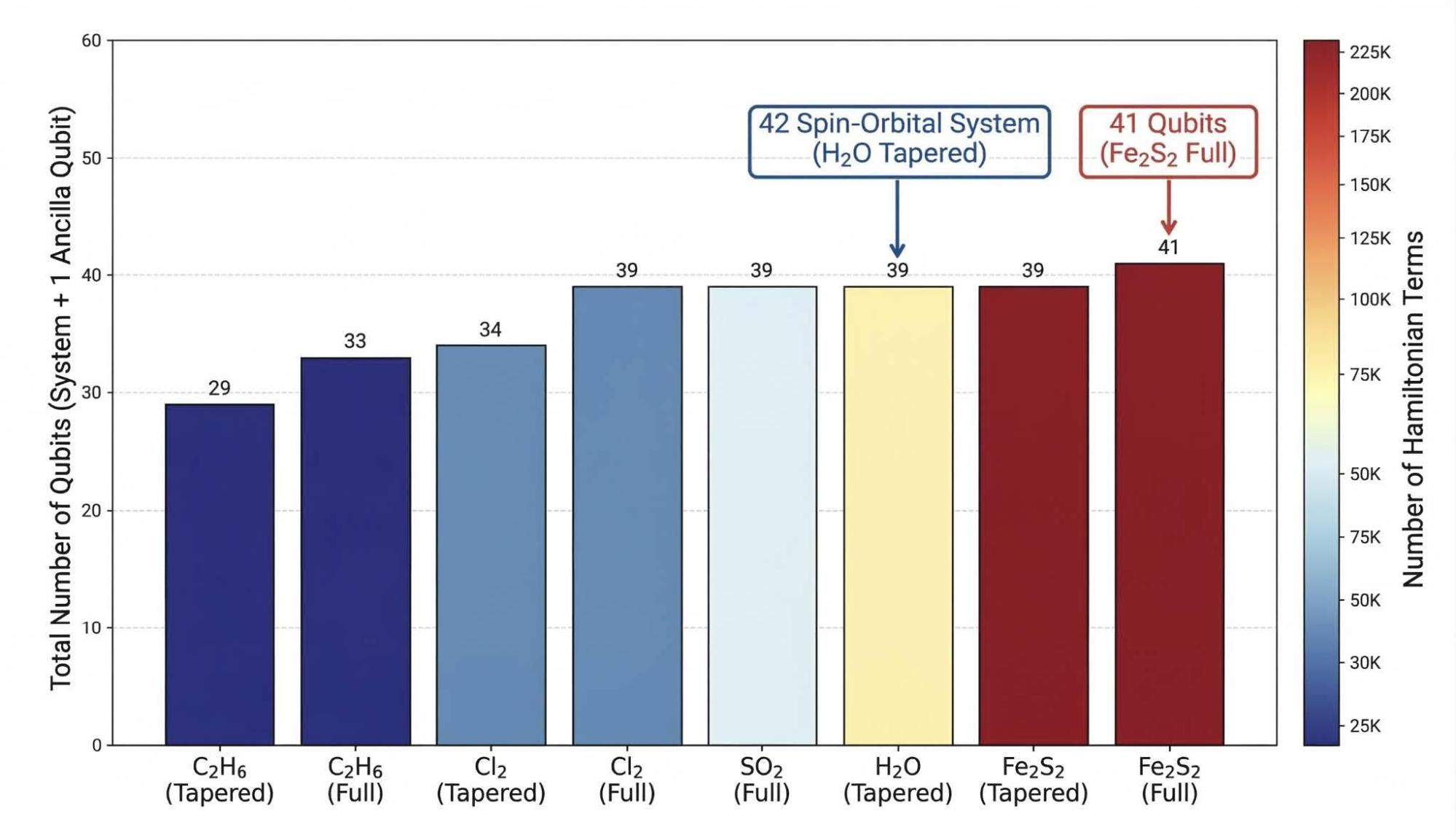
The simulation achieved two major milestones in molecular complexity: a 42-spin-orbital system for an H2O molecule and a 41-qubit pure circuit benchmark for an Fe2S2 (iron-sulfur) cluster. Modeling iron-sulfur clusters is notoriously difficult for classical computers due to their complex electronic structures, yet they are vital for understanding biological processes like nitrogen fixation and photosynthesis. By successfully simulating these systems, the researchers have expanded the scale of molecular models available for vetting the Hamiltonians and gate sequences that will eventually drive discovery in catalysts and new materials.
This collaboration underscores the strategic importance of pre-hardware algorithm validation. As the industry moves closer to the FTQC era, it is essential to have classical “gold standards” to ensure that quantum subroutines perform as expected when scaled. The ability to simulate 42-qubit circuits on classical supercomputers allows researchers to “de-risk” their software stacks today, ensuring that the industrial tools for molecular screening are rigorously tested before the arrival of large-scale, fault-tolerant systems. This work highlights a maturing shift toward treating software optimization as a foundational pillar of the quantum utility roadmap.
For the complete technical breakdown and the GTC 2026 presentation (Session P81339), consult the official Fixstars announcement here and the Osaka University research news here.
April 4, 2026

Leave A Comment