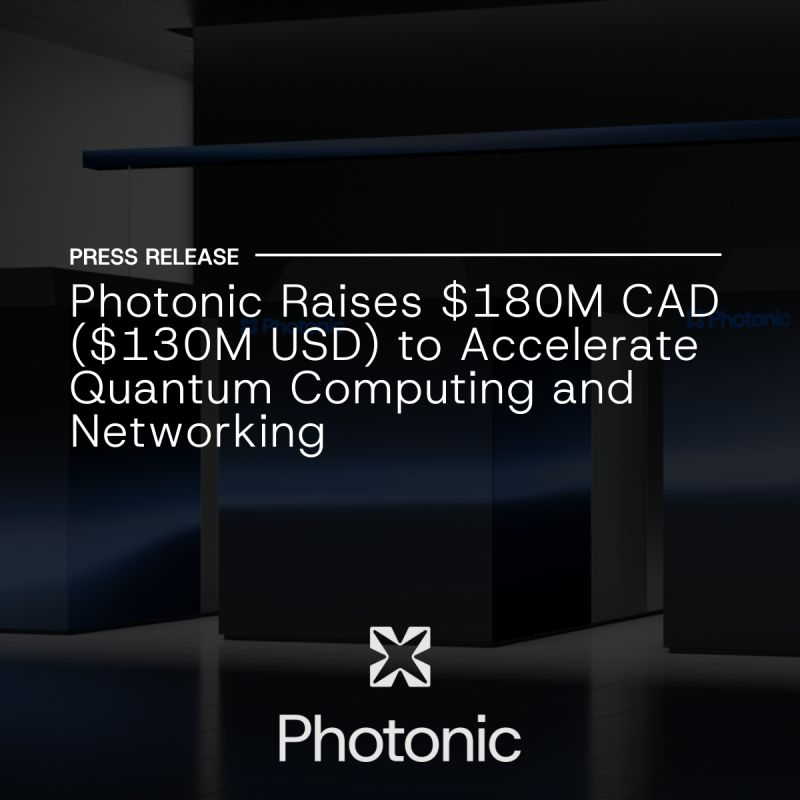
Photonic Inc. has raised $180 million CAD ($130 million USD) in the first close of a new funding round led by Planet First Partners. The investment, which includes new participation from the Royal Bank of Canada (RBC) and TELUS, brings the company’s total capital raised to $375 million CAD ($271 million USD). Returning investors include BCI and Microsoft, signaling continued institutional support for Photonic’s mission to build the first commercial-scale, fault-tolerant quantum computer using a distributed networking approach. Evercore acted as the sole placement agent for the transaction.
The company’s technical roadmap centers on its Entanglement First™ Architecture, which utilizes a unique qubit modality: optically linked silicon spin qubits based on “T center” defects in silicon. Unlike traditional monolithic quantum processors, this architecture treats networking as a native feature, enabling any-to-any connectivity through telecom-fiber links without the need for lossy wavelength conversion. This high-connectivity graph is designed to support Quantum Low-Density Parity-Check (QLDPC) codes, which Photonic claims can perform efficient error correction using significantly fewer physical qubits than standard surface codes.
Strategically, the inclusion of RBC and TELUS as investors highlights the growing commercial interest in distributed quantum technologies for secure telecommunications and financial risk modeling. The new capital will be used to advance key product milestones—including the further integration of Photonic’s architecture into the Microsoft Azure cloud environment—and to expand the company’s technical teams in Canada, the United States, and the United Kingdom. This funding follows Photonic’s selection for the Canadian Quantum Champions Program, a federal initiative providing up to $23 million in additional support to anchor high-value quantum talent and intellectual property within the country.
Read the official press release here, the technical overview of the silicon T-center platform here, and the distributed entanglement milestone announcement here.
January 6, 2026
