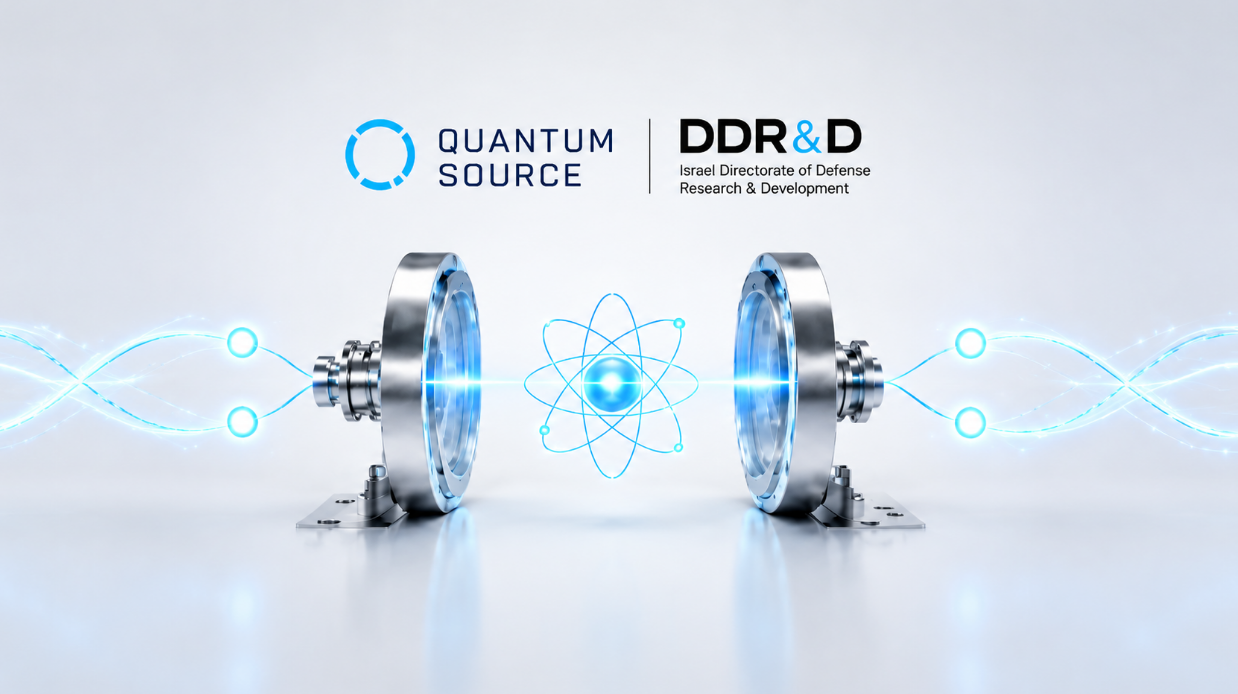
Israeli quantum hardware developer Quantum Source Labs, in collaboration with the Israel Directorate of Defense Research & Development (DDR&D / MAFAT), has demonstrated the on-demand generation of polarization-entangled photon pairs in the robust quantum singlet Bell state. Emitted from a single rubidium atom trapped within a microscopic optical cavity, the deterministic photon pairs were transmitted through more than one kilometer of standard optical fiber under continuously changing physical conditions. The distributed entanglement arrived at its destination with no measurable loss in fidelity, completely bypassing the need for active polarization stabilization, feedback systems, or channel calibration loops.
                         [ Quantum Source Hardware Profile ]
  Target Application  ──► Calibration-free metropolitan QKD, quantum repeaters, and distributed QPUs.
  Physical Interface  ──► Single Rubidium (87Rb) atom strongly coupled to a micro-cavity.
  Emitted State       ──► Singlet Bell state (maximally entangled, rotationally invariant).
  Transmission Testbed──► 1 km+ of standard, unstabilized commercial optical fiber.
  Key Advantage       ──► Deterministic, on-demand generation with complete immunity to fiber drift.
Historically, quantum networks have relied on probabilistic processes like Spontaneous Parametric Down-Conversion (SPDC) to generate these pairs. Under SPDC, photons are produced randomly, creating a fundamental trade-off where pushing for higher generation rates spikes the probability of multiple-pair generation errors. Quantum Source eliminates this operational bottleneck by leveraging cavity quantum electrodynamics (cavity QED) to trap a single rubidium atom inside a micro-cavity, which amplifies the atom-photon interaction. Upon receiving an external trigger, the atom emits exactly two entangled photons in rapid succession on a tens-of-nanosecond timescale, yielding a reliable source of high-brightness, high-fidelity entangled pairs.
By configuring the atom to emit photons exclusively in the rotationally invariant singlet Bell state, the platform naturally neutralizes polarization drift caused by environmental disturbances like temperature fluctuations, mechanical bending, and physical stress along the fiber line. Any identical polarization rotation experienced by both photons as they travel down the same path is mathematically canceled out, allowing the entanglement to emerge intact without the complex real-time stabilization hardware traditionally required in quantum communication links. This combination significantly lowers the infrastructure footprint and operational costs needed to deploy metropolitan quantum key distribution (QKD), distributed computing interconnects, and long-range quantum repeaters directly into existing commercial telecom conduits.
Review the official corporate rollout details via the Quantum Source Executive Announcement here, or browse the foundational technology roadmaps on the main Quantum Source Hub here.
July 17, 2026
