
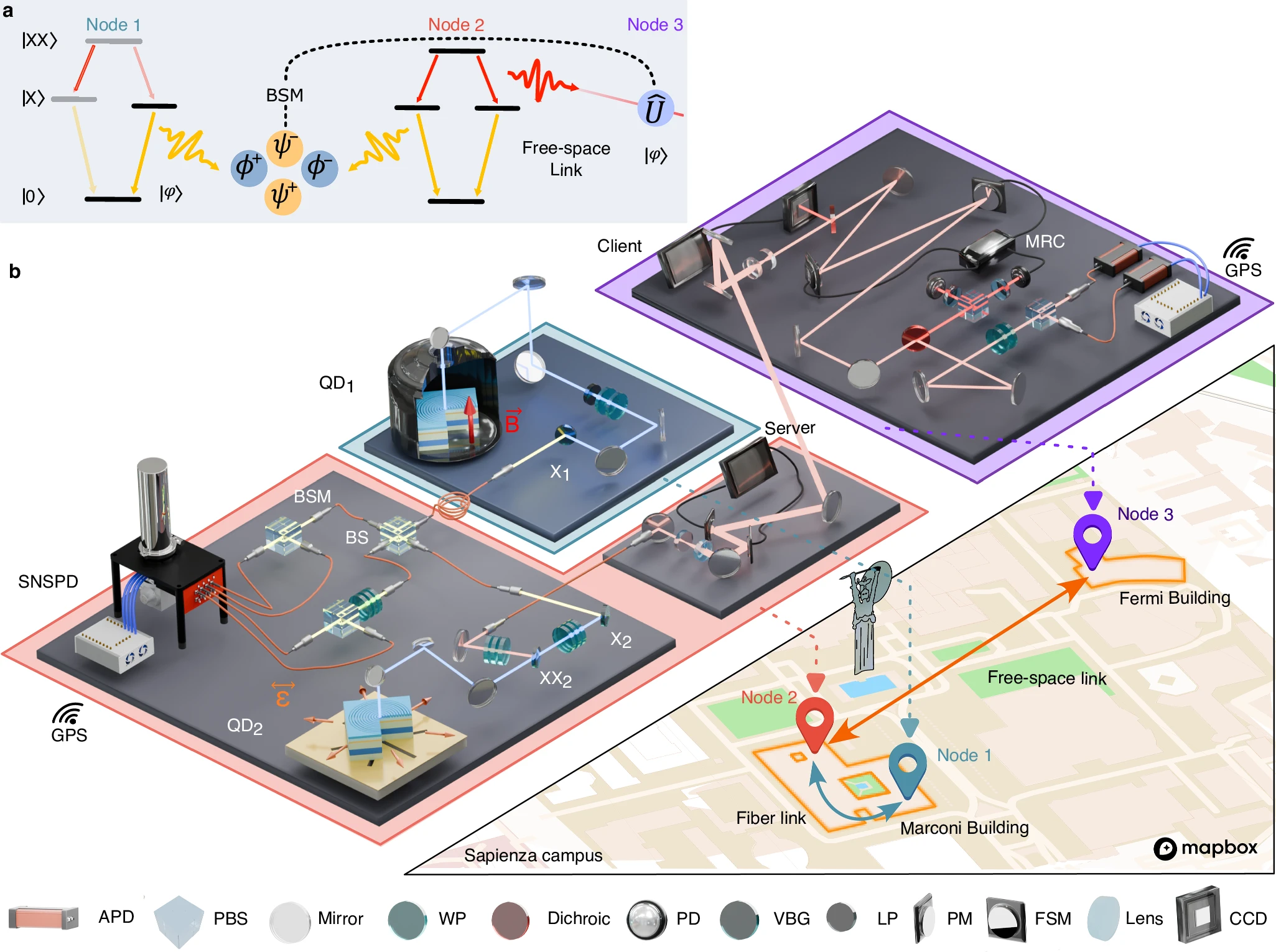
An international research team has achieved a critical breakthrough for quantum communication networks by successfully demonstrating quantum teleportation between photons generated by two independent and dissimilar semiconductor quantum dots (QDs). This successful all-photonic quantum teleportation, published in Nature Communications, is an essential step towards realizing scalable quantum relays and a practical quantum internet.
The challenge overcome was the ability to interface distinct quantum emitters, which inevitably have mismatched optical properties. The collaboration, involving researchers from Paderborn University (Germany) and Sapienza University of Rome (Italy), engineered a complex experimental protocol to solve this issue. The team achieved a teleportation fidelity of 82±1%, surpassing the classical limit by more than ten standard deviations.
The technical solution involved two primary stages of engineering: first, controlling the quantum emitters themselves. The GaAs QDs were embedded in nanophotonic cavities and integrated onto piezoelectric actuators to precisely control the electron structure and achieve ultra-low Fine Structure Splitting (FSS), necessary for generating high-fidelity entangled photon pairs. Second, the photons were engineered for indistinguishability by employing magnetic fields to tune the emission wavelength and utilizing ultrafast superconductive nanowire single photon detectors (SNSPDs) for precise temporal post-selection.
The protocol was successfully implemented in a hybrid quantum network over the Sapienza University campus in Rome, utilizing both fiber connections and a 270 meter free-space optical link. This field demonstration of all-photonic quantum teleportation in an urban communication scenario confirms the viability of using solid-state deterministic emitters to realize quantum relays, overcoming the range limitations of terrestrial fiber networks.
The achievement paves the way for the next major phase: demonstrating “entanglement swapping” between two deterministic QD sources. This is a key requirement for building a true quantum repeater based on QD emitters and confirms that the implementation of a QD-based quantum network for information processing is a likely perspective in the foreseeable future.
Read the full paper: “Quantum teleportation with dissimilar quantum dots over a hybrid quantum network” in Nature Communications here and the Paderborn University press release here.
December 7, 2025
