

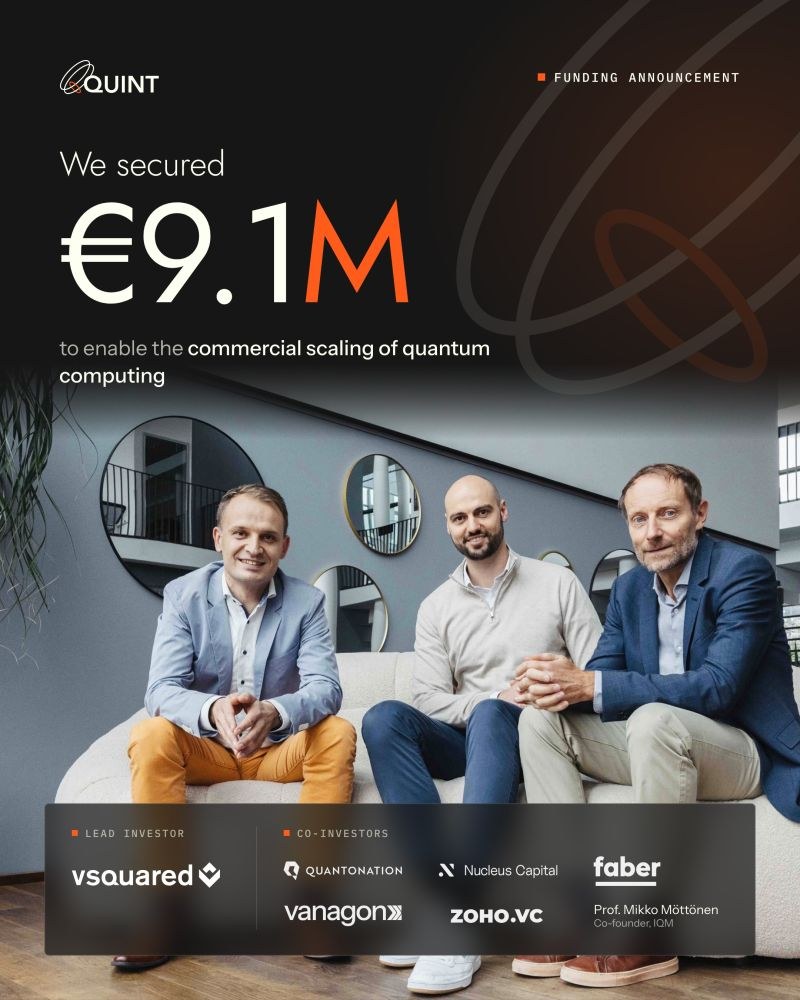
Erlangen-based quantum hardware startup Quint Computing has raised €9.1 million ($10.2 million USD) in seed funding, marking Germany’s largest-ever first financing round for a quantum computing firm. Led by Vsquared Ventures, the round includes backing from Quantonation, Nucleus Capital, Faber, Vanagon Ventures, ZOHO.VC, and Mikko Möttönen (co-founder of IQM and QMill). The equity capital is paired with a competitive €2.2 million ($2.46 million USD) European Innovation Council (EIC) Pathfinder grant, funding the commercialization of an architecture designed to reduce physical error-correction overhead by up to a factor of 100.
| Quint Computing Corporate & Technical Specifications | ||
|---|---|---|
| Dimension | Key Details | Operational & Architectural Context |
| Founding & Origins | Founded Oct 2025; spin-out from FAU Erlangen-Nürnberg | Part of the Munich Quantum Valley; led by Prof. Christopher Eichler (CEO), Prof. Michael Hartmann (CTO), and Dr. Jona Stinner (CFO). |
| Advisory Board | Prof. Florian Marquardt, Dr. Reinhard Ploss, Dr. Markus Hoffmann | Draws leadership from the Max Planck Institute for the Science of Light, Infineon Technologies, and Google Quantum AI. |
| Hardware Architecture | Superconducting circuits with continuous electrical stabilization | Suppresses dominant error mechanisms directly within physical circuit elements rather than relying solely on multi-qubit code concatenation. |
| Commercial Roadmap | Industrial pilots with Bosch, BASF, and Boehringer Ingelheim | Targets fault-tolerant simulation of complex chemical processes (e.g., liver enzyme drug metabolism) and materials design. |
| Expansion Goals | Team growth from 10 to ~40 specialists by 2028 | Recruiting across chip layout, cleanroom fabrication, decoder implementation, and algorithmic applications. |
Conventional superconducting architectures running 2D surface codes typically require thousands of physical qubits to encode a single protected logical qubit because physical error rates remain close to threshold boundaries. Quint’s patented design integrates continuous electrical control directly into the processor layout to stabilize individual circuit elements against noise before outer software codes are applied. By establishing an engineered error hierarchy at the physical level—analogous to biased bosonic systems—the platform aims to run streamlined error-correcting codes that preserve native gate clock speeds while significantly lowering cryogenic heat loads and physical wiring counts.
While the founders have demonstrated single-element stabilization in prior research at ETH Zurich and Google Quantum AI, the primary technical milestone for the company will be scaling multi-qubit fabrics without degrading gate speeds or inducing spectator-qubit crosstalk during two-qubit entangling operations.
Review the Official Press Release here with investment details shared in the LinkedIn Announcement here.
In GQI Portal
The players behind the news
The team that writes QCR tracks every company, deal and technology in the GQI Factory, GQI's verified database of the quantum industry. Next up: every story linked to its players, coming to QCR's paid plans.
- Players Companies and institutions across the quantum industry, by segment.
- Scorecards How the players compare on hardware, software, funding and more.
Newsletter
QCR Alerts in your inbox
The latest reporting and analysis from Quantum Computing Report. Free, unsubscribe any time.