

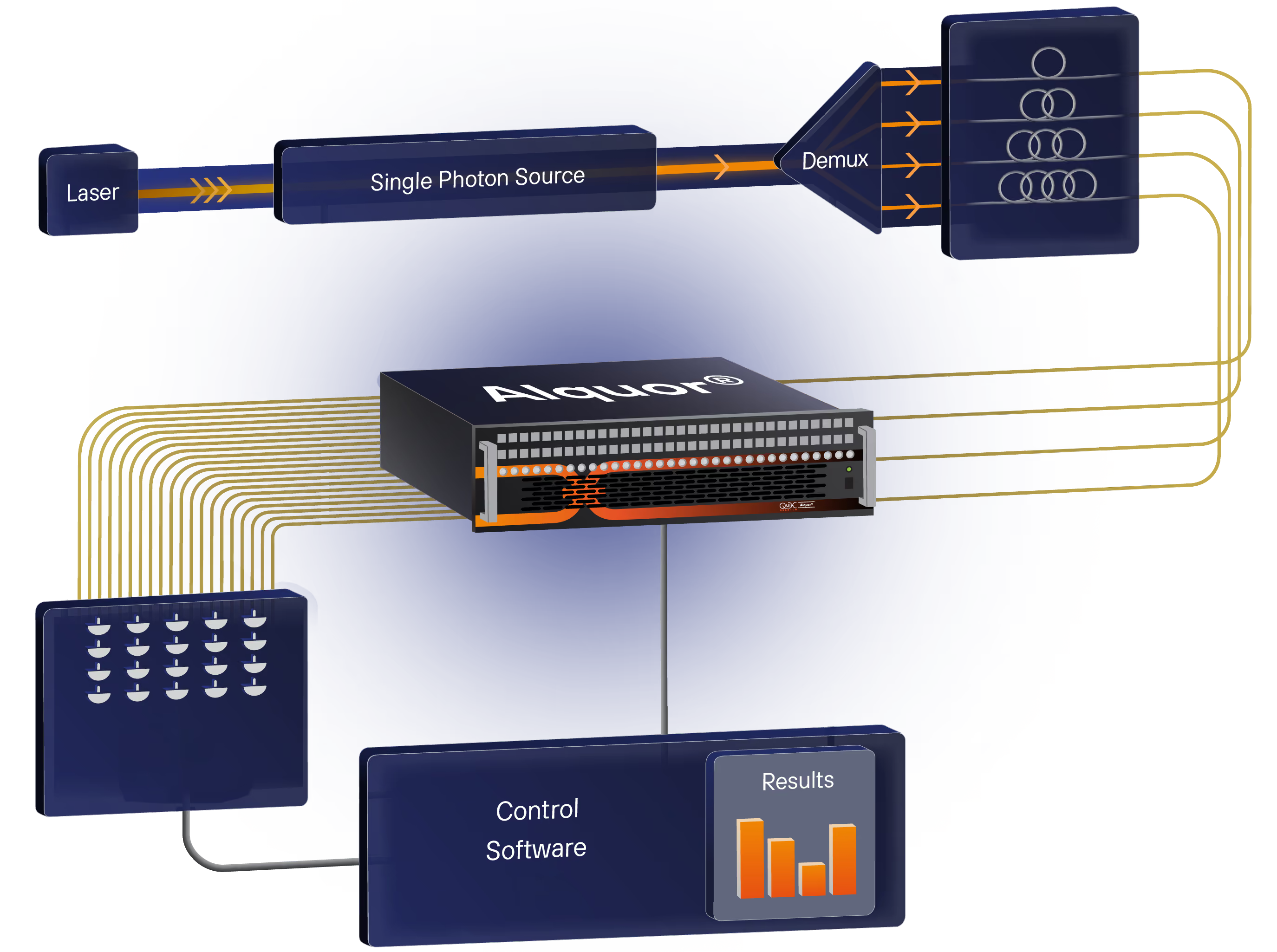
Enschede, Netherlands-based hardware developer QuiX Quantum has announced the commercial availability of Alquor 2.0, the second generation of its rack-mountable quantum photonic processor platform. Built on silicon nitride (Si3N4) photonic integrated circuits (PICs), the programmable linear optical interferometer system is offered in 8-mode, 20-mode, and 32-mode configurations. The platform is designed to transition quantum optics, boson sampling, quantum communications, and optical information processing research from manual, free-space optical table setups to a stable, rack-mountable unit.
Alquor 2.0 integrates directly into QuiX Quantum’s Photonic Assembly Control Unit (PACU) architecture and features a 3U 19-inch chassis designed for laboratory, data center, and high-performance computing (HPC) environments. Operating at room temperature, the system incorporates current-driver-based control electronics engineered to suppress electrical crosstalk across phase shifters, managing up to 1,000 thermo-optic modulators. The architecture includes 32 high-speed RF connectors for interfacing with external control systems and active feed-forward mechanisms, alongside air-cooled thermal management, a Python API for lab workflow automation, and hot-swappable photonic assemblies pre-loaded with local calibration data.
                   [ Alquor 2.0 Photonic Stack Architecture ]
                                       │
     ┌─────────────────────────────────┴─────────────────────────────────┐
     ▼                                                                   ▼
  Photonic Integration (Si3N4 PIC)                      Control & Interconnect Layer
  • 8-Mode, 20-Mode, or 32-Mode Interferometers.        • PACU Control Architecture (3U 19-inch).
  • Room-Temperature Low-Loss Waveguides.               • Current-Driven Control (Up to 1,000 Modulators).
  • Hot-Swappable Assemblies with On-Chip Calibration.  • 32 RF Connectors for Nanosecond Feed-Forward.
With over 20 first-generation units deployed to date, the Alquor platform has served as an experimental testbed for third-party academic and institutional research:
- Dissipative Quantum Systems: Researchers at ENEA and INFN Roma Tre demonstrated leaking quantum walks with controllable absorbing boundaries on a 20-mode Alquor processor to simulate non-Hermitian quantum dynamics on-chip (arXiv:2601.13269).
- Molecular Vibronic Spectra: A joint team from Paderborn University and HQS Quantum Simulations reconstructed molecular vibronic spectra using Gaussian boson sampling under a linear-coupling approximation (arXiv:2507.19442).
- Boson Sampling Benchmarks: Fraunhofer IOF, Menlo Systems, and Paderborn University integrated a 12-mode processor into the Paderborn Quantum Sampler to compare Gaussian and non-Gaussian boson sampling (arXiv:2512.08433).
- Photon Distillation: Researchers at Freie Universität Berlin, NASA Ames Research Center, and the University of Twente demonstrated photon distillation on a 20-mode processor to reduce photon indistinguishability errors (arXiv:2601.05947).
- Computational Acceleration & Search Algorithms: University of Twente researchers utilized a 12-mode processor as a hardware accelerator for Monte Carlo integration (arXiv:2509.25404), while teams at the University of Queensland, University of Western Australia, and Pawsey Supercomputing Centre implemented deterministic Grover search algorithms with 99.77% average success probability (arXiv:2506.06435).
QuiX Quantum has structured commercial pricing across three tiers: €240,000 for the 8-mode processor, €490,000 for the 20-mode processor, and €790,000 for the 32-mode processor. The company is offering an early adopter program that applies a 20% discount on 8-mode orders placed by academic and public research institutions through September 30, 2026.
Review the official commercial launch on QuiX Quantum News here, inspect product specifications here, and examine our previous coverage of QuiX Quantum’s Carina Core Hardware Delivery to DLR QCI here, Feed-Forward Control Unit Deployment here, and Dedalo Photonic Architecture Blueprint here.
In GQI Portal
The players behind the news
The team that writes QCR tracks every company, deal and technology in the GQI Factory, GQI's verified database of the quantum industry. Next up: every story linked to its players, coming to QCR's paid plans.
- Players Companies and institutions across the quantum industry, by segment.
- Scorecards How the players compare on hardware, software, funding and more.
Newsletter
QCR Alerts in your inbox
The latest reporting and analysis from Quantum Computing Report. Free, unsubscribe any time.