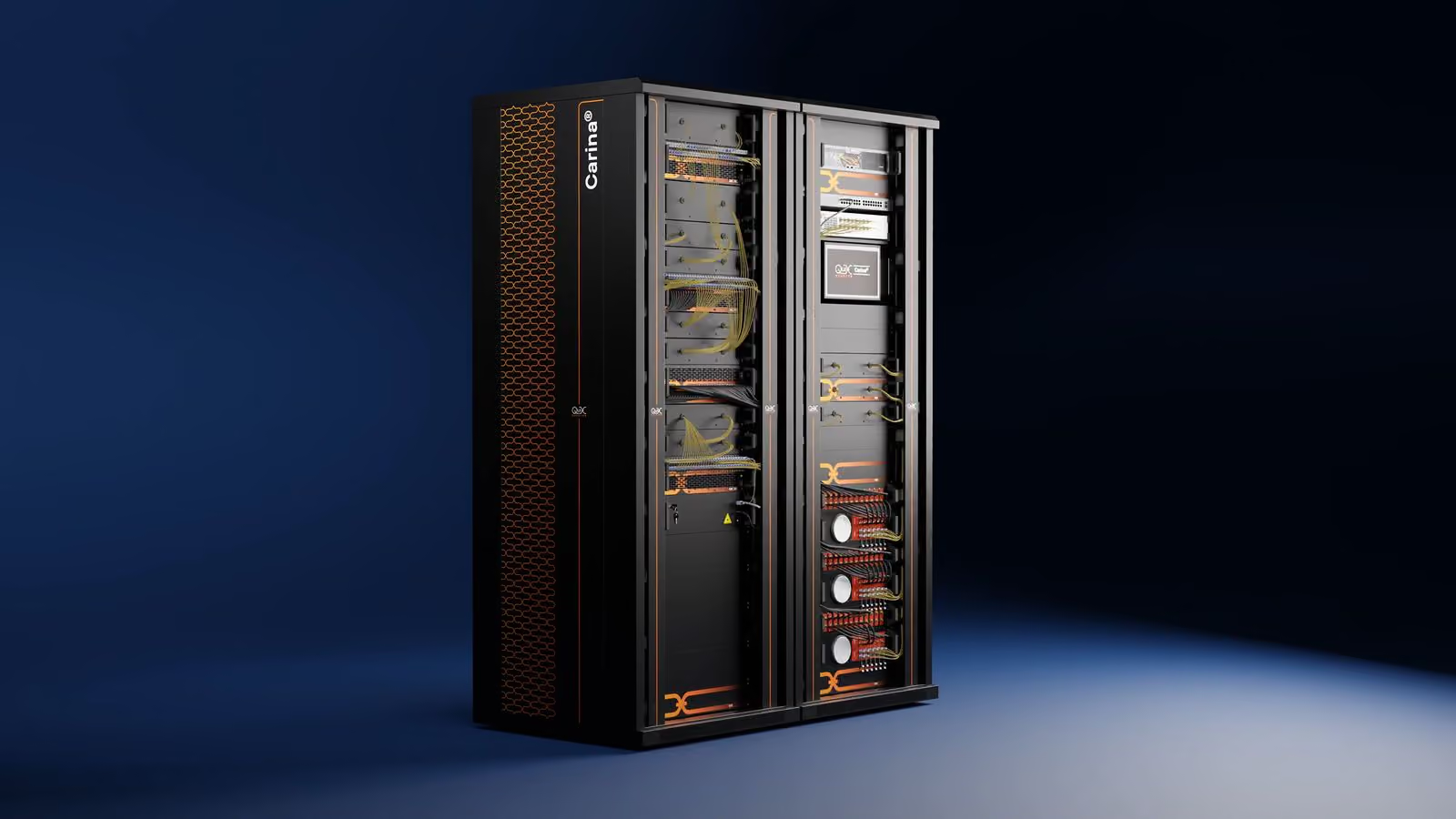
Photonic quantum hardware developer QuiX Quantum has announced the commercial launch and physical delivery of Carina, a universal photonic quantum computing architecture designed for data center deployment. Developed under the Universal Photonic Quantum Computer (UPQC) project for the German Aerospace Center’s Quantum Computing Initiative (DLR QCI), the room-temperature system marks a shift from laboratory component design toward unified system-level validation.
The hardware has been delivered to DLR QCI’s innovation centers to undergo multi-month integration, calibration, and operational readiness benchmarking.
                         [ QuiX Quantum Carina System Matrix ]
  Core Project Target ──► Universal Photonic Quantum Computer (UPQC) roadmap for DLR QCI.
  Computing Paradigm  ──► Measurement-Based Quantum Computing (MBQC) using single photons.
  Operational Thermals──► Room-temperature photonic array with rack-based structural modularity.
  Hardware Provenance ──► Silicon nitride (SiN) processor architectures manufactured in Europe.
Taming Probabilistic Scaling via Measurement-Based Architectures
Historically, linear optics quantum computing architectures have faced a structural divide. Systems like Boson Samplers were relatively straightforward to manufacture and operate in near-term environments but were limited by narrow, special-purpose computational models. Conversely, scaling a photonic system toward a universal gate-set—capable of executing any arbitrary quantum algorithm—depended on taming the fundamentally probabilistic nature of photon-photon interactions.
The Carina architecture overcomes this engineering challenge by implementing a Measurement-Based Quantum Computing (MBQC) framework, which shifts the computational workload from active gate manipulation to state measurement. Rather than relying on deterministic logic gates that require photons to interact directly mid-flight, MBQC uses a multi-tiered on-chip tracking sequence:
- Heralded Single-Photon Generation: On-chip nonlinear optical processes generate continuous streams of individual photons.
- Switching and Multiplexing Arrays: Successful photon generation events are synchronized in real time through an integrated network of high-speed electro-optical switches and fiber delay-line corridors.
- On-Chip Cluster-State Generation: Entangled resource states (cluster states) are woven natively on the silicon nitride substrate, creating the entangled network required for measurement-driven computation.
- Adaptive Measurement Layer: The system executes adaptive single-qubit operations across reconfigurable photonic integrated circuits, evaluating measurement outcomes on the fly.
Data Center Integration and Real-Time Feed-Forward Systems
Unlike alternative hardware modalities that rely on extensive sub-Kelvin cryogenic refrigeration units, much of the Carina stack operates at room temperature. This environmental stability allows the chassis to align with standard optical networking protocols and rack-mounted data center infrastructure, facilitating hybrid co-processing alongside classical High-Performance Computing (HPC) and AI clusters.
To shift the optical hardware out of laboratory cleanrooms and into standard enterprise racks, the system relies on two proprietary control abstractions:
- Photonic Assembly Control Unit (PACU): This module provides a standardized, structural control layer over the underlying photonic chips and reconfigurable optoelectronic matrix elements.
- Feed-Forward Control Unit (FFCU): This high-speed processing block converts signals from single-photon detectors directly into real-time routing actions on the photonic integrated circuits. By computing measurement results and reconfiguring subsequent switch paths before downstream photons advance, the FFCU guarantees deterministic universality.
The modular platform is backed by “below-threshold” error mitigation protocols that suppress physical qubit errors to levels compatible with future fault-tolerant systems. By anchoring its hardware deployment to scalable silicon nitride foundries within Europe, QuiX Quantum intends to use Carina as the physical validation layer for its upcoming next-generation Dedalo architecture, which will introduce full-scale logical qubit routing and loss-protection mechanisms.
Review the official corporate disclosure here, with additional delivery details available here, or explore the hardware specifications here. The architectural blueprints and error-mitigation data are available in the technical white paper here. For details regarding system integration at the Ulm Innovation Centre and future ecosystem access via the QCI Connect compute service, consult the DLR QCI programmatic updates here.
July 14, 2026
