QuiX Quantum, in collaboration with NASA’s Quantum Artificial Intelligence Laboratory, the University of Twente, and Freie Universität Berlin, has demonstrated “below-threshold” error mitigation on a photonic quantum computer. The experiment, conducted on the QuiX Bia™ Cloud Quantum Computing Service, represents the first hardware-level verification of net-positive error reduction in a photonic system. By suppressing physical qubit errors to levels compatible with fault-tolerant scaling, the project addresses the “distinguishability” bottleneck that typically degrades quantum interference in single-photon sources.
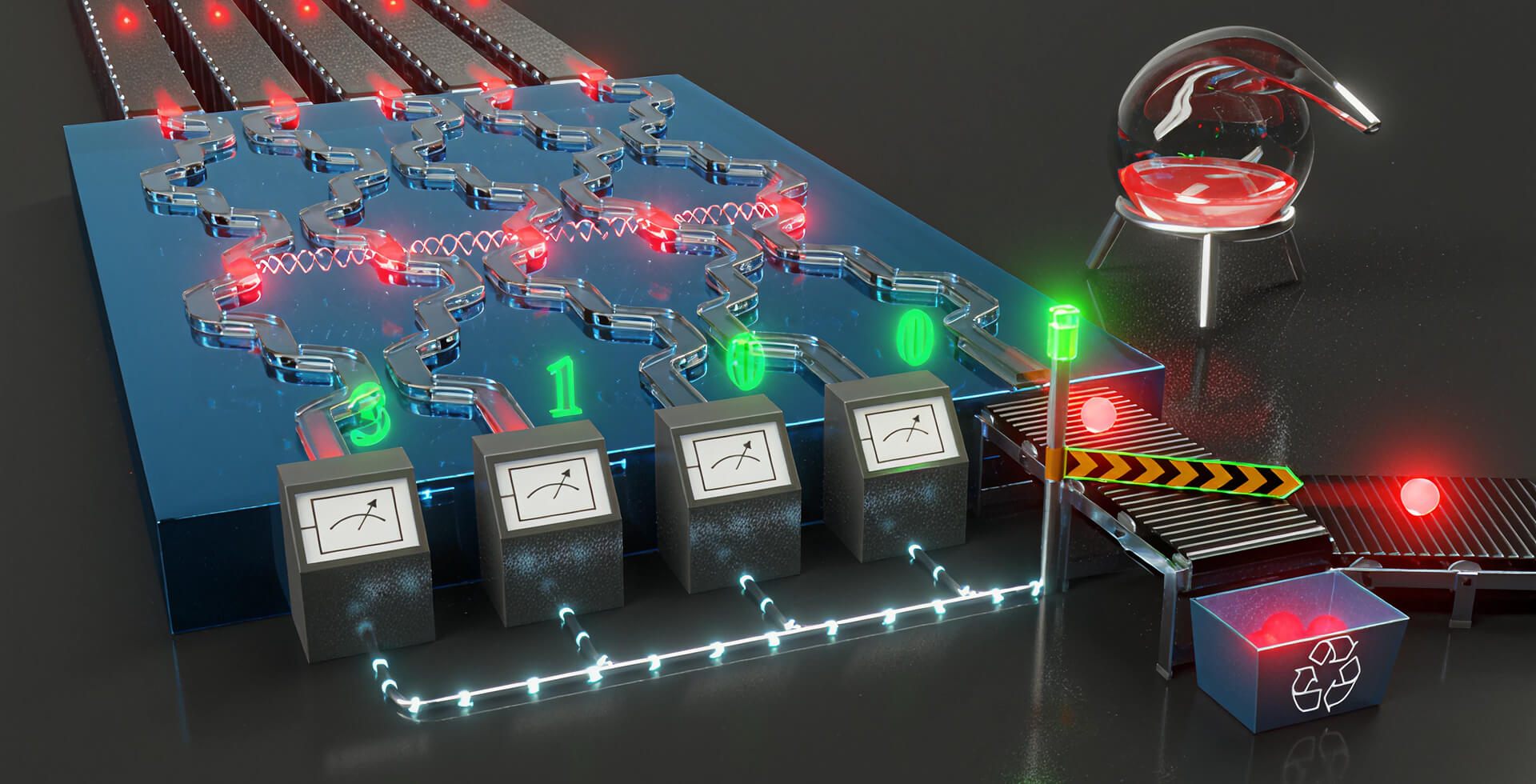
The methodology utilizes photon distillation, an intrinsically bosonic, coherent error-mitigation technique. Unlike traditional Quantum Error Correction (QEC), which relies on heavy qubit redundancy and classical post-processing, photon distillation employs quantum interference among multiple imperfect photons to project them into purified internal states. This process utilizes a multimode optical Fourier transform to “distill” higher-quality, more indistinguishable photons before computation begins. This hardware-level approach is intended to serve as a pre-processing step to reduce the computational overhead and resource requirements of subsequent fault-tolerant layers.
Using a programmable 20-mode photonic processor, the research team demonstrated a photon distillation gate that reduced photon indistinguishability error by a factor of 2.2x. Despite the introduction of additional noise inherent to the gate’s operation, the device delivered a 1.2x net reduction in total error. This result confirms “net-gain” mitigation, satisfying the fundamental requirement that an error-management protocol must remove more entropy from the system than it introduces.
Numerical modeling associated with the study indicates that integrating photon distillation into photonic architectures could reduce the number of photon sources required per logical qubit by up to a factor of four. By lowering the required component count and system complexity, the method provides a technical path toward the deployment of utility-scale photonic processors with lower capital expenditure. The project was partially supported by the Netherlands Ministry of Defense’s Purple NECtar Quantum Challenges initiative, and the technical findings are currently undergoing peer review (arXiv:2601.05947).
For the complete technical analysis and experimental data on photon distillation, consult the research paper on arXiv here and the official QuiX Quantum announcement here.
April 2, 2026

Leave A Comment