
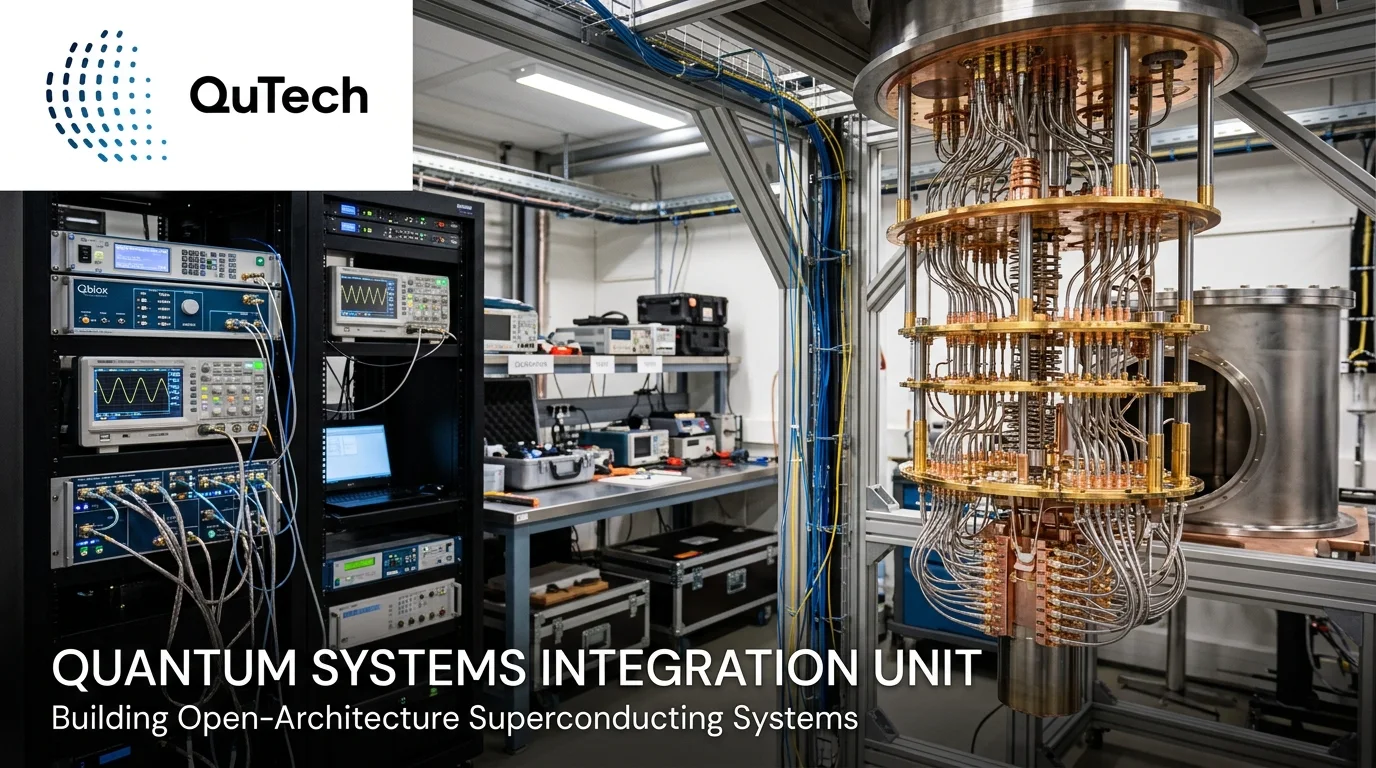
QuTech, the joint quantum research institute of Delft University of Technology (TU Delft) and TNO, has launched a dedicated Quantum Systems Integration Unit to design, assemble, and commission full-stack, open-architecture superconducting quantum computers built on a European supply chain. Seed-funded by QuTech Business Development alongside public-private partnership support from Holland High Tech, Quantum Delta NL’s CAT-1 program, the Dutch Research Council (NWO), and the EU Quantum Flagship’s OpenSuperQPlus initiative, the unit is led by Professor Leo DiCarlo as Scientific Lead, Vivek Sinha as Strategy and Partnerships Lead, and Rebecca Mayrhofer as Head of Business Development.
| QuTech Quantum Systems Integration Unit Overview & Technical Stack | |
|---|---|
| Dimension | Verified Details & Scope |
| Leadership & Governance | Scientific Lead: Prof. Leo DiCarlo; Strategy & Partnerships Lead: Vivek Sinha; Business Development: Rebecca Mayrhofer |
| Hardware & Cloud Track Record | Builds on 5 generations of Quantum Inspire processors (including Starmon-5, Starmon-7, Tuna-5, Tuna-9, and the 17-qubit Tuna-17 released July 2026) and the 100-qubit-scale HectoQubit/2 program |
| European Supply-Chain Partners | TNO, QuantWare (QPUs), Qblox (control electronics), Delft Circuits (cryogenic cabling), Orange Quantum Systems (automated calibration), Peak Quantum, and Riverlane (QEC decoding) |
| Core DiCarlo Lab R&D Inputs | Measurement-integrated leakage reduction units (98.4% removal, 99.2% assignment fidelity), tunable-coupler spectator crosstalk suppression, and ionizing-radiation error-burst mitigation |
| Commercial Roadmap | Year 1: Standardize modular system interfaces, integration blueprints, and IP base; Target: Spin out as an independent commercial venture in 2028 offering turnkey systems and integration-as-a-service |
Rather than treating quantum chip fabrication in isolation, the unit coordinates the complete hardware and software stack across cryogenics, packaging, microwave wiring, control electronics, automated calibration, compilers, monitoring, and cloud access. Building on five generations of processors deployed on QuTech’s open-access Quantum Inspire platform, including the 17-qubit Tuna-17 system released in July 2026 and the HectoQubit/2 program, the team is collaborating with European specialists including TNO, QuantWare, Qblox, Delft Circuits, Orange Quantum Systems, Peak Quantum, and Riverlane to establish standardized, modular interfaces.
To translate academic quantum error-correction breakthroughs into repeatable commercial systems, the unit directly incorporates recent DiCarlo Lab research on measurement-integrated leakage reduction units, tunable-coupler frequency positioning against spectator-qubit crosstalk, and ionizing-radiation error-burst mitigation. Over its first year, the team will formalize system-integration blueprints and intellectual property across turnkey systems, integration-as-a-service, and high-performance computing (HPC) deployments ahead of a planned commercial spinout venture in 2028.
Read QuTech’s announcement here, view the Quantum Delta NL release here, read the Holland High Tech report here, and access the supporting DiCarlo Lab papers on measurement-integrated leakage reduction here, tunable-coupler spectator mitigation here, and correlated qubit error bursts here.
In GQI Portal
The players behind the news
The team that writes QCR tracks every company, deal and technology in the GQI Factory, GQI's verified database of the quantum industry. Next up: every story linked to its players, coming to QCR's paid plans.
- Players Companies and institutions across the quantum industry, by segment.
- Scorecards How the players compare on hardware, software, funding and more.
Newsletter
QCR Alerts in your inbox
The latest reporting and analysis from Quantum Computing Report. Free, unsubscribe any time.