

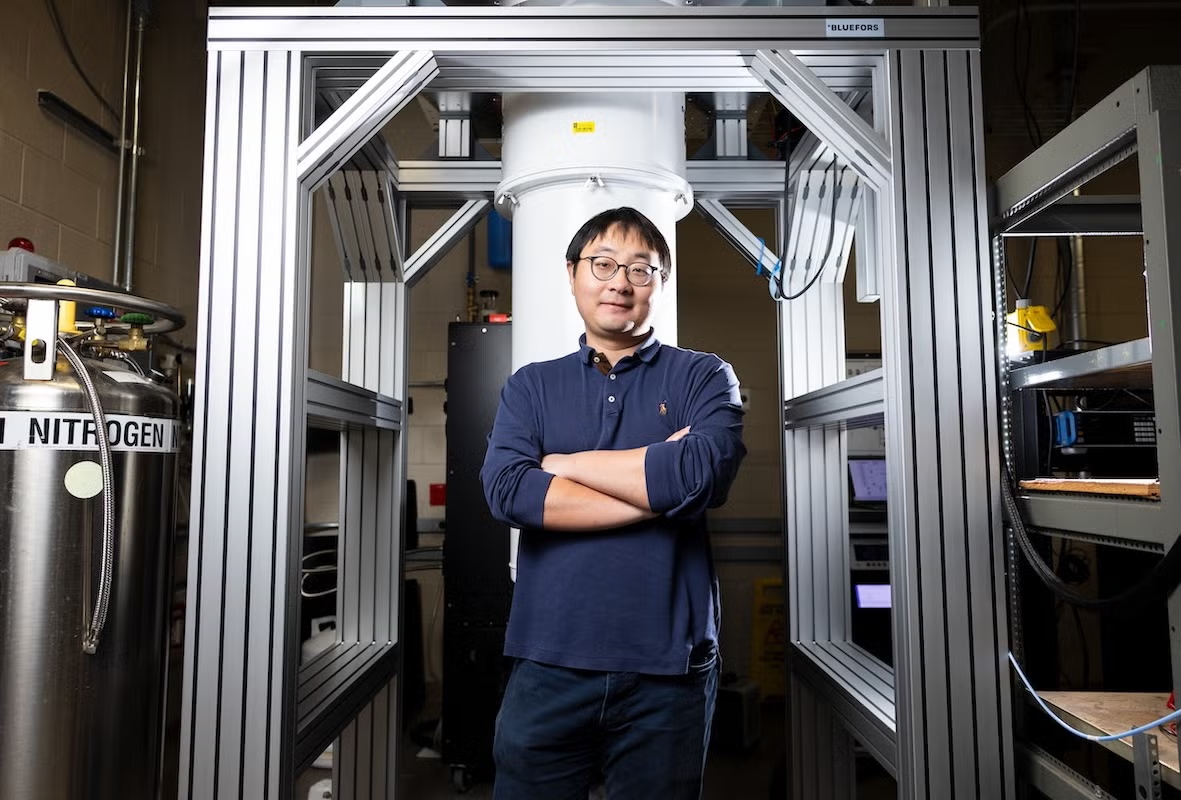
An early-career research initiative led by Assistant Professor of Physics Han Zhao at the University of Central Florida (UCF) is exploring an alternative method for fault-tolerant quantum computing by utilizing nanomechanical resonators to protect delicate quantum logic operations. Supported by the Oak Ridge Associated Universities (ORAU) Ralph E. Powe Junior Faculty Enhancement Award under Award No. FP00012463, the project bypasses the heavy hardware overhead of traditional Quantum Error Correction (QEC) schemes. Instead, the team uses microscopic physical vibrations to construct a topological “braiding” mechanism inside open quantum systems, making individual gates natively resilient to environmental interference.
                         [ UCF Topological Braiding Architecture ]
  Hardware Platform   ──► Superconducting microwave circuits coupled to nanomechanical resonators.
  Thermal Controls    ──► Dilution refrigerator infrastructure maintaining sub-Kelvin environment.
  Grant Capitalization──► $10,000 USD total seed funding ($5,000 ORAU grant matched by a $5,000 UCF fund).
In standard quantum architectures, environmental noise—including stray radiofrequency fields, micro-Kelvin thermal fluctuations, or ambient physical tremors—destabilizes fragile quantum states, causing rapid phase decoherence and calculation errors. While standard QEC mitigates this issue by grouping a high volume of physical qubits to construct a single protected logical qubit, it requires massive physical scale. Zhao’s approach introduces microscopic mechanical resonators directly into sub-Kelvin superconducting quantum circuits. By driving and controlling the physical interaction between microwave signals and these vibrating structures near absolute zero, the system forces quantum excitations to cyclically swap properties along a geometric timeline.
The competitive $5,000 ORAU seed grant, matched equally by a mandatory $5,000 contribution from UCF, provides $10,000 in total direct capital for the one-year project cycle. Free from institutional indirect costs or overhead charges, the entire funding pool is dedicated exclusively to financing specialized graduate student stipends and acquiring advanced hardware control nodes. The platform relies heavily on topology rather than absolute control precision; while individual pulse pathways can wiggle or deviate due to control imperfections, the target quantum state remains stable as long as the overarching geometric braiding pattern is completed. By embedding this structural pattern into the intrinsic coupling between the superconducting lines and the open mechanical resonators, the platform establishes a hardware-level defense layer against localized engineering faults.
The official project announcement, institutional lab profiles, and academic hardware highlights can be reviewed through the University of Central Florida News here.
In GQI Portal
The players behind the news
The team that writes QCR tracks every company, deal and technology in the GQI Factory, GQI's verified database of the quantum industry. Next up: every story linked to its players, coming to QCR's paid plans.
- Players Companies and institutions across the quantum industry, by segment.
- Scorecards How the players compare on hardware, software, funding and more.
Newsletter
QCR Alerts in your inbox
The latest reporting and analysis from Quantum Computing Report. Free, unsubscribe any time.