

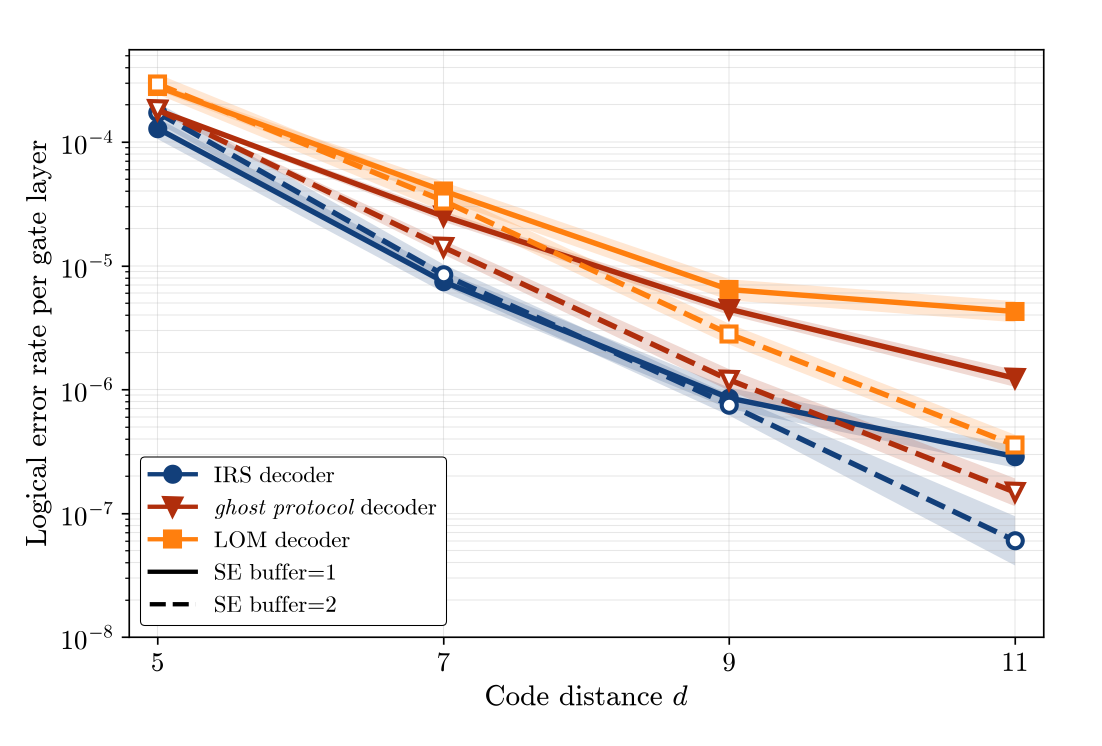
Trapped-ion hardware developer Universal Quantum has published a comprehensive technical study detailing its Iterative Redecode Scheme (IRS), a decoding architecture designed to resolve the error-correlation bottleneck in fast transversal quantum logic. Authored by Mark Webber and colleagues (arXiv:2610.26784), the research demonstrates that leveraging long-range trapped-ion connectivity for transversal CNOT (tCNOT) gates does not require decoding a global cross-block hypergraph. Instead, the propagation-assisted local (PAL) framework coordinates corrections across logical blocks using lightweight, memory-style decoders.
| Universal Quantum Iterative Redecode Scheme (IRS) Benchmarks | ||
|---|---|---|
| Benchmark Circuit | Comparison Decoder | Relative Performance Advantage (IRS) |
| Deep Random Clifford (d = 11) | Ghost Protocol / LOM Decoders | Achieves ~4× lower logical error rates than the ghost protocol; ~15× lower than Logical Observable Matching (LOM). |
| 3-Block GHZ Preparation (d = 19) | Reliable Logical Pauli-Products (RLPP) | Delivers up to 25× lower logical error rates when utilizing d/2 full syndrome-extraction rounds. |
| Repeated Logical S Gates (d = 9) | Naive MWPM / Standard LOM | Reduces circuit logical error rate to ~2.5 × 10⁻⁵ (~4–10× lower than LOM). |
| Syndrome Buffer Efficiency | Standard Lattice Surgery | Maintains distance-dependent error suppression with short syndrome-extraction buffers (⌊d/4⌋ rounds). |
Transversal operations—such as tCNOTs in CSS codes—execute multi-qubit entangling gates in constant circuit depth with respect to code distance, bypassing the O(d) overhead of surface-code lattice surgery. However, physical faults near a transversal gate propagate Pauli errors across blocks, generating higher-order correlations that break standard pairwise matching graphs. Universal Quantum’s IRS addresses this by alternating local Minimum-Weight Perfect Matching (MWPM) with deterministic Pauli-frame propagation. By storing detector corrections separately and iteratively re-decoding, the decoder strips away propagated contamination to leave clean, memory-equivalent subproblems.
The paper also introduces a prior-informed DEM (Detector Error Model) to eliminate initialization bias and a robust treatment for initially indeterminate stabilizers during state preparation (such as |0⟩L initialization). Simulating adversarial circuits like alternating tCNOT chains, the authors show that IRS converges within a few iterations, making it well-suited for windowed streaming implementations in real-time fault-tolerant hardware.
The full technical paper is available on arXiv here, with organizational commentary detailed in Universal Quantum’s Knowledge Hub here.
In GQI Portal
The players behind the news
The team that writes QCR tracks every company, deal and technology in the GQI Factory, GQI's verified database of the quantum industry. Next up: every story linked to its players, coming to QCR's paid plans.
- Players Companies and institutions across the quantum industry, by segment.
- Scorecards How the players compare on hardware, software, funding and more.
Newsletter
QCR Alerts in your inbox
The latest reporting and analysis from Quantum Computing Report. Free, unsubscribe any time.